Summary
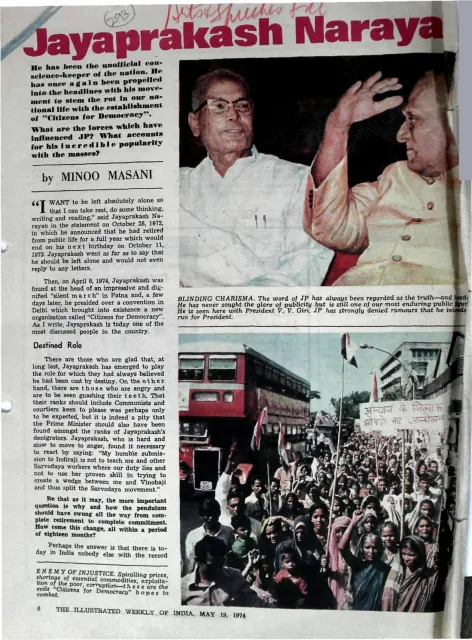
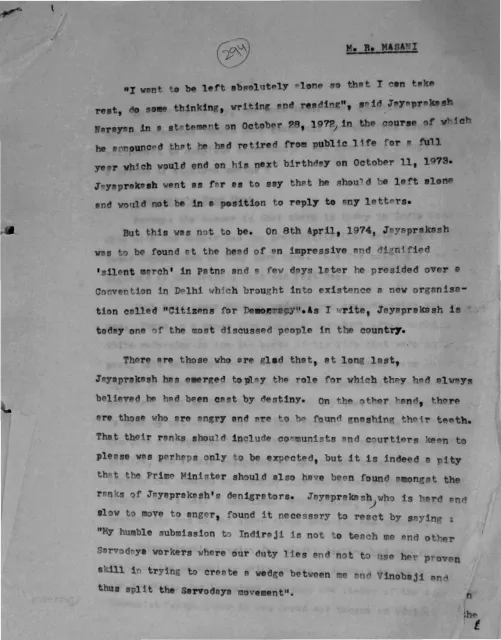
In these pages, Minoo Masani presents a biographical and political portrait of Jayaprakash Narayan, focusing on the transformation of a former communist and socialist into a Sarvodaya leader and a prominent critic of political power. Masani begins with Narayan’s attempted retirement from public life and his rapid return in 1974 through the “silent march” in Patna and the Citizens for Democracy convention in Delhi. He treats Narayan’s renewed activism as evidence of his unusual moral authority and democratic credibility, while also noting that it provoked both admiration and hostility, including from Indira Gandhi and her supporters.
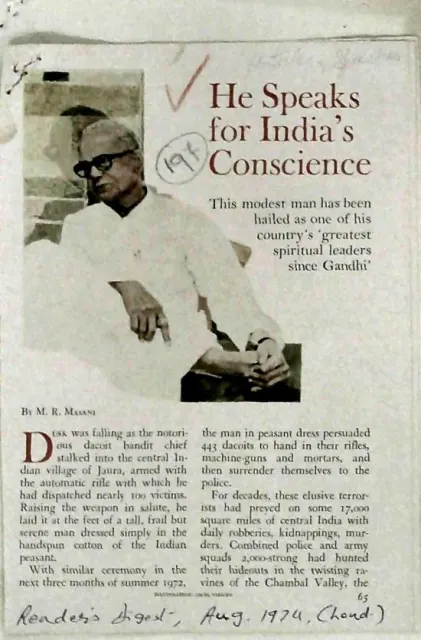
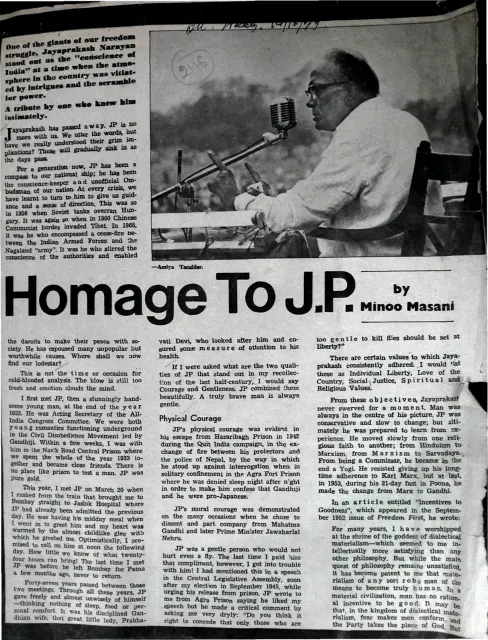
Masani traces four interwoven strands in Narayan’s public life: love of freedom, love of country, a passion for social justice, and a deep religious or spiritual dimension. The account follows Narayan’s early Marxism, his break with communist orthodoxy, his association with the Congress Socialist Party, his imprisonment during the freedom struggle, and his changing relationship with Gandhi. It then turns to Narayan’s renunciation of Marxism, commitment to Gandhian trusteeship and Sarvodaya, opposition to Naxalite violence and Chinese nationalism, defence of civil liberties and national self-determination, and re-entry into political controversy in 1973–74. The closing pages frame his 1974 activism as a possible movement for fundamental political change, while acknowledging his age, poor health, and the personal loss caused by Prabhavati Devi’s death.
Key points
- Masani describes Narayan’s return from announced retirement to public leadership in 1974.
- Narayan is presented as a figure whose credibility made him, in Masani’s words, democracy’s “best and last hope.”
- Masani identifies four strands in Narayan’s life: freedom, patriotism, social justice, and spirituality.
- The narrative follows Narayan’s movement from student Marxism and communist politics toward Gandhian Sarvodaya.
- Narayan’s disagreements with communism include objections to dictatorship, revolutionary violence, anti-nationalism, and foreign political allegiance.
- The pages highlight Narayan’s advocacy of civil liberties, the rights of Kashmiris, Tibetan resistance, and Indo-Pakistani reconciliation.
- Narayan’s critique of political opportunism culminates in his call for a principled alternative to Congress and a positive political programme.
- Masani ends by presenting Narayan’s 1974 activism as a hopeful but physically costly response to India’s political crisis.
Metadata and summary are AI-extracted from the source PDF and reviewed for editorial accuracy. The original work is available via the Read PDF tab above (where present); paragraph-level citation inside the PDF is deferred to a future engagement.