Summary
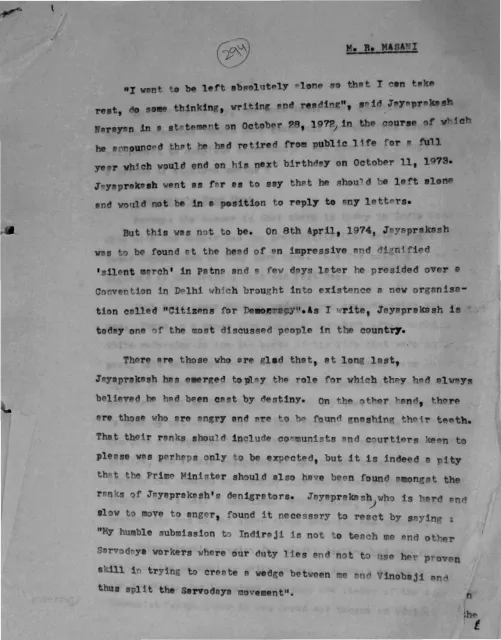
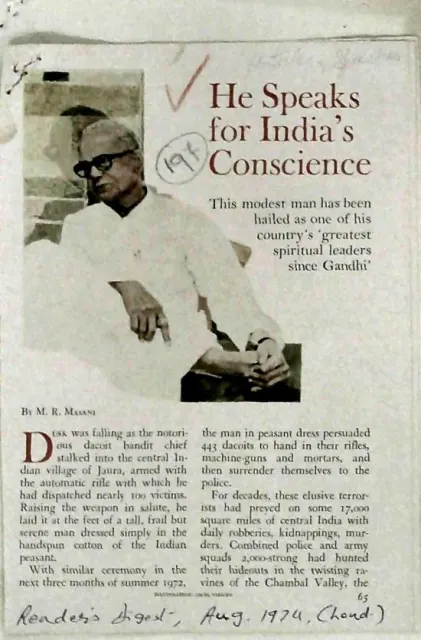
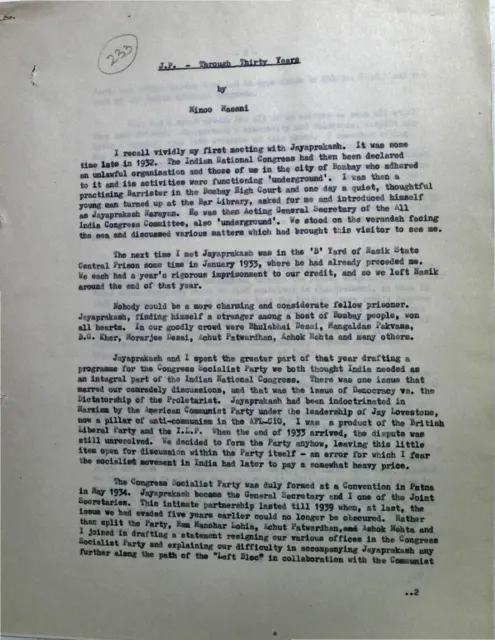
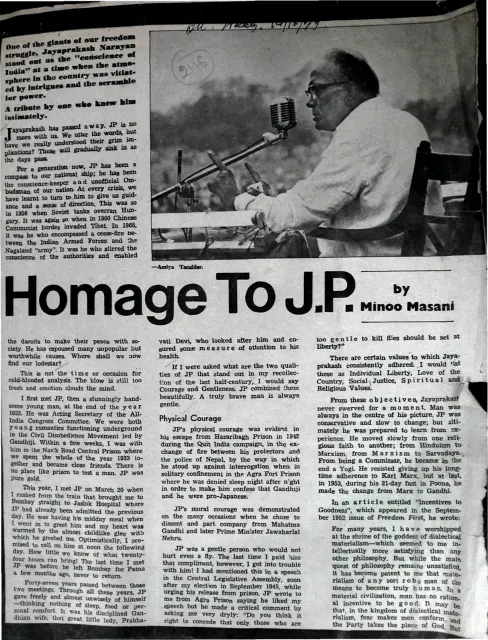
In the rendered pages, Minoo Masani presents Jayaprakash Narayan as a moral and political conscience of India rather than simply as a former party leader. Drawing on their long friendship—from underground work during the Civil Disobedience Movement and imprisonment in 1933 to their final meeting in 1977—Masani emphasizes JP’s physical, moral, and intellectual courage, his gentleness, and his willingness to dissent from both Mahatma Gandhi and Jawaharlal Nehru. He recalls JP’s interventions during national crises, including the 1956 Hungarian crisis, the 1960 Chinese invasion of Tibet, the 1965 Naga conflict, and the democratic mobilization of 1974–77.
In the rendered pages, Masani also describes JP’s political ideals as a synthesis of individual liberty, love of country, social justice, spiritual and religious values, and a Gandhian vision of India. He traces JP’s movement from Hinduism to Marxism, Sarvodaya, and a late return to Gandhi, while criticizing materialism as inadequate to the task of making people good. The tribute concludes by rejecting conventional measures of political success: JP declined office, pursued anti-corruption and self-help work, and sought a free, progressive, Gandhian India whose realization he did not live to see. PDF page 3 is a separate article by Fatma R. Zakaria and is not part of this essay.
Key points
- Masani remembers Jayaprakash Narayan as India’s unofficial moral guide and “conscience-keeper” during successive political crises.
- The essay combines personal reminiscence with an assessment of JP’s physical courage, moral courage, gentleness, and political judgment.
- JP is portrayed as consistently committed to individual liberty, love of country, social justice, and spiritual and religious values.
- Masani traces JP’s intellectual journey from Hinduism through Marxism and Sarvodaya to a renewed Gandhian orientation.
- The essay presents JP’s 1974–77 democratic mobilization, anti-corruption work, and self-help initiatives as evidence of his continuing public influence.
- Masani argues that JP’s refusal to seek high office should not be judged as political failure.
- The essay links JP’s ideal of India to participatory democracy, service of the weak, peaceful disagreement, and social reconstruction beyond materialism.
Metadata and summary are AI-extracted from the source PDF and reviewed for editorial accuracy. The original work is available via the Read PDF tab above (where present); paragraph-level citation inside the PDF is deferred to a future engagement.