essay
Challenge to Industry
1969
1 pages
Summary
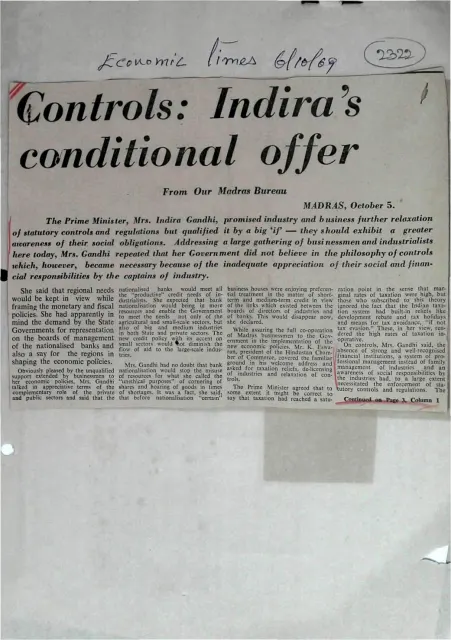
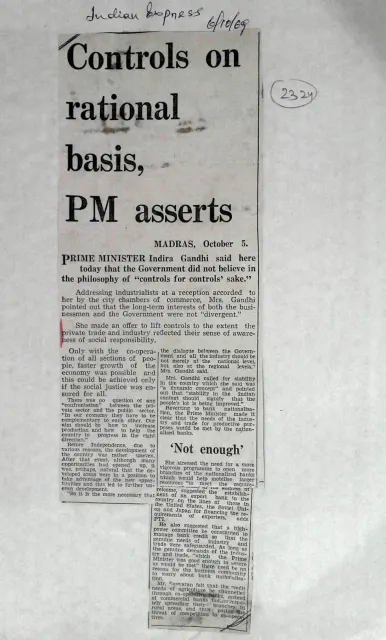
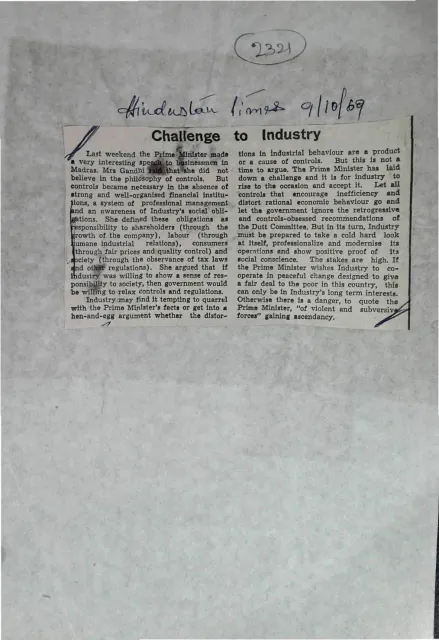
“Challenge to Industry” reports on Prime Minister Indira Gandhi’s address to businessmen in Madras, presenting her position that controls became necessary because India lacked strong, well-organised financial institutions, professional management, and sufficient awareness of industry’s social obligations. The article defines those obligations as responsibility to shareholders through company growth, to labour through humane industrial relations, to consumers through fair prices and quality control, and to society through compliance with tax laws and other regulations.
The article challenges industry to respond constructively rather than quarrel over the Prime Minister’s facts or debate whether industrial distortions are caused by controls. It urges business to accept the challenge, abandon inefficient and economically irrational controls, and reject the “retrogressive and controls-obsessed recommendations” of the Dutt Committee. At the same time, it calls on industry to professionalise and modernise its operations, demonstrate social consciousness, and cooperate in peaceful change aimed at giving the poor a fair deal, warning that otherwise “violent and subversive forces” could gain ascendancy.
Key points
- Indira Gandhi is described as defending controls as a response to weak financial institutions, inadequate professional management, and insufficient corporate social awareness.
- The article identifies industry’s obligations to shareholders, labour, consumers, and society.
- It argues that industry should not reduce the debate to whether controls or industrial behaviour caused economic distortions.
- The article urges the government to discard controls that encourage inefficiency and distort rational economic behaviour.
- It criticises the Dutt Committee’s recommendations as retrogressive and excessively focused on controls.
- Industry is asked to professionalise and modernise its operations and provide evidence of social responsibility.
- The article presents cooperation between government and industry as necessary for peaceful change and a fair deal for the poor.
Metadata and summary are AI-extracted from the source PDF and reviewed for editorial accuracy. The original work is available via the Read PDF tab above (where present); paragraph-level citation inside the PDF is deferred to a future engagement.