
essay
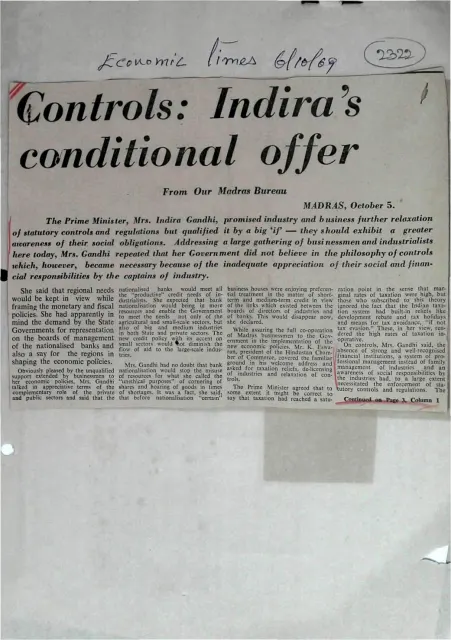
Controls: Indira’s conditional offer
Economic Times · Madras · 1969
4 pages
Summary
This Economic Times report from the Madras bureau describes Prime Minister Indira Gandhi’s conditional offer to relax statutory controls and regulations on industry and business. The proposed relaxation was contingent on business demonstrating greater awareness of its social obligations. Gandhi defended controls as responses to industry leaders’ inadequate appreciation of their social and financial responsibilities, while also calling for cooperation between government and business.
The report outlines Gandhi’s position on regional needs, monetary and fiscal policy, bank nationalisation, credit allocation, and industrial development. She supported representation for state governments and regions on the boards of nationalised banks, urged industrialists to reduce consumption and build reserves for expansion and modernisation, and linked economic stability to peaceful social change. The article also records concerns from Mr. K. Eswaran of the Hindustan Chamber of Commerce, who proposed an export bank and a high-power committee to manage bank credit, while warning that bank nationalisation could slow industrial growth and deter foreign investment. Pages 2 and 4 contain unrelated stock-market and commodity material and an advertisement rather than the article.
Key points
- Indira Gandhi offered further relaxation of industrial controls subject to business accepting stronger social obligations.
- The report presents controls as having become necessary because industrial leaders had inadequately appreciated their social and financial responsibilities.
- Gandhi supported regional representation on the boards of nationalised banks and credit policies attentive to agricultural, small-scale, and large industries.
- She argued that nationalisation should prevent misuse of bank resources and discriminatory or preferential lending practices.
- The article connects business responsibility with fair prices, quality control, labour welfare, modernisation, tax compliance, and support for development.
- Gandhi called for reduced consumption by industrialists so that savings could support expansion and modernisation.
- K. Eswaran proposed an export bank and a high-power credit-management committee, and warned against the effects of bank nationalisation on investment and industrial growth.
Metadata and summary are AI-extracted from the source PDF and reviewed for editorial accuracy. The original work is available via the Read PDF tab above (where present); paragraph-level citation inside the PDF is deferred to a future engagement.
Related across the archive
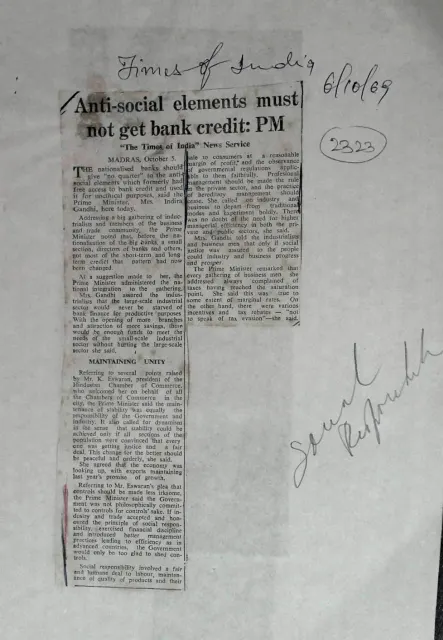 Primary workAnti-social elements must not get bank credit: PM
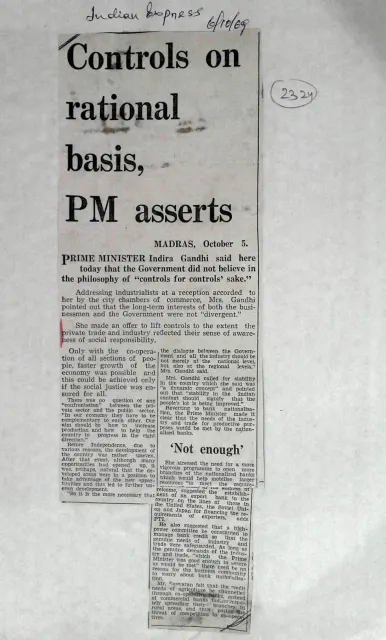 Primary workControls on rational basis, PM asserts
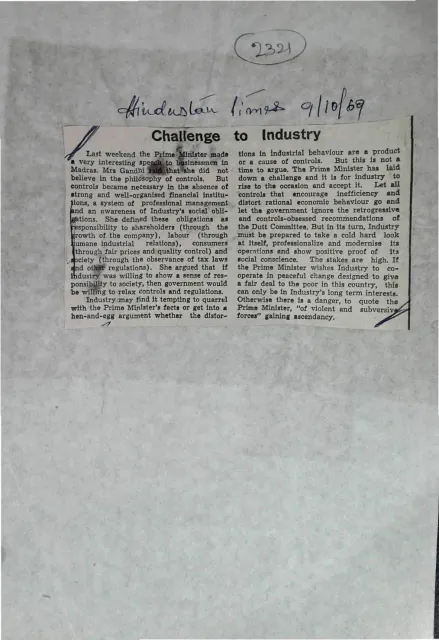 Primary workChallenge to Industry
 ThePrintBank nationalisation will be a blow to India’s mixed economy, lead to totalitarianism: Phiroze Shroff
 ExcerptEconomic Reforms In India: Where Are We And Where Do We Go?