
report
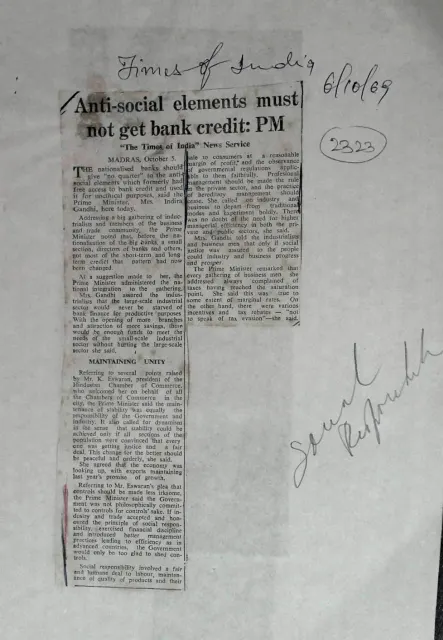
Anti-social elements must not get bank credit: PM
“The Times of India” News Service · MADRAS · 1969
1 pages
Summary
This one-page English newspaper report, datelined Madras, October 5, records Prime Minister Mrs. Indira Gandhi’s address to industrialists and business representatives. Gandhi argues that nationalised banks should deny credit to “anti-social elements” who had previously used bank finance for unethical purposes, while assuring large-scale industry that bank finance for productive purposes would not be sacrificed. She also presents expanded bank branches and savings mobilisation as ways to support small-scale industry without harming the large-scale sector.
Under the heading “MAINTAINING UNITY,” Gandhi links economic stability to confidence that all sections of the population are receiving justice and a fair deal. Responding to concerns raised by M. R. Eswaran, she says the government is not committed to controls for their own sake, but suggests that controls could be shed if industry and trade accept social responsibility, maintain financial discipline, and improve management. The report also notes her calls for greater managerial efficiency, movement away from inherited business practices, and restraint in tax evasion, while warning that the clipping does not provide the full speech or its wider context.
Key points
- Indira Gandhi calls for nationalised banks to withhold credit from anti-social elements and unethical users of finance.
- She maintains that large-scale industry should continue to receive bank finance for productive purposes.
- Expanded banking and increased savings are presented as support for small-scale industrial development.
- Economic stability is tied to social justice, fairness, and confidence among different sections of the population.
- Gandhi rejects the idea that the government is philosophically committed to controls for their own sake.
- She links the possible removal of controls to social responsibility, financial discipline, and improved management.
- The report records criticism of tax burdens and Gandhi’s call for industry to move beyond traditional business methods.
Metadata and summary are AI-extracted from the source PDF and reviewed for editorial accuracy. The original work is available via the Read PDF tab above (where present); paragraph-level citation inside the PDF is deferred to a future engagement.
Related across the archive
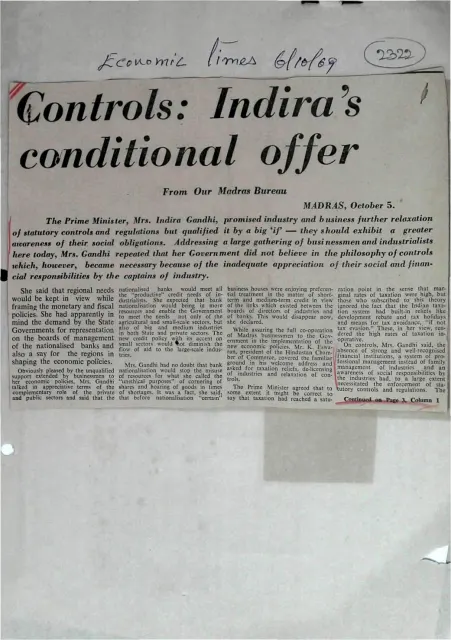 Primary workControls: Indira’s conditional offer
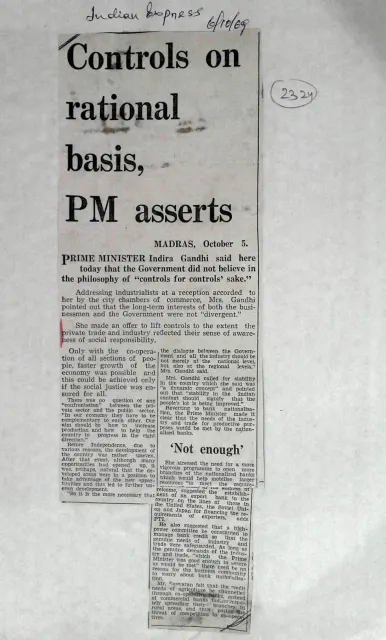 Primary workControls on rational basis, PM asserts
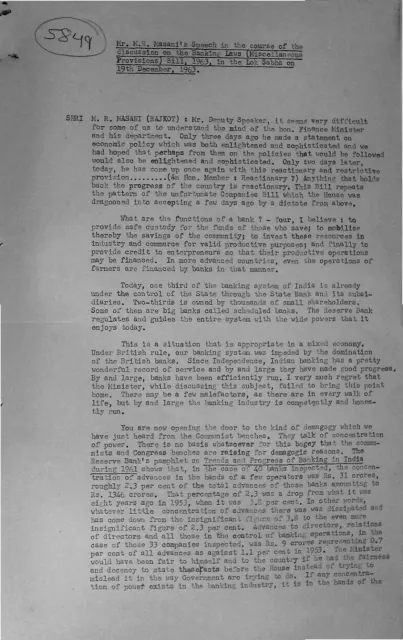 Primary workMr. M.R. Masani's Speech in the course of the discussion on the Banking Laws (Miscellaneous Provisions) Bill, 1963, in the Lok Sabha on 19th December, 1963.
 ThePrintBank nationalisation will be a blow to India’s mixed economy, lead to totalitarianism: Phiroze Shroff
 ExcerptEconomic Reforms In India: Where Are We And Where Do We Go?