
speech · parliamentary
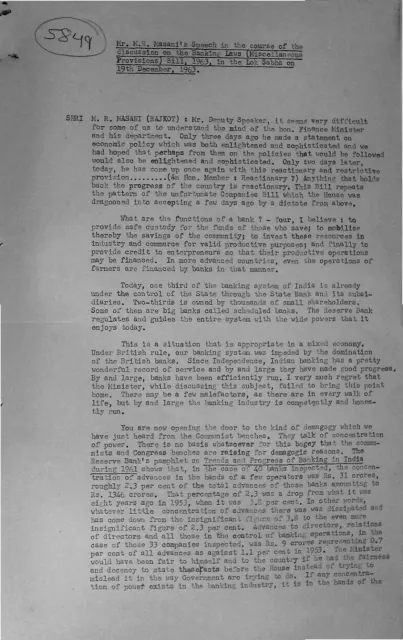
Mr. M.R. Masani's Speech in the course of the discussion on the Banking Laws (Miscellaneous Provisions) Bill, 1963, in the Lok Sabha on 19th December, 1963.
1963
5 pages
Summary
In this 19 December 1963 Lok Sabha speech, M. R. Masani opposes the Banking Laws (Miscellaneous Provisions) Bill, arguing that it would weaken rather than strengthen India’s banking system. He defines banks as institutions that mobilise savings, invest resources in productive activity, and provide credit to entrepreneurs and farmers. He defends the existing mixed structure of Indian banking, including private banks, small shareholders, depositors, and Reserve Bank regulation, while acknowledging that abuses and malefactors should be dealt with individually rather than through sweeping intervention.
Masani’s central objections concern the concentration of power in the Reserve Bank and the Government. He argues that the Bill would enable the Reserve Bank to dismiss bank directors, officers, and employees without adequate procedural safeguards; burden the institution with bureaucracy; and restrict non-banking companies from carrying on banking-related work. He portrays these provisions as threats to managerial discretion, labour protections, depositor confidence, economic decentralisation, and the rule of law. He proposes either referring the Bill to a Select Committee or postponing it pending a high-level inquiry into the banking industry. The speech concludes by contrasting the Bill’s centralising tendency with Gandhi’s and Jai Prakash Narayan’s advocacy of decentralised economic power.
Key points
- Masani presents banks as mechanisms for mobilising savings, financing productive investment, and extending credit to entrepreneurs and farmers.
- He defends the broadly satisfactory record of Indian banks and rejects the case for handicapping the entire industry because of particular abuses.
- He argues that the Bill gives the Government and Reserve Bank excessive discretionary power over bank directors, officers, and employees.
- He warns that expanded Reserve Bank responsibilities would produce bureaucracy, paperwork, and weaker supervision and leadership.
- He opposes restrictions on non-banking companies carrying on banking-related work, especially in a country where banking has not fully developed in rural areas.
- He recommends Select Committee consideration or a high-level commission of inquiry before legislation is enacted.
- He frames the debate as a conflict between a free, decentralised society and a centralised command economy, invoking Gandhi and Jai Prakash Narayan.
Metadata and summary are AI-extracted from the source PDF and reviewed for editorial accuracy. The original work is available via the Read PDF tab above (where present); paragraph-level citation inside the PDF is deferred to a future engagement.
Related across the archive
 Primary workSPEECH OF SHRI M.R. MASANI, M.P., INAUGURATING THE ALL INDIA BANK DEPOSITORS ASSOCIATION IN CALCUTTA ON 26TH FEBRUARY,1968.
 Primary workTHE BANKING COMPANIES (ACQUISITION & TRANSFER OF UNDERTAKINGS) ORDINANCE 1969
 Primary workRights, Duties & Obligations of Company Directors
 ThePrintBank nationalisation will be a blow to India’s mixed economy, lead to totalitarianism: Phiroze Shroff
 ExcerptN. A. Palkhivala's Views on Socialism