
speech · inaugural
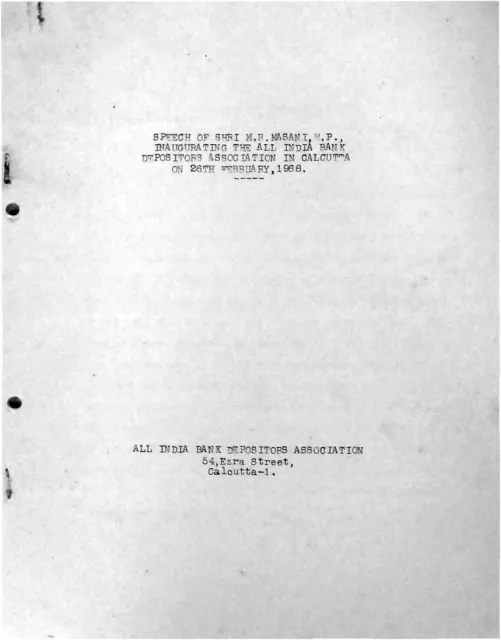
SPEECH OF SHRI M.R. MASANI, M.P., INAUGURATING THE ALL INDIA BANK DEPOSITORS ASSOCIATION IN CALCUTTA ON 26TH FEBRUARY,1968.
By Minoo Masani
ALL INDIA BANK DEPOSITORS ASSOCIATION 54, Ezra Street, Calcutta-1. · Calcutta · 1968
46 pages
Summary
In the rendered pages, Minoo Masani argues that the proposed Banking Laws Amendment Bill, 1967, would replace limited banking regulation with pervasive government and Reserve Bank control. In the rendered pages, he says the Bill would make bank management dependent on the Reserve Bank and the Finance Ministry, weaken shareholders’ control over boards, permit broad directives in the name of “banking policy,” and create a continuing threat of takeover. In the rendered pages, he presents these provisions as an indirect route to nationalisation and as a danger to democratic government, property rights, and the rule of law.
In the rendered pages, Masani also frames the issue from the standpoint of depositors and the national economy. In the rendered pages, he describes banking as dependent on reputation and confidence, argues that small depositors—not wealthy capitalists—provide the funds for productive investment, and warns that political interference could redirect deposits toward bad or politically favoured projects. In the rendered pages, he uses France as a counter-example, claiming that government ownership there was separated from day-to-day bank management. In the rendered pages, he calls on depositors to organise nationally, lobby Parliament, appear before the Select Committee, and resist the wider politicisation of private and economic life.
Key points
- In the rendered pages, Masani presents “social control” as a relabelled and more subtle form of the threat of bank nationalisation.
- In the rendered pages, he argues that the Bill would make the Reserve Bank and Finance Ministry decisive authorities over bank management and board appointments.
- In the rendered pages, he objects to the breadth of the phrase “in the interest of banking policy,” which he says could authorise almost any government directive.
- In the rendered pages, he argues that the Bill weakens shareholders’ ability to challenge compensation and could enable expropriation without effective judicial review.
- In the rendered pages, he treats depositor confidence as an essential economic resource that legislation cannot simply command or manufacture.
- In the rendered pages, he identifies the typical depositor as a small saver and gives figures contrasting millions of individual accounts with a much smaller number of business accounts.
- In the rendered pages, he urges depositors to form an all-India organisation, lobby MPs, and submit evidence to Parliament’s Select Committee.
- In the rendered pages, he broadens the banking dispute into a defence of democratic resistance against excessive political interference in social and economic institutions.
Metadata and summary are AI-extracted from the source PDF and reviewed for editorial accuracy. The original work is available via the Read PDF tab above (where present); paragraph-level citation inside the PDF is deferred to a future engagement.
People in this work
Related across the archive
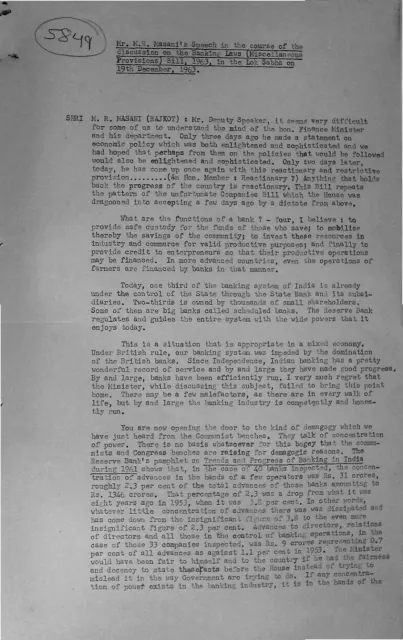 Primary workMr. M.R. Masani's Speech in the course of the discussion on the Banking Laws (Miscellaneous Provisions) Bill, 1963, in the Lok Sabha on 19th December, 1963.
 Primary workTHE BANKING COMPANIES (ACQUISITION & TRANSFER OF UNDERTAKINGS) ORDINANCE 1969
 ThePrintBank nationalisation will be a blow to India’s mixed economy, lead to totalitarianism: Phiroze Shroff
 ExcerptN. A. Palkhivala's Views on Socialism