essay
Mr Carter is not an unpopular President—his problem is that a great many Americans don’t think he is up to the job
1979
1 pages
Summary
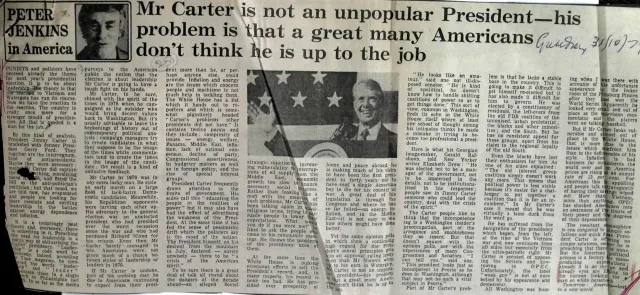
Peter Jenkins argues that Jimmy Carter’s central political problem is not personal unpopularity but widespread doubt about his competence and capacity to govern. The article contrasts Carter with Gerald Ford and Richard Nixon, suggesting that Carter inherited a difficult political and economic situation but has failed to inspire confidence or provide clear leadership. Polling, commentary from political observers, and Carter’s own record are presented as evidence of a presidency marked by pessimism, drift, and weak public communication.
The article examines the pressures facing the Carter administration, including energy shortages, welfare, Panama, the Middle East, inflation, national security, party divisions, Congressional assertiveness, and foreign-policy uncertainty. It also discusses Carter’s strained relations with different constituencies, including organised labour, minorities, conservative Democrats, and Washington insiders. Jenkins concludes that Carter’s difficulties arise less from a lack of popular approval than from the perception that he is not equal to the demands of the presidency.
Key points
- The article distinguishes between presidential popularity and public confidence in a president’s ability to do the job.
- Jimmy Carter is portrayed as having inherited serious economic, energy, foreign-policy, and political problems.
- The administration’s difficulties include inflation, energy vulnerability, welfare, Panama, the Middle East, national security, and party conflict.
- Carter’s public image is associated with pessimism, indecision, and insufficiently forceful leadership.
- The article describes weak or uncertain relationships between Carter and labour, minorities, conservative Democrats, Congress, and Washington opinion-makers.
- Comparisons with Gerald Ford, Richard Nixon, and John F. Kennedy frame the article’s discussion of presidential competence and public expectations.
Metadata and summary are AI-extracted from the source PDF and reviewed for editorial accuracy. The original work is available via the Read PDF tab above (where present); paragraph-level citation inside the PDF is deferred to a future engagement.