periodical issue
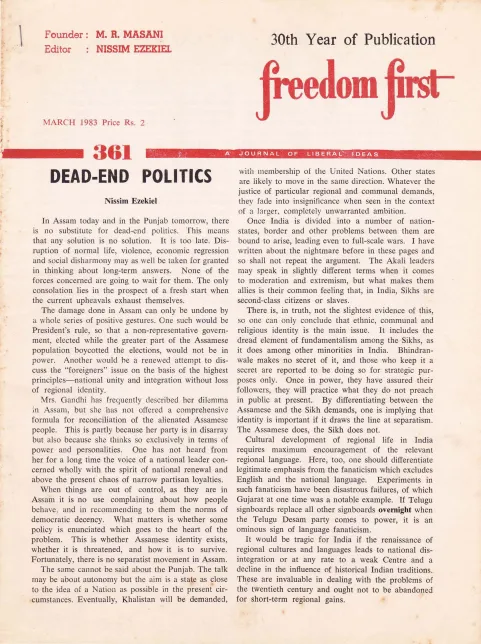
Freedom First
A Journal of Liberal Ideas
By S. V. Raju
Published for the Democratic Research Service by J. B. [illegible], Associate Editor, Freedom First at 127, Mahatma Gandhi Road, Bombay 400 023 (Phone: 273914) and printed by him at Kaiser-E-Hind Publishers & Printers, 300, Perin Nariman Street, Bombay 400 001 · Bombay · 1980
16 pages
Freedom First
Summary
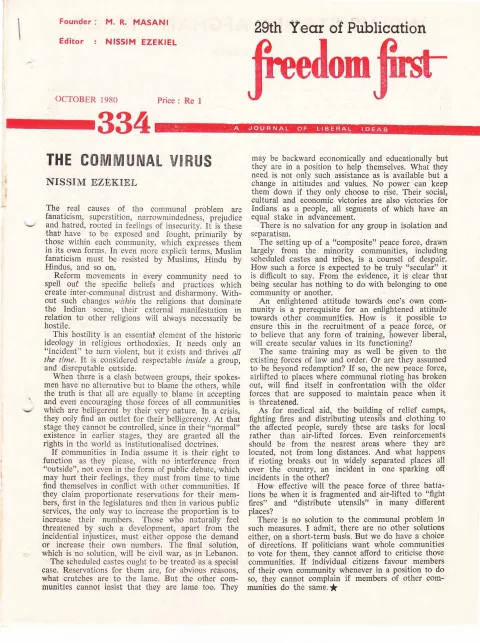
This issue of Freedom First (No. 334, October 1980, the magazine’s 29th year of publication) opens with Nissim Ezekiel’s editorial ‘The Communal Virus,’ arguing that communal violence stems from fanaticism and insecurity within every community and that reservation-driven identity politics deepens rather than resolves the problem. The issue is dominated by Cold War and foreign-policy commentary: P. M. Kamath criticises India’s ambivalent response to the Soviet invasion of Afghanistan, K. M. Pathak analyses the volatility of American public opinion toward President Carter ahead of the 1980 election, and a ‘Voices’ column reproduces Solzhenitsyn’s warning against detente with Communist regimes, paired with Rama Swarup’s commentary on Western misjudgment of Communist China. A book review section covers Brian Crozier’s ‘Strategy of Survival’ (on Soviet expansionism) and Shridath Ramphal’s ‘One World to Share’ (on North-South economic dialogue). The remainder of the issue profiles civil-society and reform initiatives: the Vigil India Movement’s charter, the Academy of Development Science at Kikwi, the Committee for the Protection of Democratic Rights’ handbook ‘Know Your Rights,’ Vasant K. Bawa’s report on the ‘Agenda for India’ conference on national political and constitutional reform, and Attar Chand’s piece on Indian scientists working abroad. A satirical short story by Githa Hariharan on women’s-magazine culture and a subscription order form round out the issue.
Key points
-
Nissim Ezekiel’s editorial “The Communal Virus” argues communal violence is rooted in fanaticism and insecurity within each religious community rather than simple inter-group friction, and criticises reservation-driven identity politics for deepening rather than resolving it.
-
P. M. Kamath’s “India’s Sterile Afghan Policy” criticises India’s abstention on the UN resolution condemning the Soviet invasion of Afghanistan and calls for India to press for unconditional Soviet withdrawal and a UN peacekeeping force on Afghanistan’s borders.
-
K. M. Pathak’s “American Public Moods and Mr. Carter’s Re-Election” surveys the volatility of US opinion toward President Carter ahead of the 1980 election, citing his Panama Canal and Camp David achievements against the damage done by inflation and the Iran hostage crisis.
-
Two “Voices” pieces reproduce Alexander Solzhenitsyn’s Foreign Affairs warning against conflating Communist regimes with their peoples and an argument that US courtship of Communist China abandons Taiwan and the mainland Chinese people.
-
A satirical short story follows a housewife who, after years internalising contradictory ideals from women’s magazines, burns her collection in an act read as liberation.
-
Book reviews cover Brian Crozier’s Strategy of Survival on Soviet expansionism and Shridath Ramphal’s One World to Share on North-South economic dialogue.
-
Features profile the Vigil India Movement’s grassroots defence of democracy and secularism, the Academy of Development Science at Kikwi bridging university and rural learners, and the Committee for the Protection of Democratic Rights’ “Know Your Rights” handbook founded in reaction to the Emergency.
-
Vasant K. Bawa reports on the “Agenda for India” conference proposing decentralisation, electoral reform and freeing media from state control, while Attar Chand’s “Our Scientists Abroad” estimates 200,000 Indian technical professionals working overseas and calls for stronger research investment to curb the brain drain.
Essays
The Communal Virus
By Nissim Ezekiel
Nissim Ezekiel’s editorial argues that communal conflict in India is rooted in fanaticism, superstition, and insecurity internal to each religious community, not merely in inter-group friction, and that these forces must be confronted from within each community rather than blamed solely on others. He criticises proportionate reservations and identity-based claims as generators of communal friction, dismisses the government’s proposed ‘composite’ peace force as ineffective and confused about secularism, and concludes that there is no short-term solution beyond individual and communal restraint from favouritism.
- Communal problems originate in fanaticism, superstition and insecurity within each community, not just between them.
- Reform must come from within each religious community rather than through external criticism alone.
- Reservations and proportional claims by communities create structural friction that can escalate to civil conflict, citing Lebanon as the endpoint.
- The scheduled castes are treated as a special case warranting reservations, unlike other communities.
- The proposed ‘composite’ peace force is criticised as an incoherent response that cannot itself guarantee secular conduct.
- There is no institutional solution; the author calls for a personal ethic of not favoring one’s own community.
India’s Sterile Afghan Policy
By P. M. Kamath
P. M. Kamath argues that India’s response to the Soviet invasion of Afghanistan in December 1979 has been weak and self-contradictory. India abstained on the UN resolution condemning Soviet withdrawal, and the government’s rhetoric of ‘defusing’ the crisis has not translated into concrete pressure on Moscow, leaving both the Afghan resistance and the Kabul government dissatisfied with India’s stance. Kamath contends that Mrs. Gandhi’s tilt toward the Soviet Union has led Moscow to take India’s acquiescence for granted, and calls for India to press for an unconditional, immediate Soviet withdrawal and to support the creation of a UN peacekeeping force on the Afghan borders.
- The Soviet invasion of Afghanistan (27 December 1979) posed the biggest foreign-policy challenge to India due to Afghanistan’s proximity and the loss of it as a buffer state.
- India abstained on the UN resolution (104-18-18) calling for unconditional Soviet withdrawal.
- Neither the Afghan resistance nor the Kabul government has been satisfied by India’s position.
- Mrs. Gandhi’s government has downplayed the crisis and been caught off-guard by Soviet announcements, being informed after France rather than directly.
- The author calls for India to demand unconditional withdrawal and support a UN peacekeeping force on the Afghan-Pakistan and Afghan-Iran borders.
American Public Moods and Mr. Carter’s Re-Election
By K. M. Pathak
K. M. Pathak examines the volatility of American public opinion regarding President Jimmy Carter ahead of the 1980 election. Carter was elected in 1976 as a ‘people’s president’ promising morality after Watergate, but within a year the public soured on him over inflation, weak leadership, and uncertain foreign policy. Pathak surveys Carter’s record, including the achievements of the Panama Canal treaties and the Camp David accords, alongside the Iran hostage crisis and its failed rescue attempt, and closes by noting the unpredictable polling swings between Carter and Ronald Reagan heading into the November election.
- American public mood swings between extremes of isolation/intervention and weak/strong presidents, amplified by television media.
- Carter was elected in 1976 as a ‘people’s president’ reacting against Nixon-era imperial presidency and Watergate.
- Inflation, energy policy failures, and perceived weakness toward the Soviets and Iran eroded Carter’s popularity within a year of taking office.
- Carter’s foreign-policy achievements include the Panama Canal treaties and the Camp David Egypt-Israel peace agreement.
- By mid-1980, polls showed Carter trailing Reagan by 18 points (Newsweek) despite narrowly securing the Democratic renomination over Edward Kennedy.
Voices 1: The Lecturer’s Plight
By A Correspondent
A short ‘Voices’ column (‘The Lecturer’s Plight’) by an anonymous correspondent criticises the rising bureaucratic qualification requirements for college lectureships in India, arguing that rigid rules around degrees and percentage marks have replaced genuine assessment of teaching ability, while lecturers’ salaries remain tied only to years of service rather than merit, driving a shift toward private coaching classes.
- New qualification rules for lecturers (M.Phil within 5 years, minimum percentage thresholds) prioritise credentialing over demonstrated teaching ability.
- Salary structures reward years of service rather than merit or research output.
- The rigidity of official rules is pushing a shift toward unregulated private coaching classes.
Voices 2: Solzhenitsyn’s Warning
By Rama Swarup
Rama Swarup’s ‘Voices’ column endorses Alexander Solzhenitsyn’s warning (published in Foreign Affairs) that American diplomacy should not conflate the Russian and Chinese peoples with their Communist regimes, and that reconciliation between the Soviet and Chinese Communist parties could occur overnight and turn against the West. Swarup extends this to argue that the United States’ embrace of Communist China as a counterweight to the USSR is a strategic error that has abandoned Taiwan and the free peoples of the Chinese mainland, comparing it to America’s earlier betrayal of Chiang Kai-shek’s Republic of China.
- Solzhenitsyn warned in Foreign Affairs that treating Red China as a shield against the USSR risks a sudden Sino-Soviet reconciliation directed against the West.
- The US policy of courting Communist China is portrayed as abandoning Taiwan and the mainland Chinese people to Communist rule.
- General Albert C. Wedemeyer’s book ‘Wedemeyer Reports’ is cited to refute claims that the Peking regime meaningfully fought Japan in WWII.
- Taiwan (Republic of China) is held up as a model of freedom, democracy and prosperity due to Chiang Kai-shek’s refusal to compromise with Peking.
Voices 3: A Very Short Story
By Githa Hariharan
Githa Hariharan’s satirical short story follows Radhika, a 33-year-old housewife, through her ritual weekly reading of women’s magazines full of articles on obesity, marriage insurance for daughters, bust development, and idealised ‘super-housewife’ profiles. After years of internalising this diet of contradictory domestic ideals, Radhika burns her collection of magazines in her backyard and is glimpsed by neighbours dancing.
- The story satirises the content of Indian women’s magazines: articles on obesity, bust development, and idealised images of domesticity.
- It depicts the psychological toll of these contradictory ideals on an ordinary housewife over time.
- The story ends with Radhika burning her magazine collection and dancing, read as a moment of liberation.
Vigil India Movement: What It Stands For
An unsigned feature lays out the charter of the Vigil India Movement, describing its goals of defending democracy, secularism, and human values through decentralised ‘Vigil Groups’ at the grassroots level, and its occasional journal ‘Vigil India’ used as study material for the movement.
- Vigil India Movement aims to resist tampering with democratic norms and institutions and to strengthen secular traits of the state.
- The movement organises through local ‘Vigil Groups’ of at least ten members, formed in both rural and urban areas.
- It positions itself as an action-oriented ‘crying and shouting movement’ rather than a conventional hierarchical organisation.
- Its occasional journal, Vigil India, serves as study material and the movement solicits Rs. 10 minimum annual contributions from ‘Friends of the Movement’.
The World of Books: Strategy of Survival by Brian Crozier
By S. V. Raju
A book review by S. V. Raju of Brian Crozier’s ‘Strategy of Survival’ (1978) argues, via an opening imaginary conversation satirising complacent Western liberal opinion, that the Soviet Union has not abandoned its goal of world Communist domination. The review praises Crozier’s distinction between reversible authoritarian regimes and irreversible totalitarian ones, and endorses his call for a vigorous Western strategy of resistance rather than complacent detente, noting that the Afghanistan invasion demonstrates the failure of Soviet subversion strategy in that country.
- Crozier’s book argues the Soviet Union retains Lenin’s original ambition of a world Communist system, backed by Pravda and Comintern program quotations.
- The review distinguishes ‘authoritarian’ regimes (reversible) from ‘totalitarian’/‘totalist’ regimes (irreversible), citing James Burnham’s earlier work on the same distinction.
- Detente is criticised as enabling continued Soviet aggrandizement while allowing the West to supply wheat and technology that strengthens the USSR.
- The Soviet invasion of Afghanistan is read as a sign of failed internal subversion, forcing overt military intervention akin to a Vietnam-style entrapment.
- Crozier is credited with outlining hard-nosed strategic options for the West to reverse Soviet gains rather than merely contain them.
The World of Books: One World to Share by Shridath Ramphal
By K. V. Padmanabhan
K. V. Padmanabhan reviews Shridath Ramphal’s ‘One World to Share’ (Oxford University Press), a collection of speeches on the North-South economic dialogue. The review, drawing on Barbara Ward’s introduction, summarises the persistent economic gap between industrialised and developing nations despite decades of decolonisation, and praises Ramphal’s global, non-partisan commitment to a more equitable world economic order across a wide range of audiences.
- The book collects Ramphal’s speeches on the North-South dialogue over global economic inequality.
- Barbara Ward’s introduction notes that the industrialised North retains over 90% of industry and a monopoly on advanced research despite having less than one-third of world population.
- The developing world’s three-point programme calls for reasonable capital and market access, price stability for primary products, and equitable global economic management.
- Ramphal is described as a ‘man for all continents’: Asian by descent, Caribbean by birth, European by education.
The Academy of Development Science: An Unacademic Introduction
An unsigned feature describes the Academy of Development Science, located at Kikwi near Karjat in Kolaba District, an autonomous institution growing out of a University of Bombay experiential-learning and study-service programme. The Academy aims to bridge academic knowledge and rural development through interdisciplinary study and direct participation, bringing together university graduates and rural students (villagers, artisans, farmers, landless labourers) as co-learners, under a governing council including Raja Ramanna and Mulk Raj Anand.
- The Academy grew from a University of Bombay ‘Graduate Volunteer Scheme,’ which won a Commonwealth Youth Service Award in 1976.
- It seeks to link educational processes to rural development through experiential learning and action-research rather than conventional academic pedagogy.
- Students include both university graduates/postgraduates and rural students with no prior formal education, learning alongside each other.
- It targets interdisciplinary study of problems like poverty, unemployment, water scarcity and food-grain shortages that cut across single academic disciplines.
- Its governing council includes Dr. Raja Ramanna, Dr. Mulk Raj Anand, and other academics and industrialists.
From Know Your Rights
A short unsigned notice on ‘Know Your Rights,’ a handbook published by the Committee for the Protection of Democratic Rights (CPDR), a Bombay-based civil liberties organisation formed in April 1977 in reaction to the Emergency. The piece describes CPDR’s work documenting police custodial deaths, corruption, and labour and peasant struggles (citing Taloja workers and Telengana peasants), and its bulletin Raksha.
- CPDR was founded in April 1977 as part of the reaction against Emergency-era rule.
- It is a Bombay-based, politically unaffiliated civil liberties organisation.
- It has documented cases including custodial deaths, university corruption, and labour/peasant struggles in Taloja and Telengana.
- It publishes a bulletin called Raksha and organizes talks, slide shows and demonstrations.
The Nation in Crisis: What Shall I Do?
By Vasant K. Bawa
Vasant K. Bawa reports on the ‘Agenda for India’ conference held in New Delhi in early April 1980, which proposed structural reforms including decentralisation of power, rethinking the Planning Commission’s role, electoral and anti-defection reforms, and protection of civil liberties by freeing media from state control. Bawa reflects on the proper role of concerned citizens and intellectuals in public life, arguing they should organise national policy debate and support civil-liberties institutions rather than direct political involvement, and closes by invoking J. D. Sethi’s citation of Gandhi on cooperating with government only when the law is just.
- The ‘Agenda for India’ conference proposed decentralisation of power, constitutional reform of Governors’ discretionary powers, and freeing media from state control.
- The conference planned a follow-up publication, ‘An Agenda for the Eighties,’ as a blueprint for a new national consensus.
- Bawa outlines three possible roles for concerned citizens: national policy debate, civil-liberties institution-building, or direct political involvement, arguing the latter two are largely mutually exclusive.
- Nineteenth-century reform organisations (Servants of India Society, Servants of the People Society) are cited as historical precedents for concerned-citizen action.
- J. D. Sethi cited Mahatma Gandhi’s view that citizens should cooperate with government when the law is right, resist a wrong law, and oppose anti-people laws, all within a political framework.
- The Assam agitation over ‘foreign nationals’ and the ‘sons of the soil’ issue is cited as an example of neglected long-term problems becoming acute crises.
Our Scientists Abroad
By Attar Chand
Attar Chand examines the phenomenon of Indian scientists and technical professionals working abroad, estimating around 200,000 Indian technical personnel overseas, including roughly 20,000 doctors and a similar number of scientists and engineers. Citing N. A. Palkhiwala’s observations from his tenure as Indian Ambassador to the US, the article argues India must improve science education, expand research infrastructure in fields like solar energy, genetic engineering and biotechnology (with an investment of Rs. 100 crores projected under the 1980-85 science plan), and reorient expatriate scientists toward national development rather than accept brain drain as inevitable.
- An estimated 200,000 Indian technical personnel work abroad, including about 20,000 doctors and a similar number of scientists/engineers.
- N. A. Palkhiwala, during his tenure as Indian Ambassador to the US, argued Indians could reach the top given education, organisation and discipline, and criticised ‘the political solubility of all problems.’
- The new 1980-85 science and technology plan projects a Rs. 100 crore investment in solar energy, ocean technology, genetic engineering and molecular biology.
- Japan and China are cited as countries with comparable salary levels to India that have not suffered a brain drain problem.
- The article calls for stronger links between expatriate scientists, research institutions and rural development needs.
Generated by the v1.5 extraction pipeline. Awaiting editorial review.
Metadata and summary are AI-extracted from the source PDF and reviewed for editorial accuracy. The original work is available via the Read PDF tab above (where present); paragraph-level citation inside the PDF is deferred to a future engagement.