correspondence
Correspondence between Mr. N. Dandekar and Mr. Vinod B. Sheth,
By N. Dandekar
2 pages
Summary
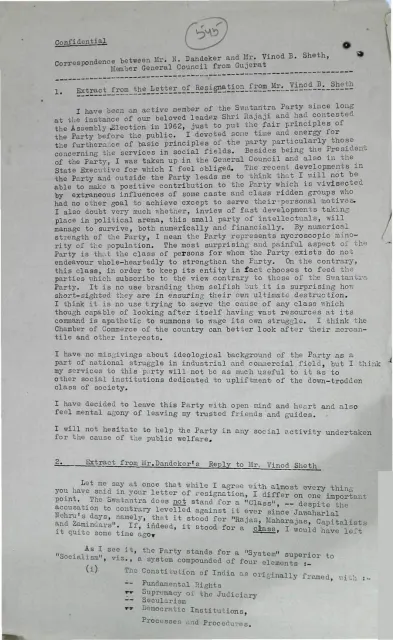
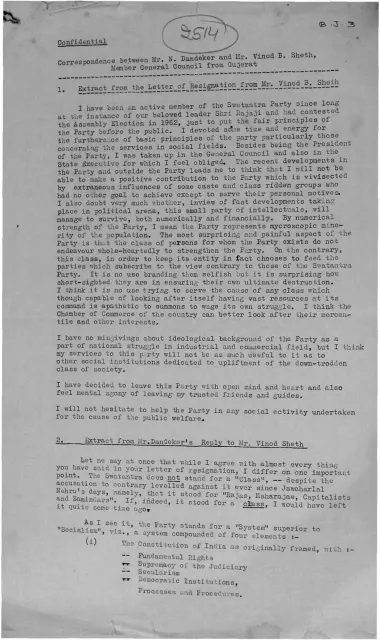
This two-page confidential correspondence consists of Vinod B. Sheth’s resignation letter from the Swatantra Party and N. Dandekar’s reply. Sheth describes his long service to the party, including work in its General Council and State Executive, but concludes that it has been weakened by caste- and class-based influences and by members whose personal interests conflict with the party’s survival. Although he remains committed to the party’s ideological background and to public welfare, he believes his efforts would be more useful in institutions serving disadvantaged sections of society.
Dandekar agrees with most of Sheth’s criticisms but rejects the claim that the Swatantra Party represents a class. He presents its position as a constitutional and economic “System” combining fundamental rights, judicial supremacy, secularism, democratic institutions, private enterprise subject to safeguards against exploitation, and public enterprise concentrated mainly in public utilities. The exchange therefore centers on the party’s identity, its relationship to class interests, and the proper balance between private initiative and state provision.
Key points
- Vinod B. Sheth resigns after concluding that the Swatantra Party has been diverted by caste- and class-based interests.
- Sheth doubts whether the party can survive politically, numerically, and financially as a small party of intellectuals.
- Sheth distinguishes his continued ideological sympathy from his judgment that his services would be more useful in social institutions serving disadvantaged people.
- N. Dandekar rejects the accusation that Swatantra stands for a particular class, including “Rajas, Maharajas, Capitalists and Zamindars.”
- Dandekar defines the party’s alternative to socialism as a constitutional and economic system based on rights, democratic institutions, private enterprise, and limited public enterprise.
- The reply defends private enterprise while accepting restraints against exploitation of consumers and workers.
- Public or state enterprise is presented as appropriate mainly for physical and service utilities needed for economic and social progress.
Metadata and summary are AI-extracted from the source PDF and reviewed for editorial accuracy. The original work is available via the Read PDF tab above (where present); paragraph-level citation inside the PDF is deferred to a future engagement.