correspondence
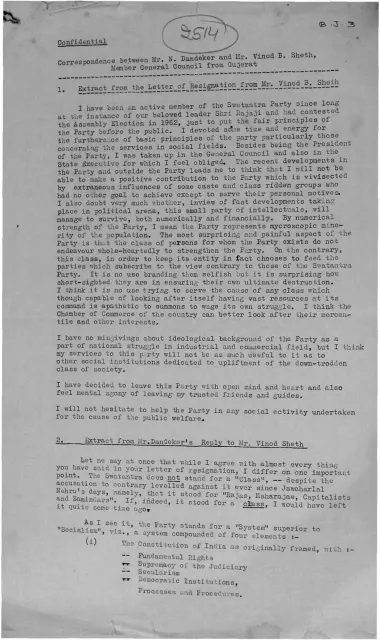
Correspondence between Mr. N. Dandeker and Mr. Vinod B. Sheth,
Member General Council from Gujarat
By N. Dandekar
2 pages
Summary
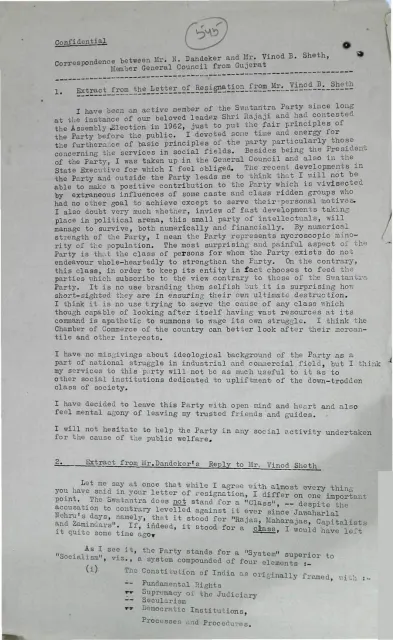
This two-page confidential document presents an extract from Vinod B. Sheth’s resignation letter from the Swatantra Party and N. Dandeker’s reply. Sheth, who says he has been associated with the party since Rajaji’s earliest initiative, attributes his resignation to the party’s recent development, its susceptibility to caste- and class-based influences, and his doubt that a small party of intellectuals can survive numerically and financially. He also argues that the social class for whom the party exists is not working wholeheartedly to strengthen it, instead supporting parties opposed to Swatantra’s views. Sheth says he would be more useful in social institutions devoted to uplifting the “down-trodden class of society,” while leaving the party with “open mind and heart.”
Dandeker’s reply agrees with most of Sheth’s criticisms but contests the claim that Swatantra is a class party. He rejects the charge, associated in the letter with Jawaharlal Nehru’s characterization, that the party stands for “Rajas, Maharajas, Capitalists and Zamindars.” Dandeker instead defines Swatantra as committed to a system superior to socialism, combining the Constitution as originally framed—including fundamental rights, judicial supremacy, secularism, and democratic institutions and procedures—with private enterprise subject to safeguards against exploitation and a public sector concentrated on utilities and infrastructure. He is particularly disturbed that Sheth’s stated concern about the party’s ideological background appears less decisive than his belief that the party’s social base is failing to sustain it.
Key points
- Vinod B. Sheth’s resignation letter cites party developments, factional or class influences, and doubts about Swatantra’s survival.
- Sheth criticizes the party’s social base for failing to strengthen the organization and for supporting ideologically opposed parties.
- Sheth distinguishes his commitment to the party’s ideological background from his decision to seek more useful social work outside it.
- N. Dandeker rejects the characterization of Swatantra as a party representing a single class.
- Dandeker presents Swatantra as an alternative system to socialism grounded in constitutionalism, private enterprise, and a limited public sector.
- The reply identifies fundamental rights, judicial supremacy, secularism, and democratic institutions as elements of the party’s constitutional position.
- The exchange frames a tension between ideological commitment and organizational or social-base concerns within Swatantra politics.
Metadata and summary are AI-extracted from the source PDF and reviewed for editorial accuracy. The original work is available via the Read PDF tab above (where present); paragraph-level citation inside the PDF is deferred to a future engagement.