Summary
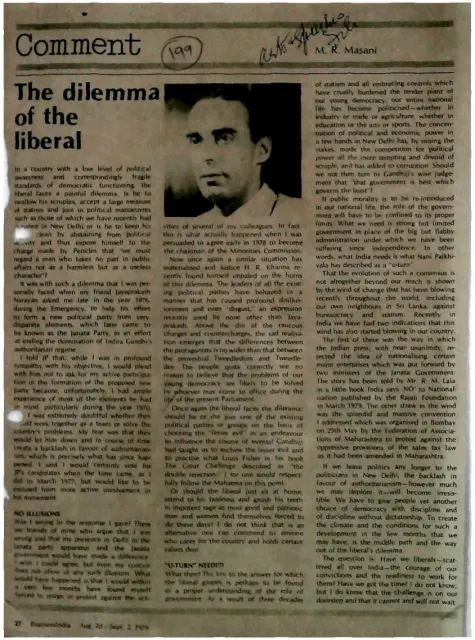
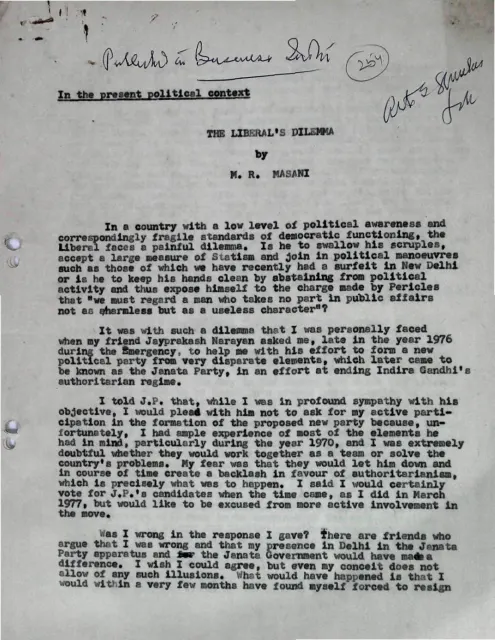
In this essay, M. R. Masani presents the liberal’s dilemma in a politically weak democracy: whether to compromise with political forces and accept some statism in order to influence events, or to remain politically uninvolved and risk becoming irrelevant. Recalling Jayaprakash Narayan’s appeal during the Emergency to help form the Janata Party, Masani explains why he supported the objective of ending Indira Gandhi’s authoritarian rule while declining active participation, fearing that the party’s disparate elements would eventually discredit democratic politics and encourage authoritarianism. He presents his later acceptance of the chairmanship of the Minorities Commission as another instance of being drawn into public office despite reservations about colleagues and political conduct.
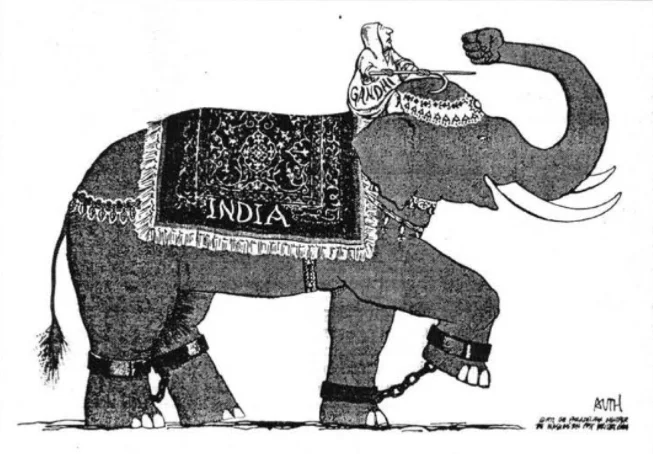
The essay argues that the deeper problem is not simply the choice between existing parties but the excessive role of government. Masani attributes the politicisation of industry, trade, agriculture, education, arts, and sport to three decades of statism and pervasive controls, which have concentrated political and economic power in New Delhi and intensified corruption. He calls instead for strong but limited government, links this position to Gandhi’s principle of choosing the “lesser evil” and practising “double rejection,” and points to recent opposition to nationalisation and Maharashtra’s Sales Tax law as signs of resistance to bureaucratic statism. The essay closes by urging scattered liberals to organise quickly for democracy with discipline rather than dictatorship.
Key points
- Masani frames liberal political participation as a choice between compromising with statist parties and withdrawing into ineffectual protest.
- He recounts declining Jayaprakash Narayan’s request that he help form the Janata Party while supporting its anti-authoritarian objective.
- He argues that the conduct of existing political leaders has produced public disillusionment and offers no confidence that a change of government alone will solve democratic problems.
- The essay attributes national politicisation and corruption to decades of statism, extensive controls, and the concentration of power in New Delhi.
- Masani advocates strong but limited government and invokes Gandhi’s ideas of the lesser evil and “double rejection.”
- Resistance to proposed nationalisation and opposition to Maharashtra’s amended Sales Tax law are presented as evidence of a possible liberal political opening.
- The conclusion calls on liberals across India to organise promptly for disciplined democracy rather than authoritarian rule.
Metadata and summary are AI-extracted from the source PDF and reviewed for editorial accuracy. The original work is available via the Read PDF tab above (where present); paragraph-level citation inside the PDF is deferred to a future engagement.