Summary
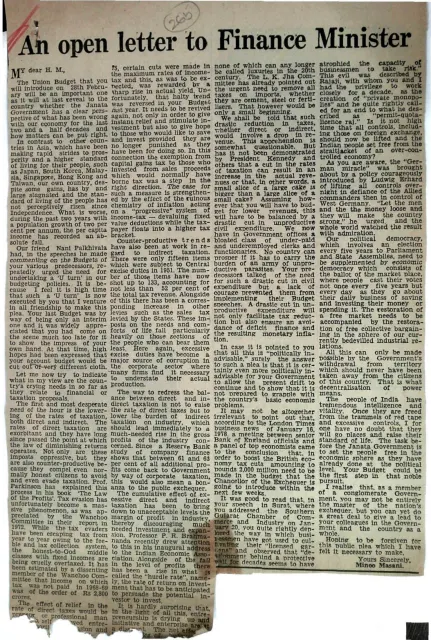
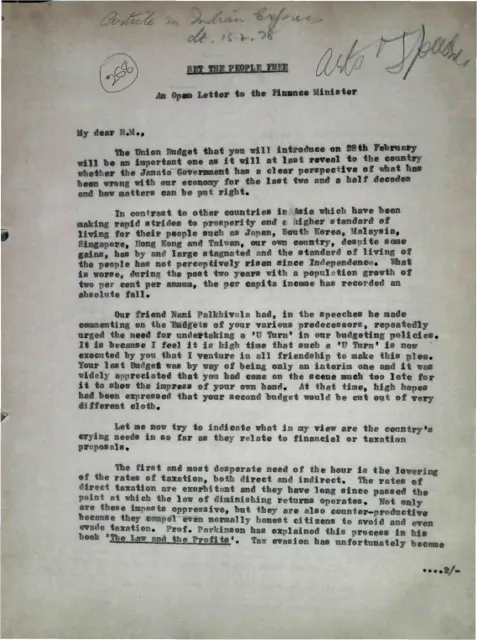
In this open letter to Finance Minister H. M. Patel, Minoo Masani argues that the Union Budget should mark a decisive break with India’s prolonged economic stagnation. He contrasts India’s experience with the rapid prosperity of Japan, South Korea, Malaysia, Singapore, Hong Kong, and Taiwan, and attributes India’s declining per-capita income and weak living standards to excessive taxation, pervasive controls, and policies that discourage enterprise and investment. Drawing on Nani Palkhivala’s earlier calls for a “U Turn” in budgeting, Masani urges substantial reductions in both direct and indirect taxes.
Masani maintains that high direct-tax rates encourage evasion and punish fixed-income middle-class taxpayers, while expanding excise duties and sales taxes burden consumers and create incentives for corporate corruption. He links the resulting decline in profits and investment to unemployment, inflation, and reduced savings, and calls for tax relief alongside sharp cuts in unproductive civil expenditure. The letter also advocates dismantling the permit-quota-licence system, freeing foreign exchange and industry from excessive controls, decentralising state power, and extending economic democracy through freer markets and collective bargaining. The five-page letter closes by presenting the budget as an opportunity for the Janata Government to “set the people free” economically, as it has already done politically.
Key points
- Masani presents the 1978 Union Budget as a test of whether the Janata Government understands India’s economic failures and can correct them.
- He compares India’s stagnation and falling per-capita income with the rapid growth of several East and Southeast Asian economies.
- The letter calls for major reductions in direct and indirect taxation, arguing that excessive rates promote evasion and suppress investment.
- Masani criticises excise duties, sales taxes, and inflation-indexed effects of progressive taxation for burdening ordinary consumers and fixed-income groups.
- He links high taxation and regulation to declining industrial profits, weak investment, unemployment, inflation, and corruption.
- He advocates cuts in unproductive civil expenditure and rejects the assumption that lower tax rates must necessarily reduce government revenue.
- The letter calls for an end to the permit-quota-licence system, freer foreign exchange, decentralisation, economic democracy, and restored collective bargaining.
Metadata and summary are AI-extracted from the source PDF and reviewed for editorial accuracy. The original work is available via the Read PDF tab above (where present); paragraph-level citation inside the PDF is deferred to a future engagement.