Summary
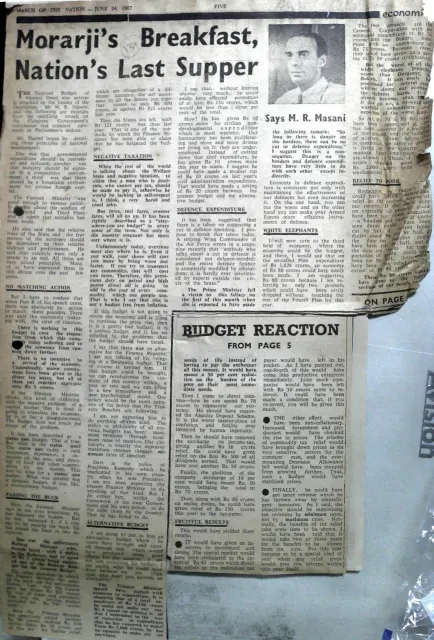
In this June 24, 1967 newspaper commentary, M. R. Masani attacks Morarji Desai’s budget as an excessive-taxation, high-spending programme that would restrain industry and leave too little room for private enterprise. He argues that the budget’s proposed increases in customs duties, excise, income tax, and corporation tax would deepen stagnation rather than restore economic growth, while public expenditure remains poorly prioritised.
Masani criticises defence spending, state-owned “white elephants,” expanding bureaucracy, and relief measures that he considers ineffective or distortionary. He contrasts the budget with an “alternative budget” based on tax reduction, reinvestment, and private capital formation, claiming that lower taxes could increase investment, employment, and government revenue. The page also includes a boxed continuation, “Budget Reaction,” which develops the case that cuts in taxation and customs duties would stimulate productive enterprise and reduce inflationary pressure.
Key points
- Masani presents the National Budget as a continuation of restrictive taxation and excessive state expenditure.
- He argues that higher taxes and duties will discourage industry, investment, and private enterprise.
- The commentary attacks rising defence expenditure and the funding of inefficient public-sector projects or “white elephants.”
- Masani criticises the growth of bureaucracy and the diversion of public money away from productive uses.
- He proposes an alternative budget centred on substantial tax reductions and the encouragement of reinvestment.
- The continuation argues that lower taxes could increase capital formation, employment, production, and ultimately revenue.
- Relief to the poor is discussed as necessary but vulnerable to waste and administrative inefficiency.
Metadata and summary are AI-extracted from the source PDF and reviewed for editorial accuracy. The original work is available via the Read PDF tab above (where present); paragraph-level citation inside the PDF is deferred to a future engagement.