Summary
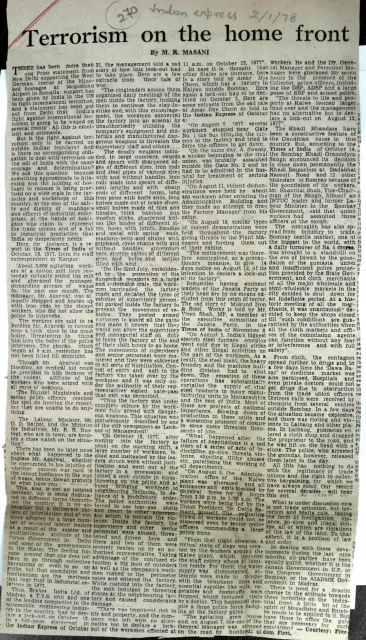
In this newspaper article, M. R. Masani argues that industrial unrest in India has taken on the character of “terrorism on the home front.” He supports the claim with reports of lock-outs, sabotage, threats, intimidation, assaults on managers and supervisors, and the manufacture or use of improvised weapons during labour disputes. A detailed account of unrest at a cotton mill in Kanpur is presented alongside incidents involving textile, engineering, steel, chemical, and pharmaceutical factories.
Masani places responsibility not only on militant workers but also on management failures and governmental inaction. He criticises the apparent inability of police and administrators to protect workers, managers, and property, and warns that prolonged strikes, lock-outs, coercion, and the disruption of essential production threaten public order and the wider economy. The article calls for the rule of law to prevail over “terrorism” by employers or unions, while stressing that genuine grievances must still be addressed through lawful industrial relations.
Key points
- Masani characterises violent and coercive industrial disputes as a form of domestic terrorism.
- The article records incidents of threats, assaults, sabotage, intimidation, and improvised weapons in factories.
- Examples are drawn from disputes in Kanpur and several Bombay industrial sectors, including textiles, engineering, steel, chemicals, and pharmaceuticals.
- The author argues that law enforcement and government authorities have failed to protect persons and property adequately.
- The article links industrial disruption to shortages, reduced production, and damage to the wider economy.
- Masani criticises both militant unions and management practices that provoke or sustain conflict.
- The proposed standard is the rule of law: grievances should be pursued through lawful industrial relations rather than coercion.
Metadata and summary are AI-extracted from the source PDF and reviewed for editorial accuracy. The original work is available via the Read PDF tab above (where present); paragraph-level citation inside the PDF is deferred to a future engagement.