Summary
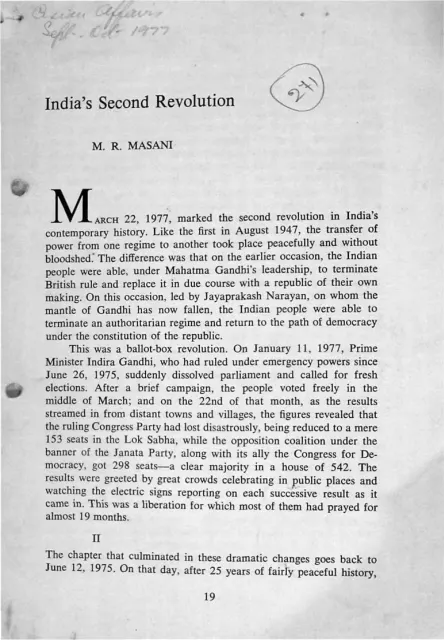
In the rendered pages, M. R. Masani presents the March 1977 election as India’s “second revolution”: a peaceful, ballot-box overthrow of Indira Gandhi’s Emergency regime and a restoration of democratic government under Jayaprakash Narayan’s moral leadership. He recounts the Allahabad High Court judgment against Gandhi’s 1971 election, her refusal to resign, the arrests of opposition leaders on the night of June 25–26, 1975, censorship of the press, and the suppression of dissent. Masani characterizes the Emergency as authoritarian rather than fully totalitarian, and argues that its reversibility depended on citizens, courts, journalists, and political activists who continued to assert legality and freedom.
Key points
- The March 1977 election is described as a peaceful democratic revolution that ended the Emergency government.
- Masani traces the Emergency to the Allahabad High Court judgment challenging Indira Gandhi’s 1971 election and her decision not to resign.
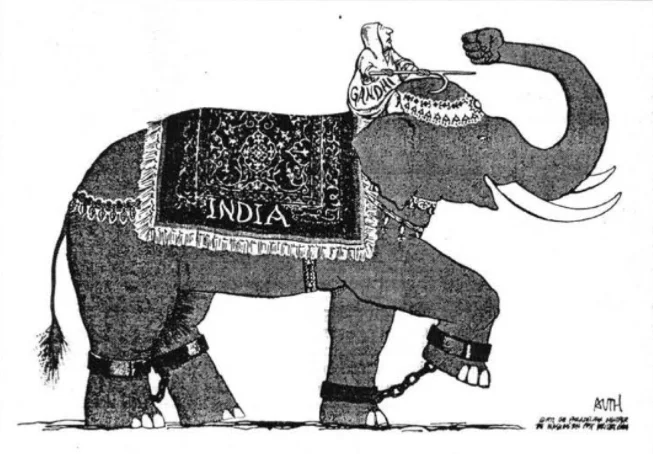
- The account emphasizes arrests, preventive detention, press censorship, propaganda, and the weakening of judicial and constitutional safeguards.
- Masani presents liberal democracy as requiring courage, legality, citizen rights, independent journalism, and social forces capable of resisting state domination.
- He argues that excessive concentration of political and economic power, including the statist economic model associated with Indian planning, helped create the conditions for authoritarianism.
- The 1977 result is qualified by criticism of the first-past-the-post electoral system, which converted a plurality of votes into a disproportionate parliamentary majority.
- Masani warns that the Janata government could reproduce Congress practices through defections, patronage, centralized control, and compromises over principle.
- The closing pages treat Jayaprakash Narayan’s role as morally decisive but uncertain, asking whether he could hold the new government to the standards of austerity, honesty, and democratic conduct.
Metadata and summary are AI-extracted from the source PDF and reviewed for editorial accuracy. The original work is available via the Read PDF tab above (where present); paragraph-level citation inside the PDF is deferred to a future engagement.