essay
THE MILLS OF HISTORY
3 pages
Summary
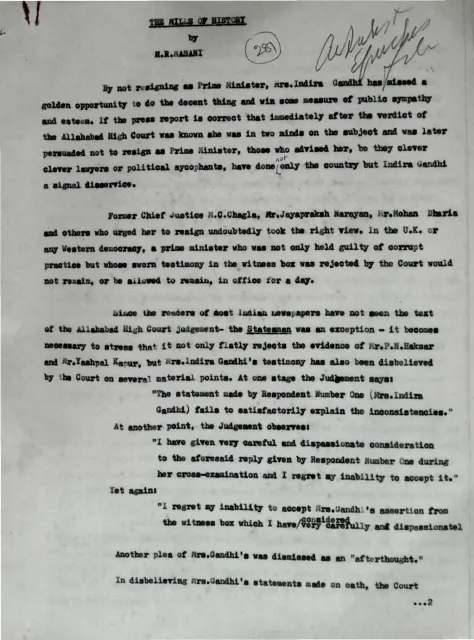
In “The Mills of History,” H. R. Masani argues that Indira Gandhi should have resigned as Prime Minister after the Allahabad High Court verdict rather than remain in office while appealing. The essay presents resignation as the ethically and politically proper response, criticising the lawyers and political advisers who persuaded her to stay. It stresses that the Court rejected not only evidence from P. N. Haksar and Yashpal Kapoor but also important parts of Gandhi’s own testimony, while noting that the judgment remained subject to appeal.
Masani distinguishes the legal question from the question of political and moral propriety: even if the Supreme Court were later to reverse the judgment, Gandhi’s decision not to resign had already damaged her credibility and dignity. The essay links this crisis to the Gujarat election defeat, economic mismanagement, unemployment, India’s international reputation, and the weakening of political institutions. It closes by defending the independence of the Indian judiciary and invoking the slow but inexorable movement of history against personality cults and political expediency.
Key points
- Masani argues that Indira Gandhi missed an opportunity to resign after the Allahabad High Court verdict and thereby preserve public respect.
- The essay emphasises that the Court disbelieved material portions of Gandhi’s testimony and rejected explanations offered during cross-examination.
- It separates the legal merits of a possible Supreme Court appeal from the independent issue of political and moral propriety.
- Masani contends that remaining in office forfeited Gandhi’s credibility and dignity, even if she might later have returned as Prime Minister after a favourable appeal.
- The Gujarat election defeat is presented as a personal political defeat for Gandhi after she made the campaign a one-person contest.
- The essay criticises her Marxist policies for worsening economic conditions, unemployment, currency debasement, and India’s international standing.
- It concludes that institutions, especially an independent judiciary, can ultimately check personal rule and political expediency.
Metadata and summary are AI-extracted from the source PDF and reviewed for editorial accuracy. The original work is available via the Read PDF tab above (where present); paragraph-level citation inside the PDF is deferred to a future engagement.