notice · position paper
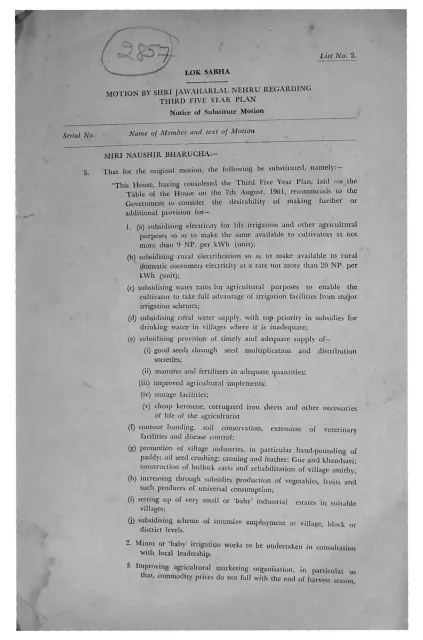
MOTION BY SHRI JAWAHARLAL NEHRU REGARDING THIRD FIVE YEAR PLAN
Notice of Substitute Motion
New Delhi · 1961
2 pages
Summary
This two-page Lok Sabha notice, dated August 21, 1961, presents Shri Naushir Bharucha’s substitute motion concerning the Third Five Year Plan. It calls for expanded public support for agriculture and rural life, including subsidised electricity and water, improved seeds, fertilisers, implements, storage, veterinary services, soil conservation, rural industries, village employment, minor irrigation, and stronger agricultural marketing. It also proposes seasonal floor prices, agricultural insurance, land distribution, regularisation of unauthorised cultivation, and protection against eviction of agricultural tenants.
The motion extends beyond agricultural production to a broad programme of rural development and social administration. Its proposals include rehabilitation of cultivators displaced by river-valley projects, the decentralisation of democratic institutions and greater resources for village panchayats, free elementary and basic technical education for village youth, a separate ministry for Scheduled Castes, Buddhists, Scheduled Tribes and others, improved village communications, and specific railway and irrigation projects in Maharashtra. The document records only the substitute motion text and does not include debate, government response, or the outcome of the motion.
Key points
- The document proposes a substitute motion on the Third Five Year Plan in the Lok Sabha.
- It advocates subsidised electricity and water for agricultural and rural domestic use.
- It calls for timely supplies of seeds, fertilisers, implements, storage, kerosene, and other agricultural necessities.
- It proposes village industries, intensive employment schemes, minor irrigation, soil conservation, and veterinary extension.
- It seeks agricultural marketing reforms, seasonal floor prices, and insurance against natural calamities.
- It recommends land distribution, regularisation of unauthorised cultivation, and an immediate halt to the eviction of agricultural tenants.
- It links rural development with panchayati institutions, free basic education, social administration, roads, telephones, postal services, railways, and rehabilitation of displaced cultivators.
Metadata and summary are AI-extracted from the source PDF and reviewed for editorial accuracy. The original work is available via the Read PDF tab above (where present); paragraph-level citation inside the PDF is deferred to a future engagement.