pamphlet · manifesto
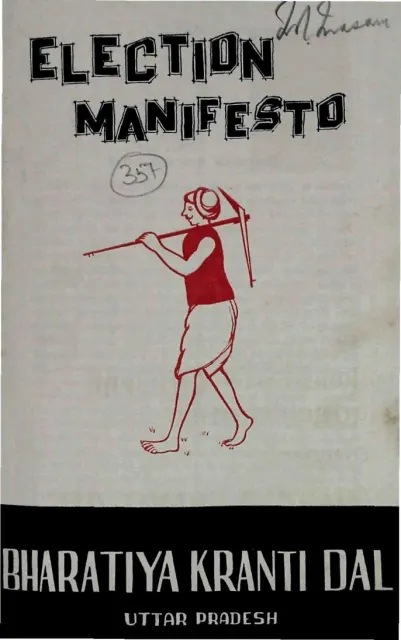
ELECTION MANIFESTO
शिवचरण सिंह महासचिव द्वारा भारतीय क्रान्तिदल उत्तर प्रदेश के त्रिलोचन मार्ग लखनऊ के लिये प्रकाशित। · LUCKNOW · 1968
10 pages
Summary
This 1968 Bharatiya Kranti Dal election manifesto presents the party as a response to national decline, corruption, weak administration, economic stagnation, unemployment, inequality, and insecurity. It calls for an honest and efficient administration, strict enforcement of law, judicial reform, curbs on political violence and separatist tendencies, and a democratic order grounded in truth, non-violence, public duty, and constitutional government. The manifesto repeatedly invokes Mahatma Gandhi’s principles while rejecting civil disobedience, political agitation, and coercive forms of mobilisation as inappropriate for contemporary public life.
The economic programme gives priority to agriculture, small farms, handicrafts, village electrification, low-capital industries, and the movement of surplus agricultural labour into non-agricultural employment. It supports peasant proprietorship, abolition of landlordism, land ceilings, soil conservation, food procurement, anti-hoarding measures, voluntary cooperation, and carefully sequenced industrialisation. Later sections address education, public health, scheduled-caste uplift, caste discrimination, population control, prohibition, municipal reform, urban property rights, national integration, and a more security-conscious foreign policy. The document is dated Lucknow, 26 September 1968, and identifies the Bharatiya Kranti Dal of Uttar Pradesh as its issuing organisation.
Key points
- The manifesto attributes India’s crisis to political misleadership, corruption, administrative inefficiency, declining public morality, economic underdevelopment, unemployment, and widening inequality.
- It proposes honest, impartial, disciplined, and efficient administration, strict application of law, judicial reform, and strong action against corruption and economic crimes.
- It advocates democracy and constitutional rule while rejecting political agitation, civil disobedience, fasts, dharnas, and other methods it regards as inconsistent with Gandhian truth and non-violence.
- Agriculture is treated as the foundation of development, with emphasis on small farms, improved inputs, irrigation, soil conservation, village electricity, and movement of surplus labour into industry and services.
- The economic programme supports peasant proprietorship, abolition of landlordism, land ceilings, small-scale industry, and a gradual transition from agriculture through light and medium industry to heavy industry.
- The manifesto combines social reform with state action: scheduled-caste uplift, removal of caste discrimination, expanded health services, sanitation, universal primary education, technical education, and population control.
- It calls for national self-reliance, stronger defence and alliances based on national interest, and an international order relying on negotiation, mediation, and arbitration rather than exploitation and war.
Metadata and summary are AI-extracted from the source PDF and reviewed for editorial accuracy. The original work is available via the Read PDF tab above (where present); paragraph-level citation inside the PDF is deferred to a future engagement.