programme · position paper
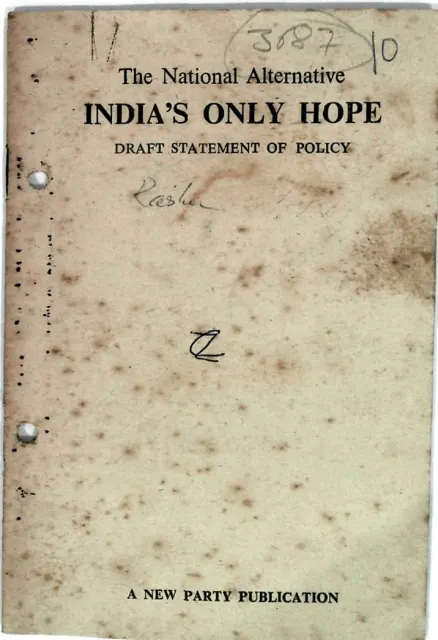
THE NATIONAL ALTERNATIVE
STATEMENT OF POLICY
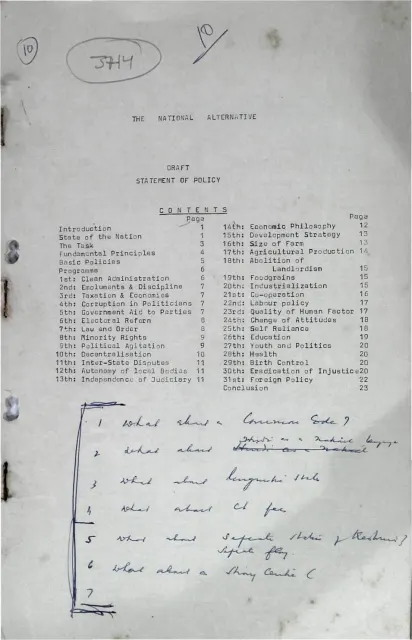
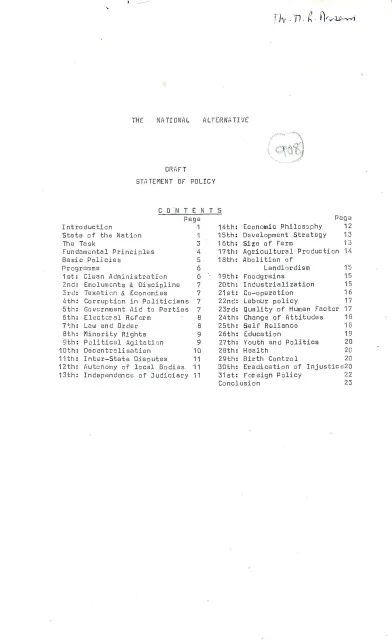
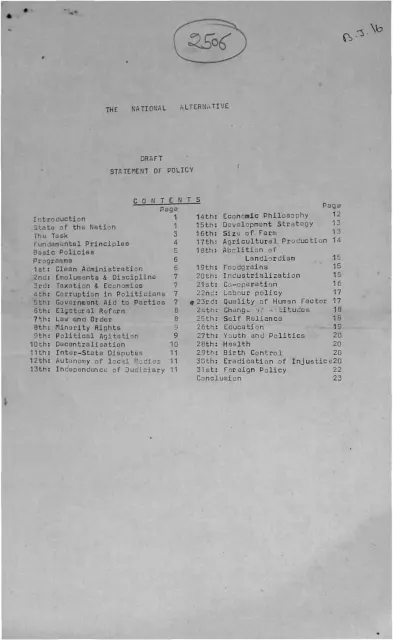
25 pages
Summary
This draft statement of policy presents “The National Alternative” as a proposed programme for a “New Party” intended to replace Congress rule with a democratic, decentralised, economically liberal and culturally rooted alternative. Its diagnosis of India is sharply critical: inflation, unemployment, corruption, administrative failure, weak institutions, centralisation and declining public confidence are attributed to the ruling party’s policies and to the influence of imported socialist and Soviet models. The document argues that India’s circumstances require an approach grounded in Indian realities, including village life, self-government and the ethical ideas associated with Mahatma Gandhi.
The visible sections combine constitutional and political reforms with an extensive economic programme. They advocate clean administration, electoral reform, protection of minorities and religious freedom, an independent judiciary, stronger states and local bodies, and non-violent political agitation against abuses of power. Economically, the draft opposes state capitalism, excessive licensing, nationalisation and centralised planning, while defending competition, dispersed property ownership, private enterprise, self-employment and reduced state control. Agriculture receives priority through land-tenure reform, a proposed minimum and optimum farm-size framework, improved credit and irrigation, soil conservation, abolition of landlordism and expanded rural electrification. The document also addresses foodgrains, small-scale industrialisation, co-operation, labour rights, education, merit and self-reliance. The rendered material ends during the education section; later listed sections on youth and politics, health, birth control, eradication of injustice, foreign policy and the conclusion were not visible.
Key points
- The draft describes India as facing economic decline, political corruption, administrative inefficiency and threats to democratic institutions.
- It proposes a “New Party” as a national corrective to Congress and as an alternative to authoritarian centralisation.
- Its fundamental principles are democracy, nationalism, secularism expressed as “Sarva Dharma Sama Bhav,” and social justice.
- The political programme stresses clean government, electoral fairness, minority protection, civil liberties, rule of law and judicial independence.
- The economic programme rejects state capitalism and excessive planning in favour of competition, dispersed ownership, private enterprise and self-employment.
- Agriculture is given priority through land reform, improved rural infrastructure, better access to credit and technology, and abolition of landlordism.
- The document supports labour organisation and bargaining rights while advocating decentralised, labour-intensive industrialisation.
- Education is presented as central to social development, with emphasis on teacher status, primary schooling, merit, vocational training and equal opportunity.
Metadata and summary are AI-extracted from the source PDF and reviewed for editorial accuracy. The original work is available via the Read PDF tab above (where present); paragraph-level citation inside the PDF is deferred to a future engagement.