essay · statement of principles
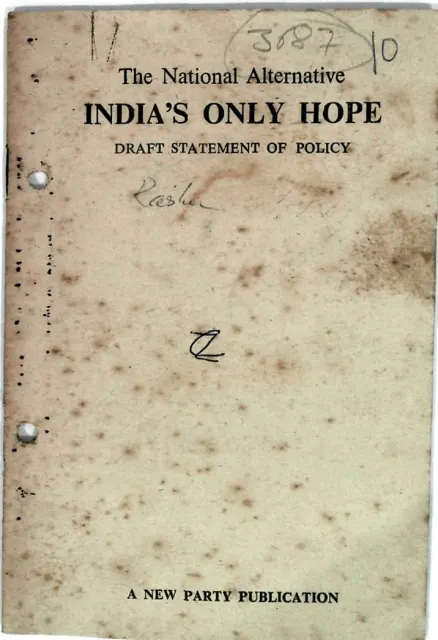
THE NATIONAL ALTERNATIVE
DRAFT STATEMENT OF POLICY
25 pages
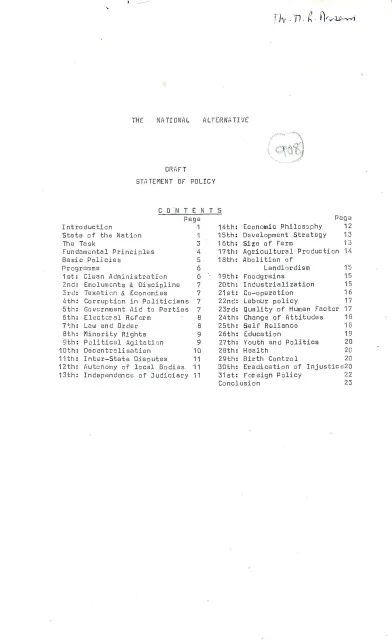
Summary
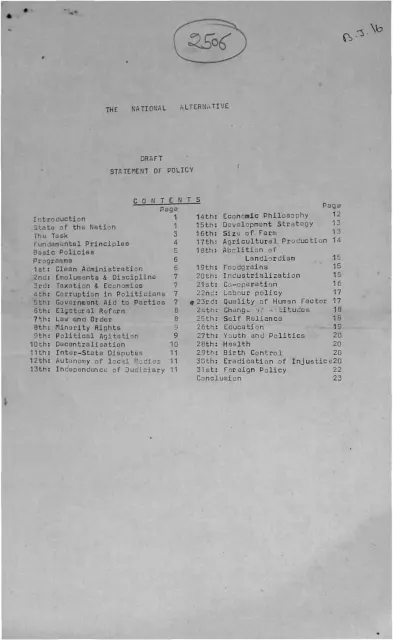
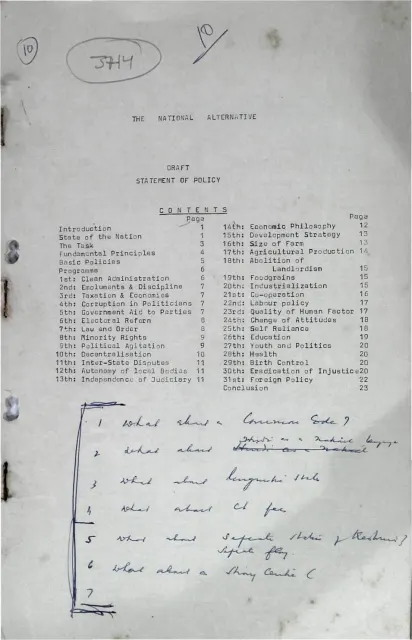
The National Alternative is a draft political policy statement that presents India as being at a crossroads after 27 years of independence. Its opening diagnosis attributes poverty, inflation, unemployment, corruption, administrative failure, weak rural development, and democratic erosion to prolonged one-party rule by Congress. The document argues that a viable national alternative must be rooted in Indian realities and political traditions, drawing particularly on Mahatma Gandhi’s ideas of self-government, decentralisation, individual responsibility, and limits on state power. It rejects both Soviet-style socialism and unrestrained private exploitation, proposing instead a democratic, nationalist, secular, and socially just order.
Key points
- The document portrays India as facing economic decline, inflation, unemployment, rural distress, corruption, and institutional decay.
- It argues that one-party dominance has weakened Parliament, the judiciary, the press, elections, civil services, and federal institutions.
- The proposed New Party is founded on democracy, nationalism, secularism expressed as Sarva Dharma Sama Bhav, and social justice.
- The programme calls for clean administration, public-servant discipline, tax reform, anti-corruption measures, political-party financing, electoral reform, and protection of minorities.
- It advocates decentralisation of authority and development, stronger state autonomy, empowered local bodies, and an independent judiciary.
- Its economic philosophy opposes both state capitalism and unrestricted exploitation, favouring competitive enterprise, self-employment, dispersed ownership, and reduced licensing controls.
- The agricultural programme prioritises rural production, small and medium holdings, abolition of landlordism, rural credit, irrigation, soil conservation, and the movement of surplus labour into non-agricultural work.
- The later rendered pages emphasise labour freedom, education, merit, self-reliance, and small-scale, labour-intensive industrialisation.
Metadata and summary are AI-extracted from the source PDF and reviewed for editorial accuracy. The original work is available via the Read PDF tab above (where present); paragraph-level citation inside the PDF is deferred to a future engagement.