essay · statement of principles
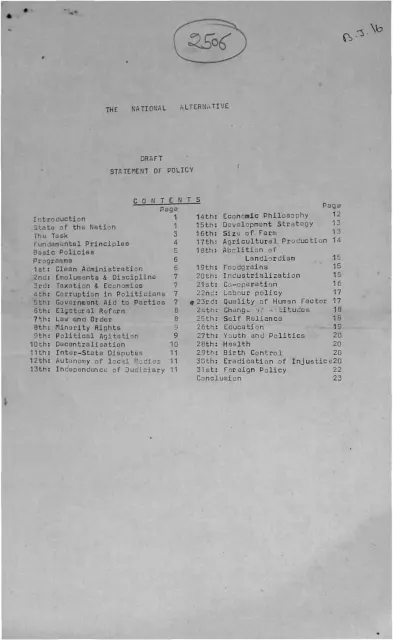
DRAFT STATEMENT OF POLICY OF THE NATIONAL ALTERNATIVE
25 pages
Summary
This draft statement presents “The National Alternative” as a proposed political party intended to replace Congress rule with a decentralised, democratic, economically liberal programme. Its diagnosis of India is sharply critical: poverty, unemployment, inflation, corruption, administrative failure, weakened constitutional safeguards, centralisation, electoral malpractice, and declining public morale are attributed to the ruling party’s policies and concentration of power. The document calls for a political alternative rooted in Indian realities and invokes Mahatma Gandhi’s ideas of self-government, village life, limited state interference, and moral renewal.
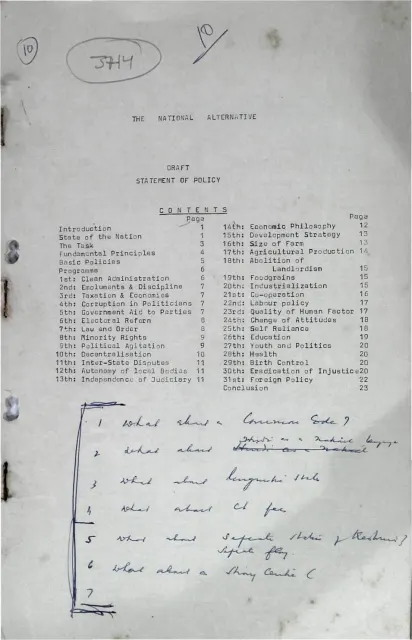
The statement’s principles combine democracy, nationalism, secularism understood as equal respect for all faiths, and social welfare. Its programme advocates clean administration, disciplined but fairly treated public servants, simpler taxation, anti-corruption procedures, public funding and auditing of political parties, electoral reform, protection of minorities, judicial independence, federalism, and stronger local bodies. In the economic sections visible here, it rejects both state capitalism and collectivism, criticises centralised planning, nationalisation, licensing and quota controls, and favours competition, dispersed ownership, self-employment, agricultural priority, small-scale and labour-intensive industry, peasant proprietorship, and consumer choice. The final rendered pages extend these proposals to labour rights, merit-based education, civic formation, self-reliance, and changes in public attitudes.
Key points
- The document diagnoses India’s post-independence crisis as the result of Congress centralisation, economic mismanagement, corruption, and institutional decline.
- It proposes a new party grounded in democracy, nationalism, equal respect for religions, social welfare, and individual freedom.
- Its constitutional programme emphasises free elections, press freedom, minority protection, judicial independence, federalism, and empowered local government.
- Its economic philosophy rejects both unrestricted private exploitation and unlimited state control, favouring competition, dispersed ownership, and consumer welfare.
- Agriculture is assigned first priority, with rural credit, irrigation, soil conservation, electricity, peasant proprietorship, and an end to landlordism.
- The statement favours labour-intensive, decentralised production and protection for cottage and small-scale industries over premature large-scale industrialisation.
- It links political freedom to independent trade unions, merit-based education, administrative integrity, self-reliance, and civic responsibility.
Metadata and summary are AI-extracted from the source PDF and reviewed for editorial accuracy. The original work is available via the Read PDF tab above (where present); paragraph-level citation inside the PDF is deferred to a future engagement.