essay
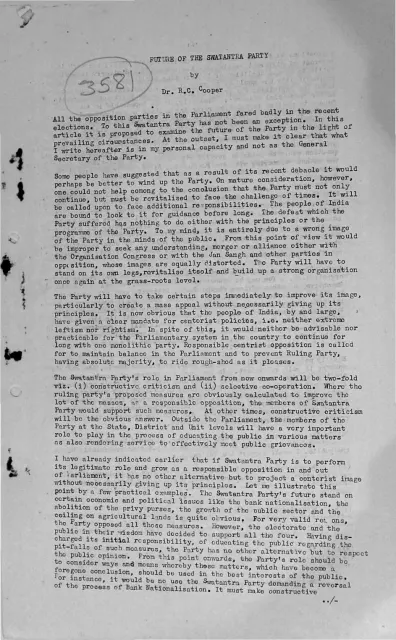
FUTURE OF THE SWATANTRA PARTY
3 pages
Summary
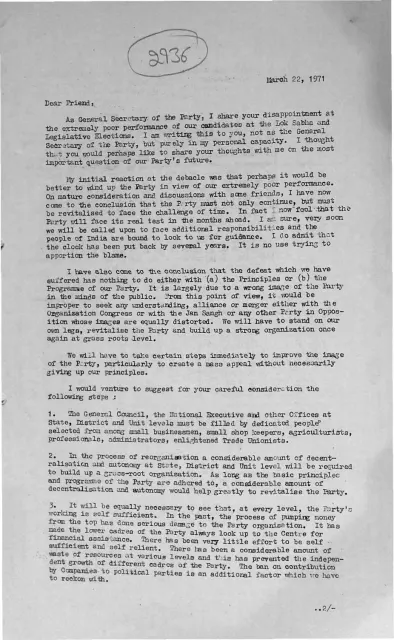
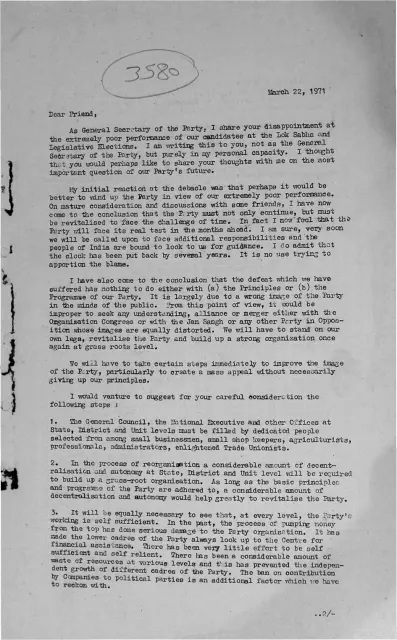
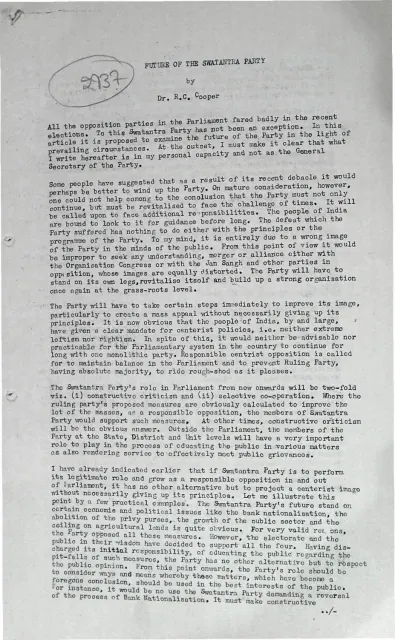
In this three-page typescript, Dr. R.C. Cooper argues that the Swatantra Party should not be dissolved after its poor electoral performance. He attributes the defeat not to the party’s principles or programme but to a distorted public image, and rejects mergers or alliances with the Organisation Congress, the Jan Sangh, or other opposition parties. Instead, he calls for the party to stand on its own, rebuild a strong grassroots organisation, and present itself as a responsible centrist opposition capable of balancing the ruling party in Parliament.
The document proposes a pragmatic approach to policy: constructive criticism and selective co-operation, including practical recommendations for nationalised banks, public-sector enterprises, agricultural land ceilings, and the Privy Purses question. Cooper urges the party to educate the public rather than simply reverse policies it previously opposed, while retaining its commitments to Fundamental Rights. He also recommends organisational decentralisation, financial self-sufficiency, an employment and public-works programme, protection of small farms and personal property, price stabilisation, national integration, and restoration of law and order.
The final page emphasises the creation of a Youth Wing to reconnect party leadership with younger voters and identifies unemployment, vocational education, housing, educational access, recreational facilities, educational assistance, and apprenticeships as youth concerns. Cooper also highlights the alienation of Muslim and other minority voters from opposition parties and calls for research into its causes and for a more balanced distribution of minority votes between the ruling Congress and opposition parties.
Key points
- The Swatantra Party should be revitalised rather than wound up after its electoral defeat.
- Cooper argues that the party’s failure resulted from a distorted public image, not from its principles or programme.
- The party should act as a responsible centrist opposition through constructive criticism and selective co-operation.
- Policy positions should become practical proposals for improving nationalised banks, public-sector productivity, agricultural productivity, and the Privy Purses settlement.
- Organisational renewal requires decentralisation, autonomous state, district, and unit bodies, and greater financial self-sufficiency.
- The proposed public agenda includes employment creation, public works, small-farm and property rights, price stability, national integration, and law and order.
- A Youth Wing should address unemployment, vocational education, housing, educational access, recreation, and apprenticeships.
- The party must investigate the alienation of Muslim and other minority voters from opposition parties.
Metadata and summary are AI-extracted from the source PDF and reviewed for editorial accuracy. The original work is available via the Read PDF tab above (where present); paragraph-level citation inside the PDF is deferred to a future engagement.