essay
FUTURE OF THE SWATANTRA PARTY
3 pages
Summary
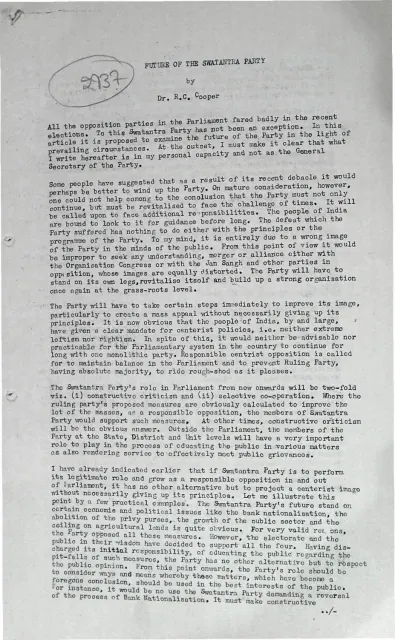
In this three-page essay, Dr. R.C. Cooper argues that the Swatantra Party should not be dissolved after its poor electoral performance. Writing in his personal capacity rather than as the Party’s General Secretary, Cooper attributes the defeat to a distorted public image rather than to the Party’s principles or programme. He calls for reorganisation, a stronger grassroots presence, and an independent identity rather than an alliance with the Organisation Congress, Jan Sangh, or other opposition parties. The Party’s parliamentary role, he proposes, should combine constructive criticism with selective cooperation, while its State, District, and Unit organisations should educate the public and address grievances.
Key points
- Cooper rejects winding up the Swatantra Party and calls instead for its revitalisation.
- He attributes the Party’s electoral defeat to a distorted public image, not to its principles or programme.
- He advocates a centrist public image without abandoning opposition to bank nationalisation, excessive public-sector expansion, and restrictions on agricultural landholdings.
- The Party should act in Parliament through constructive criticism and selective cooperation, while remaining an effective check on a majority government.
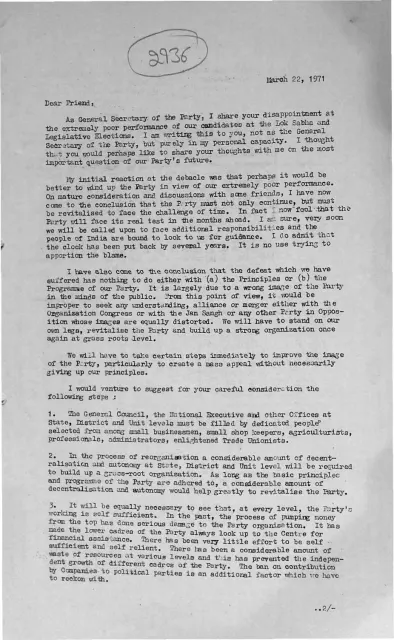
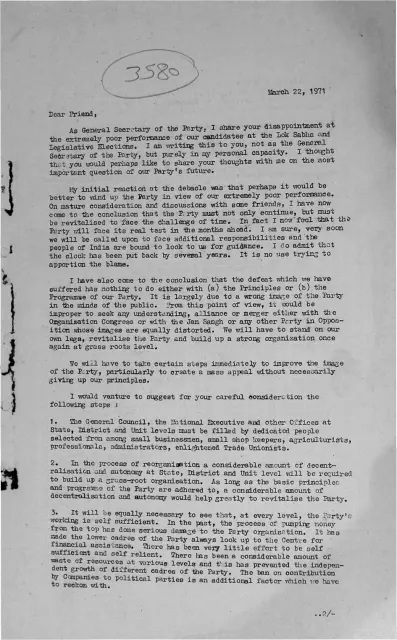
- Reorganisation should decentralise authority, recruit representatives from social and occupational groups, and make Party units financially self-sufficient.
- The proposed public programme stresses employment, public works, small-farm and small-house property rights, price stability, national integration, and restoration of law and order.
- A new Youth Wing should address unemployment, vocational guidance, housing, education, recreation, and apprenticeships.
- Cooper identifies the alienation of Muslim, Scheduled Caste, tribal, and other minority voters as a major electoral problem requiring careful investigation.
Metadata and summary are AI-extracted from the source PDF and reviewed for editorial accuracy. The original work is available via the Read PDF tab above (where present); paragraph-level citation inside the PDF is deferred to a future engagement.