essay · report
NATIONAL HEADQUARTERS' NOTE ON ORGANISATION
SWATANTRA PARTY · Bombay · 1971
3 pages
Summary
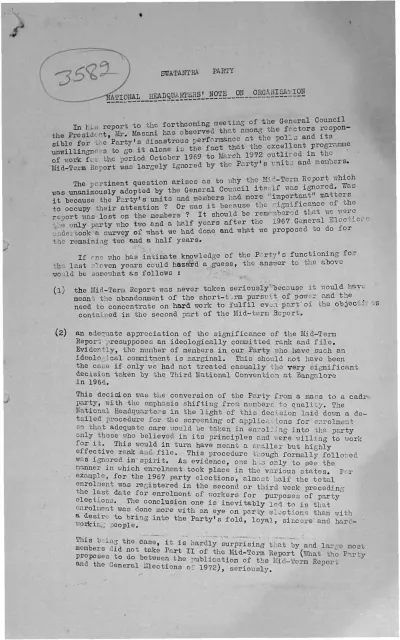
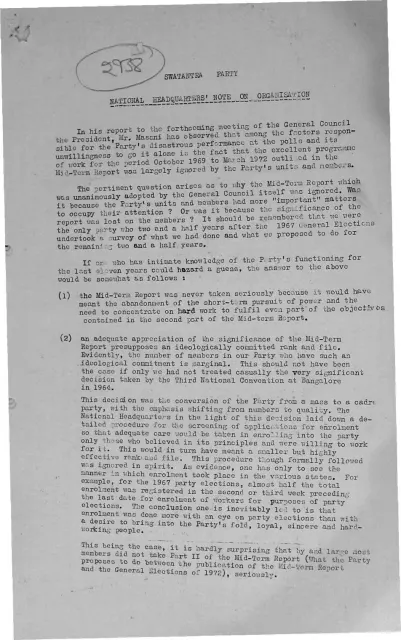
This three-page National Headquarters’ note, dated Bombay, April 12, 1971, diagnoses the Swatantra Party’s poor electoral performance as an organisational and ideological failure rather than a rejection of its principles. It argues that the Party’s Mid-Term Report was ignored because members pursued short-term power, lacked ideological commitment, and treated recruitment and candidate selection casually. Large-scale defections, last-minute candidacies, and the privileging of electoral numbers over principled organisation are presented as evidence of this problem.
The note calls for a renewed affirmation of Swatantra policies and principles, a disciplined cadre-based organisation, mass education in the Party’s programme, stronger feeder organisations among farmers, women, and youth, and candidate selection based chiefly on quality and party work. It accepts that such a programme might initially reduce membership, but argues that it would produce a smaller, cleaner, more disciplined, and ideologically motivated party capable of offering an alternative to socialist politics. The note closes by invoking Lenin’s observation about the power of an organised minority. The document contains no named human author or signatory.
Key points
- The note attributes the Party’s disastrous electoral performance chiefly to organisational weakness and members’ reluctance to undertake sustained work.
- It argues that the Mid-Term Report was ignored because it required abandoning short-term power-seeking and concentrating on longer-term party-building.
- The 1964 decision to convert the Party from a mass party into a cadre party was formally followed but ignored in spirit.
- Casual enrolment and last-minute candidate selection produced weak ideological commitment and contributed to defections.
- The General Council is urged to restate Swatantra principles and distinguish the Party’s economic and social programme from socialist parties, including the Jan Sangh.
- Proposed reforms include mass political education, a disciplined rank and file, feeder organisations among farmers, women, and youth, and candidate selection based on quality and party record.
- The note accepts possible short-term numerical losses in pursuit of a principled and ideologically committed organisation.
Metadata and summary are AI-extracted from the source PDF and reviewed for editorial accuracy. The original work is available via the Read PDF tab above (where present); paragraph-level citation inside the PDF is deferred to a future engagement.