essay
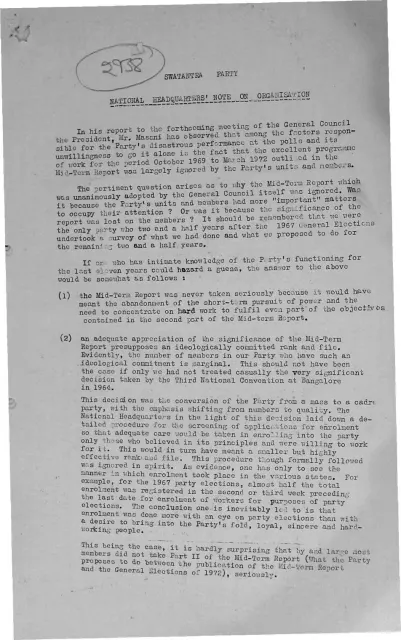
NATIONAL HEADQUARTERS' NOTE ON ORGANISATION
SWATANTRA PARTY · Bombay · 1971
3 pages
Summary
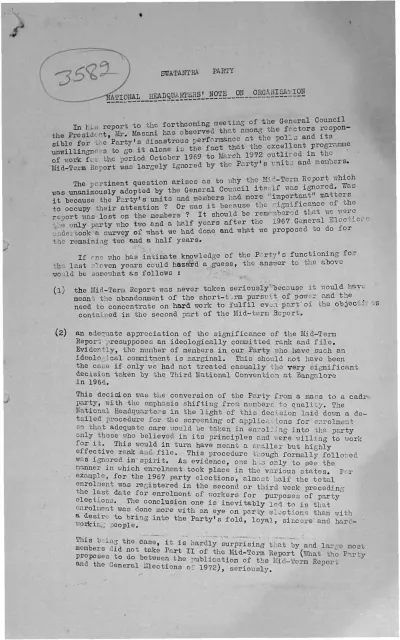
This three-page organisational note attributes the Swatantra Party’s poor electoral performance not primarily to rejection of its policies, but to organisational weakness, inadequate ideological commitment, short-term ambitions, and insufficiently sustained work by its members. It argues that the Party’s Mid-Term Report was ignored because implementing it would have required abandoning the pursuit of immediate power, improving member selection, and building a smaller but more committed cadre organisation. The note also criticises last-minute candidate selection and the tendency of legislators and leaders to prioritise the prospect of toppling governments over maintaining a principled party identity.
The proposed remedy is a restatement of Swatantra principles, a renewed emphasis on quality rather than numerical strength, ideological education, dedicated work among farmers, women, and youth, and the selection of candidates on the basis of character and party record rather than electoral convenience. The note presents the Party as a distinct alternative to both opportunistic politics and the “shades of the socialist hue,” and warns that its future depends on disciplined organisation and public education before the anticipated failure of Mrs. Gandhi’s policies. It closes by invoking Lenin’s claim that an organised minority can overcome a disorganised majority.
Key points
- The note explains the Swatantra Party’s electoral debacle through organisational weakness rather than popular rejection of its principles.
- The Mid-Term Report was allegedly ignored because it demanded sustained work and a retreat from short-term efforts to gain power.
- The Party’s conversion from a mass party to a cadre party was not implemented seriously, especially in membership screening and enrolment.
- Last-minute candidate selection produced defections and left the Central Parliamentary Board with little effective authority.
- The Party is urged to restate its principles, conduct mass ideological education, and develop organisations among farmers, women, and youth.
- Future candidates should be chosen primarily for quality, character, and records of party work rather than simply financial resources or electoral prospects.
- The note argues that a smaller, disciplined, ideologically committed organisation could eventually become more effective than a larger but opportunistic one.
Metadata and summary are AI-extracted from the source PDF and reviewed for editorial accuracy. The original work is available via the Read PDF tab above (where present); paragraph-level citation inside the PDF is deferred to a future engagement.