essay · position paper
Kerala Land Reforms Act as amended by Act 35 of 1969
1969
3 pages

Summary
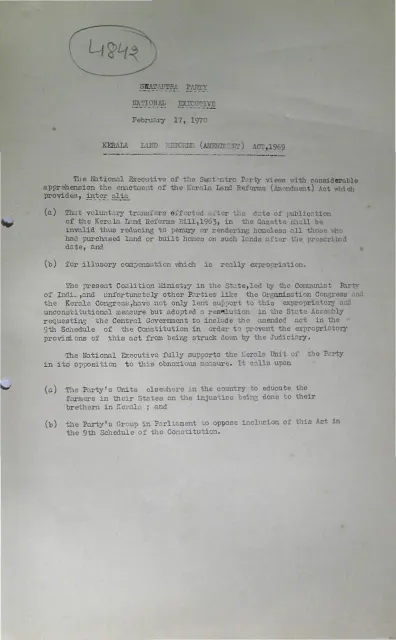
This three-page position paper criticizes provisions of the Kerala Land Reforms Act as amended by Act 35 of 1969. It objects to the ceiling on landholding, the invalidation of voluntary transfers made after publication of the Kerala Land Reforms Bill, 1963, and the vesting of surrendered land and tenants’ holdings in the Government. The paper emphasizes the consequences for purchasers who may lose homes and life savings, arguing that some innocent purchasers could be rendered homeless with inadequate compensation.
The paper also attacks the compensation scheme for landlords, describing its graduated rates, delayed payment, and eight annual instalments as economically ruinous. It argues that the system effectively converts private landlordism into state landlordism and characterizes the sale of vacant land to landless people at 55 percent of actual value, with payment possibly deferred through sixteen-year bonds, as confiscation rather than compensation. The final section claims that the Act also disrupts the administration and rental income of temples, churches, mosques, and other religious institutions, allegedly forcing some places of worship to close.
Key points
- The paper objects to statutory ceilings on the ownership, holding, possession, and mortgaging of land.
- It argues that certain voluntary land transfers made after publication of the 1963 Kerala Land Reforms Bill become invalid.
- It presents the plight of innocent purchasers who may lose land, houses, and invested savings.
- It criticizes the vesting of surrendered land and tenants’ holdings in the Government as a shift from private to state landlordism.
- It argues that compensation to landlords is reduced by graduated rates and paid over eight annual instalments.
- It describes the sale of vacant land at 55 percent of actual value and the use of sixteen-year bonds as confiscatory.
- It claims that the Act threatens the land-based finances and administration of religious institutions.
Metadata and summary are AI-extracted from the source PDF and reviewed for editorial accuracy. The original work is available via the Read PDF tab above (where present); paragraph-level citation inside the PDF is deferred to a future engagement.