essay · statement of principles
STATEMENT
1 pages
Summary
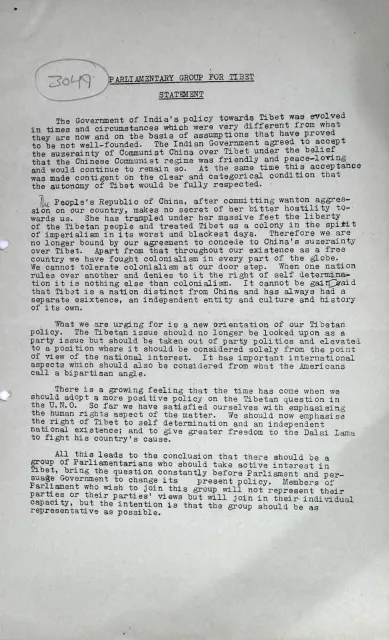
This one-page statement from the Parliamentary Group for Tibet calls for a fundamental change in India’s policy towards Tibet. It argues that India’s earlier acceptance of Chinese suzerainty rested on assumptions that have proved unfounded, including the belief that the Chinese Communist regime was friendly and peace-loving and that Tibet’s autonomy would be respected. In the rendered page, the statement presents China’s rule as colonial domination and rejects any continuing obligation to accept Chinese suzerainty after what it describes as aggression and the suppression of Tibetan liberty.
The statement urges that the Tibetan question be removed from party politics and treated as a matter of national interest, including through a bipartisan approach. It recommends a more positive Indian position at the United Nations, with emphasis on Tibet’s human rights, right to self-determination, and independent national existence, and calls for greater freedom for the Dalai Lama to pursue his country’s cause. It concludes by proposing a representative parliamentary group to maintain pressure on Parliament and persuade the government to change its policy.
Key points
- India’s earlier Tibet policy was based on assumptions about China’s intentions and respect for Tibetan autonomy that the statement considers disproven.
- China’s rule in Tibet is characterised as colonialism and as a denial of the Tibetan people’s liberty and right to self-determination.
- The Tibetan question should be treated as a matter of national interest rather than as a party issue.
- India should adopt a more positive policy on Tibet at the United Nations, especially by foregrounding human rights and self-determination.
- The statement supports Tibet’s independent national existence and greater freedom for the Dalai Lama to advance its cause.
- It proposes a cross-party parliamentary group whose members would act in an individual capacity and seek to change government policy.
Metadata and summary are AI-extracted from the source PDF and reviewed for editorial accuracy. The original work is available via the Read PDF tab above (where present); paragraph-level citation inside the PDF is deferred to a future engagement.