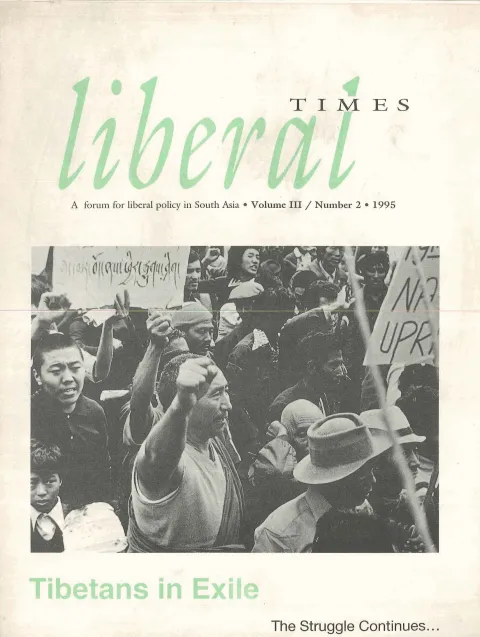
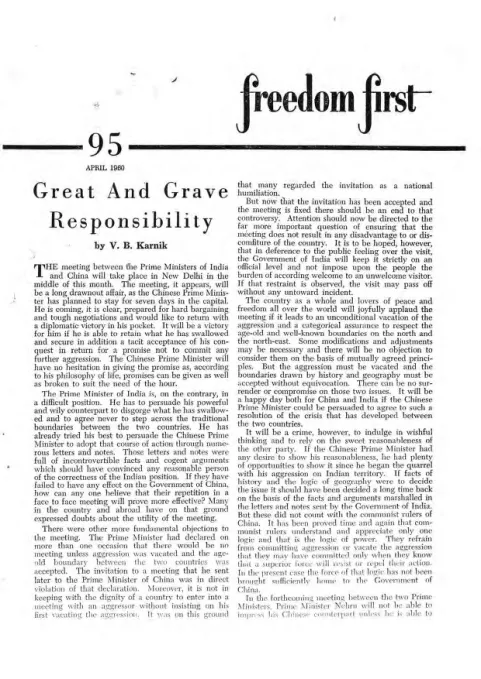
periodical issue
Freedom First
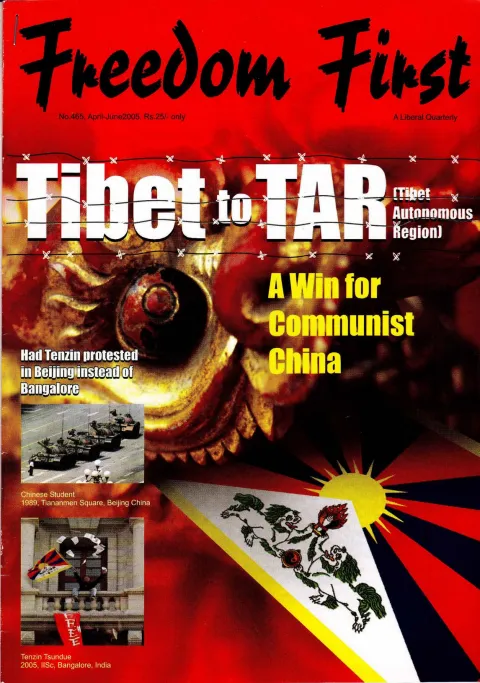
Tibet to TAR (Tibet Autonomous Region): A Win for Communist China
By Minoo Masani
Publishers: Indian Committee for Cultural Freedom (ICCF), 3rd Floor, Army & Navy Building, 148, Mahatma Gandhi Road, Mumbai 400 001. Published by J. R. Patel for the Indian Committee for Cultural Freedom (ICCF) and printed by him at Kaiser-E-Hind Private Ltd., Plot No.A-191, Road No.16A, MIDC, Wagle Industrial Estate, Thane (W) - 400 604. · Mumbai · 2005
56 pages
Freedom First
Summary
This is issue No. 465 (April–June 2005) of Freedom First, the Bombay-based liberal quarterly published by the Indian Committee for Cultural Freedom, in its 53rd year of publication, edited by S. V. Raju. The issue’s cover feature, ‘From Tibet to TAR (Tibet Autonomous Region): A Win for Communist China,’ assembles five essays marking the 46th anniversary of the Tibetan National Uprising Day and the Dalai Lama’s March 10, 2005 statement: Ajay B. Agrawal indicts India’s ‘shameful role’ in Tibet’s annexation by tracing Nehru’s diplomatic vacillation between 1949 and 1950; Claude Arpi surveys the 1955 Bandung Conference as the moment the promise of Asian-African solidarity was betrayed for Tibet; the Dalai Lama’s own statement reflects on 46 years of exile and reaffirms the Middle Way approach; Aspi Mistry pushes back on media coverage that mischaracterized the Dalai Lama’s statement as abandoning independence; Pema Thinley argues geopolitical and commercial expediency has left the world unwilling to press China on Tibet; and Tenzin Tsundue, writing as a second-generation exile, describes younger Tibetans’ impatience with the ‘Genuine Autonomy’ compromise. In the rendered pages the issue also carries editorial front matter (‘With Many Voices,’ a page of press quotations; ‘Of Cabbages and Kings,’ short editorial comment on UN Security Council ambitions, apologetic diplomacy, community housing, and dance-bar legislation), tributes to G. K. Sundaram and Soli Sorabjee, and a reprint of Minoo Masani’s 1956 essay ‘Why I Oppose Communism’ marking his birth centenary. The table of contents (visible on p.1/PDF p.3) shows the issue continues with essays on the Liberal Budget 2005, gender issues, profiles of Rajaji, V. D. Savarkar and Narayan Singh Thapa, a profile of Ganesh Vasudev Joshi, a media piece on attacks on the press, and book reviews — none of which are covered here as they fall outside the rendered page range.
Key points
-
Freedom First No. 465 (April-June 2005) devotes its cover feature, “From Tibet to TAR,” to five essays marking the 46th anniversary of the Tibetan National Uprising Day and the Dalai Lama’s March 10, 2005 statement.
-
Ajay B. Agrawal’s “The Annexation of Tibet — India’s Shameful Role” argues Tibet was fully independent until 1950, and that Nehru’s government conceded a “vague suzerainty of China” it could not later escape, quoting Sardar Patel’s prescient 1950 warning letter.
-
Claude Arpi’s “The Irony of the Bandung Conference” argues the 1955 Bandung Conference’s anti-colonial rhetoric masked Tibet’s abandonment, citing Acharya Kripalani’s description of the Panchsheel Agreement as “born in sin.”
-
The Dalai Lama’s own March 10, 2005 statement reaffirms the Middle Way Approach seeking genuine autonomy rather than independence, while acknowledging Chinese economic development in Tibet alongside continued human-rights concerns.
-
Aspi Mistry rebuts press coverage claiming the Dalai Lama “gave up” the demand for a free Tibet, and Pema Thinley’s reprinted Tibetan Review editorial argues global commercial self-interest, from the EU’s arms-embargo debate to US retreat from UN pressure, leaves China facing no real accountability.
-
Tenzin Tsundue, writing as a second-generation exile, describes the 20,000-member Tibetan Youth Congress’s generational impatience with the “Genuine Autonomy” compromise and its demand for full independence.
-
A reprint of Minoo Masani’s 1956 essay “Why I Oppose Communism,” marking his birth centenary, traces his journey from socialist sympathies to anti-Communism grounded in Lord Acton’s axiom that liberty is the supreme good.
-
“Of Cabbages and Kings” comments on India’s UN Security Council ambitions, a Supreme Court ruling permitting caste-exclusive housing societies, and criticises the Maharashtra government’s dance-bar ban as moral posturing.
Essays
Many Voices
The unsigned lead editorial ‘With Many Voices’ (in the rendered pages) is a compilation of quotations clipped from the Indian press in April–May 2005, on subjects ranging from judicial commentary on rape cases, the Congress high command’s treatment of Sheila Dixit, corruption in the Enron affair, the Pope’s death, and the Sankaracharya bail controversy, to Tibetan activist Tenzin Tsundue’s remark on the Dalai Lama’s autonomy strategy.
- A curated set of press quotations from April-May 2005 on judicial overreach, political patronage, corruption, and religious controversies.
- Includes a quotation from Tibetan activist Tenzin Tsundue criticizing the Dalai Lama’s autonomy-only strategy as insufficient.
Of Cabbages and Kings
The unsigned editorial column ‘Of Cabbages and Kings’ (in the rendered pages) offers brief comments on several unrelated topics: skepticism about India’s push for a permanent UN Security Council seat while basic needs go unmet; the phenomenon of nations apologizing for historic wrongs (Germany to Israel, Japan to Korea, China demanding apologies from Japan) and a call for Russia to apologize for Soviet-era atrocities; a Supreme Court ruling upholding caste/religion-restricted cooperative housing societies, welcomed as consistent with liberal freedom of association; a Supreme Court ruling that temple management is a secular function subject to government oversight, argued to be consistent with separation of religion and state; VIP airport privileges enjoyed by Rahul Gandhi; and the Maharashtra government’s ordinance banning dance bars, criticized as moral posturing that will merely push the trade underground.
- Criticizes India’s ambition for a UN Security Council seat as misplaced given domestic poverty, poor infrastructure, and lack of basic services.
- Calls for Vladimir Putin, as a former KGB officer, to apologize for Soviet atrocities against Eastern Europe, paralleling Japan-Korea and Germany-Israel apologies.
- Endorses the Supreme Court’s ruling permitting caste- or religion-exclusive cooperative housing societies as an exercise of freedom of association.
- Argues management of temples (and other religious institutions) should rest with the community concerned, consistent with separation of religion and state, per a Supreme Court ruling on secular oversight.
- Criticizes the Maharashtra government’s ordinance banning dance bars as a moralistic distraction from more serious issues like the state’s power shortage, arguing it will merely drive the trade ‘underground.‘
Essay 3
Two short tribute notes mark milestones of two public figures. The first, by G. K. Sundaram, recalls The Hindu’s April 2005 interview marking the 75th anniversary of the Vedaranyam Salt Satyagraha, revealing that industrialist G. K. Sundaram had taken part in the satyagraha at age 16, was later a Swatantra Party nominee to the Rajya Sabha, and was a long-time supporter of Freedom First. The second tribute, on Soli Sorabjee turning 75, recounts his felicitation in New Delhi (with former President K. R. Narayanan releasing a Festschrift), and credits Sorabjee’s legal defence of Freedom First’s right to publish uncensored during the Emergency.
- G. K. Sundaram, Coimbatore industrialist, took part in the Vedaranyam Salt Satyagraha at age 16 and was later nominated to the Rajya Sabha by the Swatantra Party.
- Soli Sorabjee, felicitated on his 75th birthday (March 9, 2005), is credited with successfully defending Freedom First’s right to publish without censorship during the Emergency.
Tibet - The Travail Continues,
An unsigned framing editorial, ‘Tibet - The Travail Continues,’ precedes the cover feature, situating the Dalai Lama’s March 10, 2005 statement on the 46th anniversary of the Tibetan National Uprising Day within a critique of contemporary global realpolitik. It argues that both India (under UPA and previously) and the wider world, tempted by Chinese markets, are pressuring the Dalai Lama into accepting autonomy over independence, and it reaffirms Freedom First’s long-standing support for Tibetan freedom since it began publication in June 1952.
- Frames the Dalai Lama’s 46th Uprising Day statement as showing continuing willingness to remain within the People’s Republic of China under the Middle Way Approach.
- Criticizes India’s ‘second honeymoon’ with Communist China and the pressure from world powers (US, EU) chasing Chinese markets, arguing this undermines support for Tibetan freedom.
- Reaffirms the journal’s editorial position of unconditional support for Tibetan independence since its founding in June 1952.
Why I oppose Communism
By Minoo Masani
A reprint marking Minoo Masani’s birth centenary of his 1956 essay ‘Why I Oppose Communism,’ originally written for the Cold War-era booklet series ‘Background Books’ published by Phoenix House, London. Masani traces his personal political journey from socialist sympathies at the London School of Economics, through disillusionment following the Webbs, contact with Mahatma Gandhi’s philosophy (which he contrasts point-by-point with dialectical materialism), to his mature opposition to Soviet Communism grounded in liberty as ‘the supreme good’ (invoking Lord Acton). He catalogues the scale of Soviet territorial expansion since 1939 and argues democracy’s capacity for self-correction makes it morally superior to Communism, closing with an invocation of H. G. Wells on intellectual independence. Only the pages rendered here (through p.6/PDF p.9) were seen; the essay may continue further into the issue.
- Masani recounts his personal trajectory from socialist sympathizer (LSE, Labour Party, 1926 General Strike) to committed anti-Communist, dating his break to the Great Purges of 1936.
- Contrasts Gandhi’s philosophy of decentralization and ‘means as important as ends’ against Communism’s dialectical materialism and ‘ends justify the means’ logic.
- Cites Lord Acton’s axiom that liberty is the supreme good as the basis for placing freedom above peace, even above avoiding war.
- Provides statistics on Soviet territorial and demographic expansion since 1939 (5,239,660 sq. miles annexed, 582,411,000 people brought under Communist rule).
- Frames the fundamental issue between democracy and Communism as moral, concerning the true nature of man, and argues democracy’s capacity for self-correction makes it preferable despite its imperfections.
- A sidebar quotes Jayaprakash Narayan (from Towards Total Revolution, Vol. 2) arguing Gandhism, unlike socialism, pursues a stateless society without making the social process dependent on state power.
Cover Feature: From Tibet to TAR - The Annexation of Tibet
By Ajay B. Agrawal
Ajay B. Agrawal’s essay ‘From Tibet to TAR: The Annexation of Tibet — India’s Shameful Role’ (excerpted from his book India, Tibet & China: The Role Nehru Played) argues that Tibet was fully independent up to 1950, with no Chinese law, currency, soldiers, or administrative presence, and that India’s Nehru-led government failed Tibet through vagueness and appeasement once Communist China moved to ‘liberate’ it. Drawing on Frank Moraes, B. N. Mullick, and Nehru’s own letters, Agrawal shows Nehru accepting a Chinese ‘suzerainty’ framing he knew was flawed, dropping Tibet ‘like a hot potato’ once China declared its 1950 liberation intent, and quotes Sardar Patel’s prescient November 1950 letter warning Nehru that Chinese assurances of peaceful intent could not be trusted and that India’s defense now faced two fronts.
- Tibet had no Chinese law, judge, policeman, newspaper, soldier, postal system, or currency before 1950 — evidence marshalled from journalist Frank Moraes’s Revolt in Tibet.
- China’s own 1949-50 rhetoric (‘liberation of Tibet’) and its 200-year absence of representation in Tibet before 1911 are cited as proof of Tibet’s historical independence.
- Nehru’s December 1949 letter conceded a ‘vague suzerainty of China’ over Tibet despite recognizing Tibetan autonomy — a position Agrawal calls a self-created ‘fiction of suzerainty’ that Nehru could not later escape.
- Sardar Patel’s 7 November 1950 letter to Nehru warned that Chinese assurances were deceptive, that India’s defense now had to face two fronts (Pakistan and Communist China), and lamented that ‘the Tibetans put faith in us… and we have been unable to get them out of the meshes of Chinese diplomacy.’
- India was the first country to recognize the Communist government in China, receiving no goodwill in return; the essay frames India’s China policy as consistently conciliatory and consistently punished.
The Irony of the Bandung Conference
By Claude Arpi
Claude Arpi’s ‘The Irony of the Bandung Conference’ revisits the April 1955 Bandung Conference of 29 Asian and African leaders, arguing that even as Bandung’s rhetoric of ‘Live and let live’ and anti-colonial solidarity was being proclaimed, Tibet — independent for 2,000 years — was already being sacrificed by Nehru’s idealism and the Panchsheel Agreement (which Acharya Kripalani called ‘born in sin’). Arpi narrates Zhou Enlai’s charm offensive at Bandung, Nehru’s personal excitement at hosting Zhou, and traces the subsequent Chinese consolidation of Tibet, closing with a comparison to the hollow 50th-anniversary re-enactment of Bandung in April 2005 and an April 10, 2005 Bangalore incident in which a Tibetan protester (Tenzin Tsundue) was branded a ‘miscreant’ by India’s Ministry of External Affairs.
- The April 1955 Bandung Conference, the first major Asian-African anti-colonial summit, is presented as the moment Tibet’s fate was effectively sealed even as its rhetoric praised sovereignty and non-interference.
- The 1954 Panchsheel Agreement, presented to the Indian Parliament by Nehru, is described by Acharya Kripalani as ‘born in sin’ — its idealistic preamble masking what amounted to a death warrant for independent Tibet.
- Zhou Enlai is depicted as the conference’s ‘star performer’ and Nehru’s genuine enthusiasm for hosting him is documented through Nehru’s own letters to Edwina Mountbatten.
- Zhou Enlai denied to other Asian leaders at Bandung that China intended to introduce Communism into Tibet, calling the idea ‘impracticable’ — a claim the essay treats as calculated deception.
- The 50th-anniversary Bandung re-enactment in April 2005 is presented as hollow, given ongoing regional tensions (India-Pakistan, China-Japan, North Korea, Burma, Sudan, Nepal-India).
- The essay closes by noting an April 10, 2005 incident in Bangalore where a Tibetan youth (identifiable as Tenzin Tsundue, per other essays in the issue) was called a ‘miscreant’ by the Indian Ministry of External Affairs for trying to protest to the visiting Chinese Premier.
The Dalai Lama’s Statement of March 10, 2005
By The Dalai Lama
An extract of the Dalai Lama’s March 10, 2005 statement on the 46th anniversary of the Tibetan National Uprising Day, reflecting on more than four decades of change in Tibet — acknowledging Chinese-driven economic progress (citing the Golmud-Lhasa railway) alongside persistent human rights concerns, lack of religious freedom and self-rule, and internal Tibetan dissatisfaction voiced historically by the Panchen Lama and by Baba Phuntsok Wangyal. The Dalai Lama reaffirms his 1992 pledge to dissolve the Tibetan government-in-exile upon any return with genuine freedom, and restates commitment to the Middle Way Approach — seeking autonomy, not independence, within the People’s Republic of China.
- The Dalai Lama acknowledges China’s economic development in Tibet (citing the Golmud-Lhasa railway) while criticizing the lack of true ethnic equality, self-rule, and stability under Chinese Autonomous Region administration.
- Cites the Panchen Lama’s early-1960s petition and Baba Phuntsok Wangyal’s biography as evidence that senior Tibetan officials within Tibet are ‘extremely dissatisfied.’
- Reaffirms his 1992 announcement that he will not hold office in a future Tibetan government and that the exile administration will be dissolved once genuine freedom is achieved.
- Restates full commitment to the Middle Way Approach: not seeking independence, remaining within the People’s Republic of China, seeking only genuine autonomy.
Misunderstanding the Dalai Lama
By Aspi Mistry
Aspi Mistry’s ‘Misunderstanding the Dalai Lama’ rebuts press coverage — led by The Times of India’s headline ‘Dalai gives up demand for free Tibet’ — arguing the Dalai Lama has never endorsed Chinese annexation of Tibet and that his March 10, 2005 statement was consistent with a Middle Way position he has held since 1979 and reaffirmed via a 1997/1998 referendum-consultation process among exiled Tibetans. Mistry quotes the Dalai Lama’s 2003 remark to Friends of Tibet that ‘as a Buddhist, I cannot lie… Historically, Tibet was an independent country,’ arguing media sensationalism, not the statement itself, was the real story.
- Mistry challenges The Times of India’s front-page headline ‘Dalai gives up demand for free Tibet’ as a mischaracterization of the March 10, 2005 statement.
- The Dalai Lama has maintained since 1979 that he would not insist on full independence and has held this Middle Way position consistently since 1988.
- In a 1998 statement the Dalai Lama described a poll of exiled Tibetans and a resolution by the Assembly of People’s Deputies empowering him to use discretion on the question without a referendum.
- Quotes the Dalai Lama’s April 2003 remark to Friends of Tibet that ‘as a Buddhist, I cannot lie… Historically, Tibet was an independent country.‘
Now is Not the Time for A Negotiated Settlement
By Pema Thinley
Pema Thinley’s ‘Now is Not the Time for Negotiated Settlement’ (reprinted from the Tibetan Review’s April 2005 editorial) argues that global commercial self-interest — the EU’s push to lift its arms embargo on China, the US’s retreat from pursuing a UN human rights resolution, and general competition for access to the Chinese market — has left China facing no real pressure on human rights or Tibet, so that any negotiated settlement reached ‘now’ would hand China unearned legitimacy while yielding Tibet minimal gains; better, the essay argues, to keep pursuing dialogue and non-violence while awaiting a future, more democratic China.
- The EU is moving to lift its 15-year arms embargo on China (imposed after the 1989 Tiananmen crackdown) despite US objections, reflecting the world’s prioritizing of commercial access to China’s market over human rights concerns.
- The US has abandoned pursuing a UN Commission on Human Rights resolution against China; the Commission itself is criticized as compromised by having China and other rights-violating states as members.
- Argues a negotiated settlement reached under current conditions would grant China ‘a real semblance of legitimacy… for the very first time in history’ while yielding Tibet minimal concessions.
- Cites Nepal’s closure of Tibetan exile offices and deportation of Tibetan refugees, and China’s anti-secession law targeting Taiwan (March 14, 2005), as examples of the world’s deference to Beijing.
- Concludes that non-violence and the Middle Way must continue as strategy, but the timing and terms of any negotiated breakthrough should wait for a ‘more democratic and mature China.‘
Tibetan Independence is not Negotiable
By Tenzin Tsundue
Tenzin Tsundue’s ‘Tibetan Independence is not Negotiable’ describes generational tension within the Tibetan exile community: while the Dalai Lama has pursued ‘Genuine Autonomy’ (the ‘Middle Way,’ first floated by Deng Xiaoping in 1979) as a compromise granting Tibet Hong Kong-style ‘One Country, Two Systems’ status, younger Tibetans — represented by the 20,000-member Tibetan Youth Congress — continue to demand full independence and are increasingly willing to say ‘We beg to differ, your Holiness.’ Tsundue, describing himself as a second-generation exile born in India, notes the scale of the diaspora (130,000 refugees, 30 camps, 100 schools, 5,000 Tibetan soldiers in the Indian army at Siachen) and worries that goalposts keep shifting as his generation comes of age to take up the freedom struggle.
- The Dalai Lama’s ‘Genuine Autonomy’/Middle Way position, proposed by Deng Xiaoping in 1979, seeks a Hong Kong-style ‘One Country, Two Systems’ status for a unified three-province Tibet, not independence.
- China has not granted official recognition to the Dalai Lama’s negotiating delegations despite three visits since diplomacy resumed in September 2002, and reportedly wants Tibet’s status resolved before the 2008 Beijing Olympics.
- The Tibetan Youth Congress, the largest Tibetan NGO with 20,000 members across 77 chapters worldwide, explicitly rejects the autonomy-only goal and demands full independence.
- The exile community today numbers over 130,000 people across 30 refugee camps in India, with about 100 Tibetan schools and more than 400 monasteries/cultural centres, plus roughly 5,000 Tibetan soldiers serving in the Indian army at the Siachen Glacier.
- Tsundue, a second-generation exile, expresses frustration that as his generation matures to take on the freedom struggle, the political ‘goal posts’ keep shifting toward lesser autonomy.
Generated by the v1.5 extraction pipeline. Awaiting editorial review.
A Protest that Captured World Attention
No summary was extracted for this article. Listed for completeness.
Economics: The Liberal Budget 2005 - The Way Forward
No summary was extracted for this article. Listed for completeness.
Metadata and summary are AI-extracted from the source PDF and reviewed for editorial accuracy. The original work is available via the Read PDF tab above (where present); paragraph-level citation inside the PDF is deferred to a future engagement.