letter
Letter to Triguna Son
New Delhi-11 · 1969
2 pages
Summary
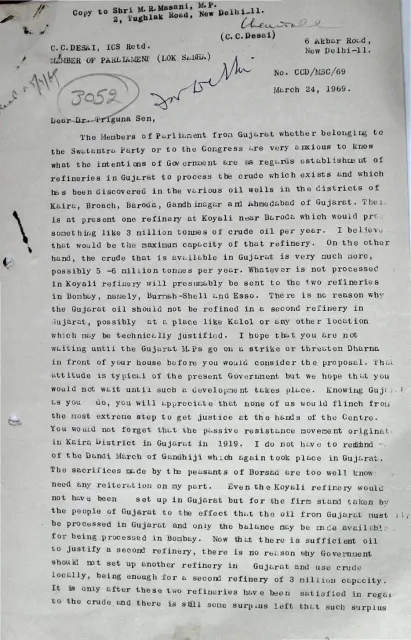
This two-page letter, dated 24 March 1969, is C. C. Desai’s appeal to Dr. Triguna Sen, Minister for Petroleum and Chemicals, for greater governmental attention to Gujarat’s petroleum resources. Desai argues that the Koyali refinery near Baroda, with an estimated capacity of about three million tonnes of crude oil annually, cannot process all of Gujarat’s available crude, which he estimates at roughly five to six million tonnes per year. He therefore urges the establishment of a second refinery in Gujarat, potentially near Kalol, rather than sending the surplus to refineries in Bombay.
The letter also asks for data on Gujarat’s crude-oil production and reserves and on the natural gas discovered by ONGC. Desai proposes that this gas be used not only for power generation at Dhuvaran but also for fertiliser production, which he presents as the most economical use of the resource. His economic argument is combined with a regional and political appeal: he invokes Gujarat’s history of resistance, including the 1919 passive-resistance movement in Kaira, Gandhi’s Dandi March, and the sacrifices of the peasants of Borsad. He closes by requesting a meeting only after the relevant data have been collected and circulated to Gujarat’s Members of Parliament.
Key points
- Desai asks the Union government to establish a second oil refinery in Gujarat.
- He estimates Gujarat’s available crude at approximately five to six million tonnes annually, against Koyali’s capacity of about three million tonnes.
- He argues that Gujarat’s crude should be processed locally before any surplus is sent to Bombay or elsewhere.
- He requests information on existing crude production and the proved potential of Gujarat’s oil reserves.
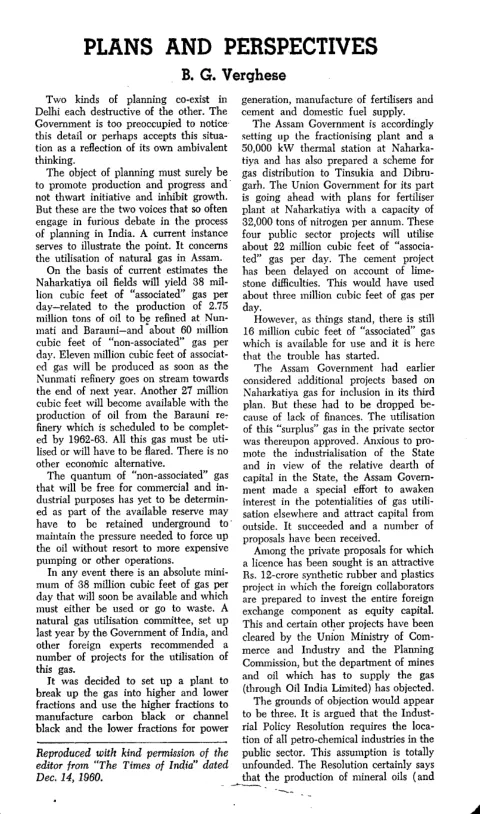
- He asks for data on ONGC’s natural-gas discoveries and the government’s plans for their utilisation.
- He recommends natural gas as an economical feedstock for fertiliser production, in addition to power generation at Dhuvaran.
- He frames the demand as a matter of justice to Gujarat and invokes the region’s history of political resistance.
Metadata and summary are AI-extracted from the source PDF and reviewed for editorial accuracy. The original work is available via the Read PDF tab above (where present); paragraph-level citation inside the PDF is deferred to a future engagement.