pamphlet
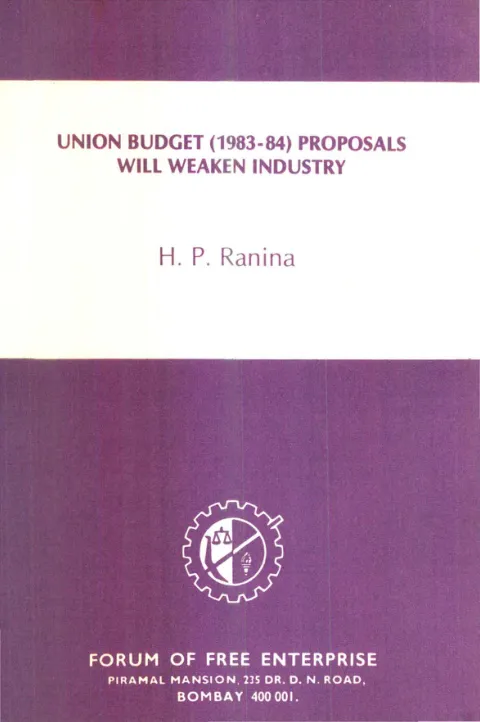
Union Budget (1983-84) Proposals Will Weaken Industry
By HP Ranina
Published by M. R. PAI for the Forum of Free Enterprise, "Piramal Mansion", 235 Dr. Dadabhai Naoroji Road, Bombay-1, and printed by U.K. Goshalia at Ruby Printers, 30-D, Cowasji Patel Street, Fort, Bombay-400 023. · Bombay · 1983
16 pages
Part of The Union Budget
Union Budget (1983-84) Proposals Will Weaken Industry
By HP Ranina
Summary
In this Forum of Free Enterprise booklet, the taxation authority H. P. Ranina argues that the 1983-84 Union Budget, far from reviving a sagging economy, will weaken Indian industry. He sets the scene with a grim survey: agricultural production fallen to 125 million tonnes after the drought, industrial growth down from 8.6% in 1981-82 to 4.5% in 1982-83, recession across some twenty-five major industries, and rising prices that threaten ‘disastrous’ inflation as money supply expands. Government’s own pre-budget imposts on railway freight, postal charges and petroleum prices, he warns, will have a ‘snow-balling effect.’
Ranina’s central indictment is fiscal: national debt has grown so large it ‘could appropriately be described as the most outstanding public figure of India today’, while public-sector units return a net profit of only about 1.5% on sales — and would have been wholly in the red but for ONGC and Oil India. He faults the Finance Minister’s failure to cut non-plan, non-developmental expenditure, and his ‘futile exercise’ of trimming the lowest marginal income-tax rate only from 33% to 28.125% when, he argues, it ‘should in no case exceed 10%.’
Turning to the proposals affecting industry, Ranina examines the incentives — 100% depreciation for energy-saving devices, a higher 35% investment allowance for pollution-control equipment, raised excise rebates for higher production, and the new Section 80-HHC for exports — but stresses that higher production often ‘cannot be achieved due to reasons beyond the control of the industrialists’, chiefly inadequate electric power, labour unrest, scarce raw materials and credit restrictions. His conclusion is bleak: the Budget will eat into ploughed-back profits, retard industrial growth, push the deficit past Rs 3,000 crores, and leave ‘the spectre of a stagnating economy’ haunting the common man. The booklet carries the standard disclaimer that its views are not necessarily those of the Forum.
Key points
-
H. P. Ranina, a taxation authority, argues the 1983-84 Budget will weaken Indian industry rather than revive the economy.
-
Sets a grim baseline: agricultural output down to 125 million tonnes, industrial growth fallen from 8.6% to 4.5%, recession in ~25 major industries.
-
Pre-budget imposts on railway freight, postal and petroleum prices will have a ‘snow-balling’ inflationary effect.
-
Public-sector units yield only ~1.5% net profit on sales and would be wholly in the red but for ONGC and Oil India.
-
Criticises the Finance Minister’s failure to cut non-plan, non-developmental expenditure and his ‘futile’ trimming of the lowest income-tax rate (33% to 28.125%); says it should not exceed 10%.
-
Industrial incentives (100% depreciation for energy-saving devices, 35% investment allowance for pollution control, higher excise rebates, Section 80-HHC for exports) are undercut by infrastructure failures.
-
Higher production is blocked by inadequate electric power, labour unrest, raw-material scarcity and credit restrictions beyond industrialists’ control.
-
Conclusion: deficit likely to cross Rs 3,000 crores; the Budget will retard growth and leave ‘the spectre of a stagnating economy’ haunting the common man.
Generated by the v1.5 extraction pipeline. Awaiting editorial review.
Metadata and summary are AI-extracted from the source PDF and reviewed for editorial accuracy. The original work is available via the Read PDF tab above (where present); paragraph-level citation inside the PDF is deferred to a future engagement.