Summary
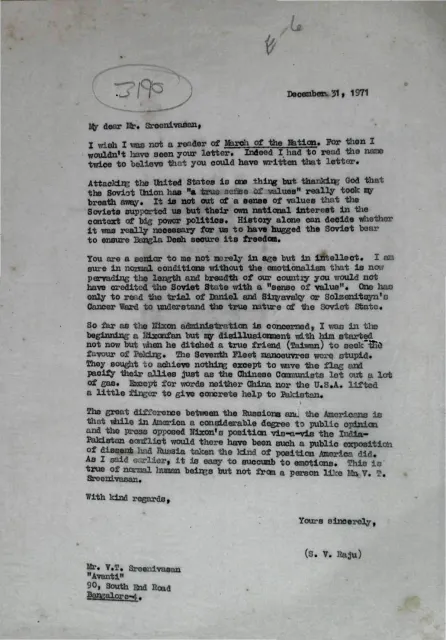
In this letter dated December 31, 1971, S. V. Raju responds sharply to V. T. Sreenivasan’s defence of the United States and praise for the Soviet Union during the Indo-Pak conflict. Raju argues that Soviet support for Bangladesh arose from national interest and power politics, not from a distinctive “sense of values,” and says that history alone can determine whether Soviet assistance was necessary for Bangladesh’s independence. He invokes the Moscow trials and the persecution of dissident writers as evidence of the Soviet state’s character.
Raju also criticises the Nixon administration’s handling of Pakistan, arguing that the Seventh Fleet’s manoeuvres were largely symbolic and that both China and the United States failed to provide Pakistan with meaningful concrete assistance. He contrasts the American debate—where public opinion and the press challenged Nixon’s position—with what he presents as the absence of comparable public opposition in Russia. The second page reproduces Sreenivasan’s newspaper letter, headed “Perfidius US,” which praises Abraham Lincoln’s legacy and claims that the Soviet Union has a “true sense of values.”
Key points
- Raju rejects the claim that Soviet support for Bangladesh reflected a superior moral or political “sense of values.”
- The letter interprets Soviet assistance through national interest and great-power politics.
- Raju cites the Moscow trials and the persecution of dissident writers to characterise the Soviet state.
- He criticises Nixon’s policy toward Pakistan and describes the Seventh Fleet manoeuvres as ineffective.
- The letter argues that neither China nor the United States gave Pakistan substantial concrete help.
- Raju contrasts American public and press criticism of Nixon with the absence of comparable public opposition in Russia.
- An attached clipping by V. T. Sreenivasan praises Abraham Lincoln and the Soviet Union while condemning U.S. policy.
Metadata and summary are AI-extracted from the source PDF and reviewed for editorial accuracy. The original work is available via the Read PDF tab above (where present); paragraph-level citation inside the PDF is deferred to a future engagement.