Summary
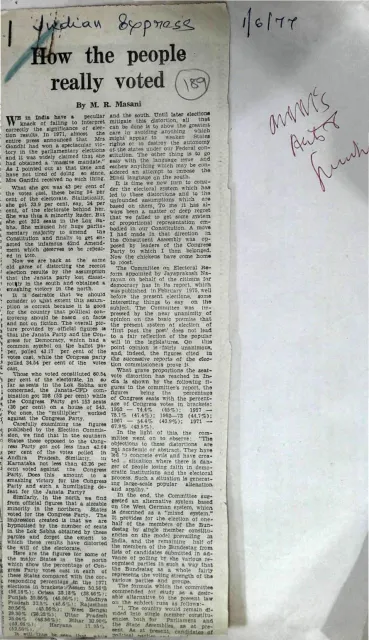
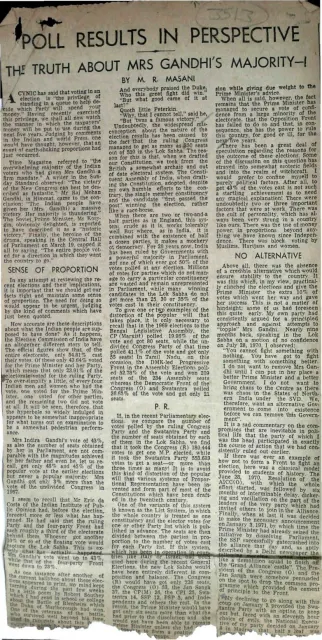
In the two visible installments of “Poll Results in Perspective,” M. R. Masani argues that Indira Gandhi’s parliamentary majority should not be treated as a straightforward popular mandate. He challenges celebratory press accounts by examining vote shares, seat allocation, first-past-the-post rules, and the effects of multi-member constituencies. He notes that Gandhi’s 43 per cent of the vote produced a large parliamentary majority, while opposition parties received substantial votes but comparatively few seats. Comparisons between the Congress and Swatantra Party, and between election results in West Bengal and Tamil Nadu, are used to illustrate how the electoral system can distort popular representation.
Masani’s second installment treats the election as a warning about the condition of Indian governance rather than as an occasion for political excuses. He calls for restoration of political order, civil liberties, administrative discipline, and economic policies capable of producing stable prices and employment. He criticises licensing, permits, excessive taxation, inflation, unemployment, and what he describes as the socialist economic framework’s tendency to reward inefficiency. The article concludes by warning that India needs credible leadership and a principled alternative to the Congress, while acknowledging that the Swatantra Party itself must develop stronger organisation and leadership. Pages 2 and 4 contain unrelated newspaper reports and are not part of the article.
Key points
- Masani disputes the interpretation of Indira Gandhi’s parliamentary majority as evidence of overwhelming popular support.
- He explains how first-past-the-post elections and constituency arrangements can convert a minority of votes into a large legislative majority.
- The article compares Congress and opposition vote shares and cites examples from West Bengal and Tamil Nadu to demonstrate electoral disproportionality.
- Masani argues that the election creates an obligation for the government to restore political order, civil liberties, administrative discipline, stable prices, and employment.
- He criticises licensing, permits, inflation, excessive taxation, unemployment, and socialist economic policies for discouraging enterprise and hard work.
- The second installment warns against complacency, political chaos, and the absence of a credible alternative to the Congress.
- Masani presents the Swatantra Party as a possible alternative but says it must build effective organisation, leadership, and a broader social base.
Metadata and summary are AI-extracted from the source PDF and reviewed for editorial accuracy. The original work is available via the Read PDF tab above (where present); paragraph-level citation inside the PDF is deferred to a future engagement.