essay
Masani challenges new Congress claim
TIMES OF INDIA · 1971
1 pages
Summary
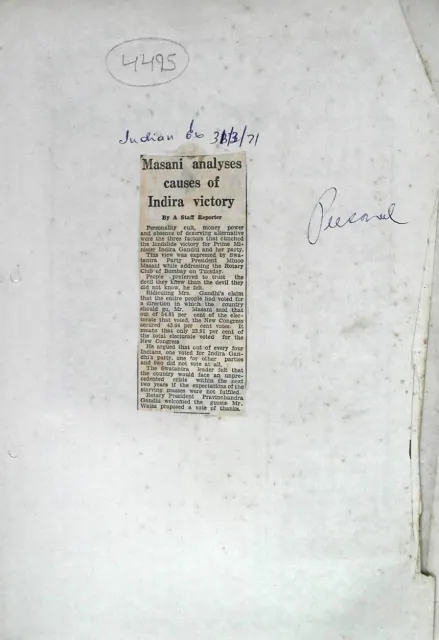
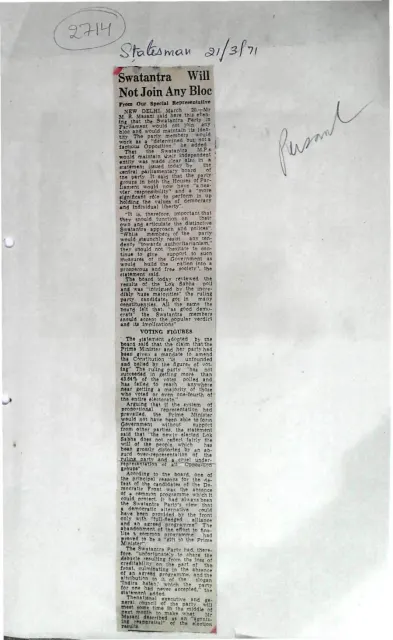
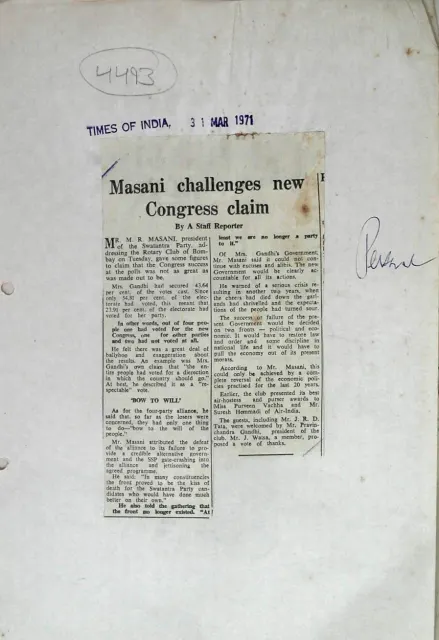
This Times of India report, dated 31 March 1971, records M. R. Masani’s challenge to the claim that the Congress victory in the recent elections represented an overwhelming popular mandate. Speaking to the Rotary Club of Bombay, Masani distinguished between the Congress’s share of votes cast and its share of the total electorate: he noted that only 54.81 per cent of electors voted, meaning that Congress received the support of 23.91 per cent of the electorate. He also argued that the four-party alliance had failed because the Swatantra Party and the S.S.P. had entered the alliance without a credible alternative programme, and because the anti-Congress front had effectively collapsed.
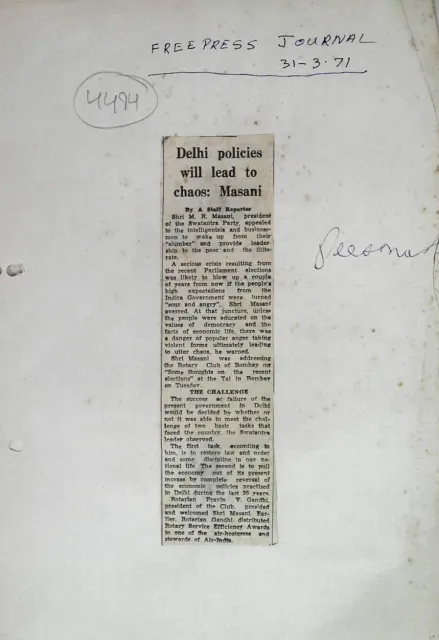
The report presents Masani’s view that the new government would have to address a serious crisis in political and economic governance. He called for restoration of law and order, greater discipline in national life, and a reversal of the economic policies pursued over the previous two decades. The article also briefly reports a Rotary Club entertainment programme featuring Miss Purveen Vachha, Suresh Hemmadi, J. R. D. Tata, and J. Watsa.
Key points
- Masani disputed the interpretation of the Congress election result as a broad popular endorsement.
- He calculated that Congress had received 43.64 per cent of votes cast but only 23.91 per cent of the total electorate’s support.
- He attributed the four-party alliance’s failure to the absence of a credible alternative programme and the Swatantra Party’s alliance with the S.S.P.
- He said the anti-Congress front no longer existed and described the election as a serious setback for Swatantra Party candidates.
- He argued that the new government would need to restore law and order and impose greater discipline in national life.
- He called for a complete reversal of the economic policies pursued during the previous twenty years.
Metadata and summary are AI-extracted from the source PDF and reviewed for editorial accuracy. The original work is available via the Read PDF tab above (where present); paragraph-level citation inside the PDF is deferred to a future engagement.