essay
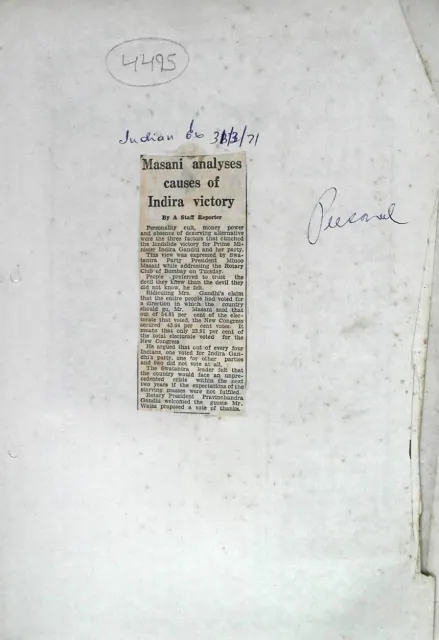
Masani analyses causes of Indira victory
Indian Express · 1971
1 pages
Summary
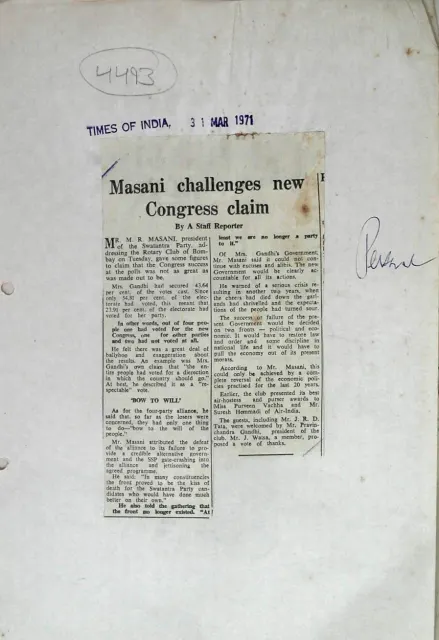
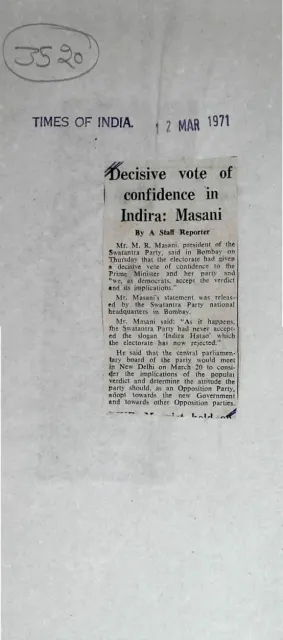
The article reports Minoo Masani’s explanation of Indira Gandhi’s 1971 electoral victory, identifying three decisive factors: a personality cult surrounding Gandhi, the use of money power, and the absence of a convincing alternative. Speaking at a Rotary Club of Bombay meeting, Masani argues that Congress’s victory should not be read as evidence of overwhelming popular support.
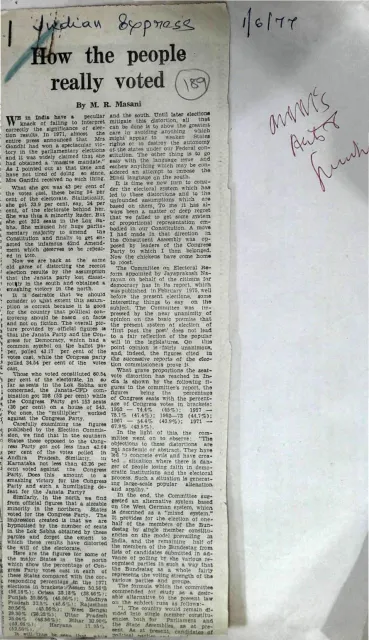
Masani cites turnout figures to qualify the result: only 54.81 per cent of electors voted, and the New Congress received 43.64 per cent of the votes cast—equivalent to 23.91 per cent of the total electorate. He also argues that the electorate rejected every fourth Indian candidate associated with the New Congress, while many voters supported other parties or did not vote at all. The article concludes with his warning that the country could face an unprecedented crisis within the next two years if expectations among the starving masses remain unfulfilled.
Key points
- Masani attributes Indira Gandhi’s victory to personality cult, money power, and the lack of a credible alternative.
- The article presents the election result as weaker evidence of popular support than the victory margin suggests.
- Only 54.81 per cent of electors voted, according to the figures quoted.
- The New Congress received 43.64 per cent of votes cast, or 23.91 per cent of the total electorate.
- Masani says one in four Indian candidates of the New Congress was rejected.
- He warns of a possible unprecedented crisis if the expectations of the starving masses are not fulfilled.
Metadata and summary are AI-extracted from the source PDF and reviewed for editorial accuracy. The original work is available via the Read PDF tab above (where present); paragraph-level citation inside the PDF is deferred to a future engagement.