essay
Behind the sweeping tide
THE ECONOMIC TIMES · 1971
2 pages
Summary
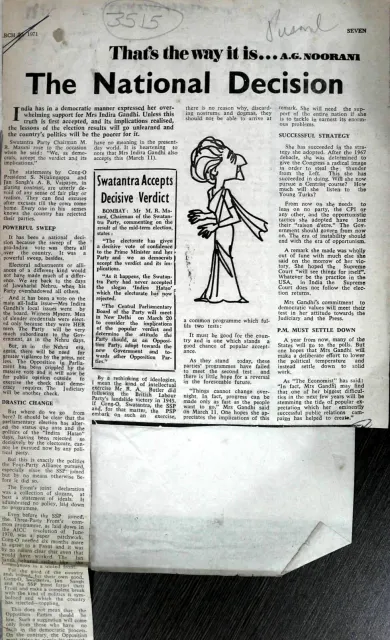
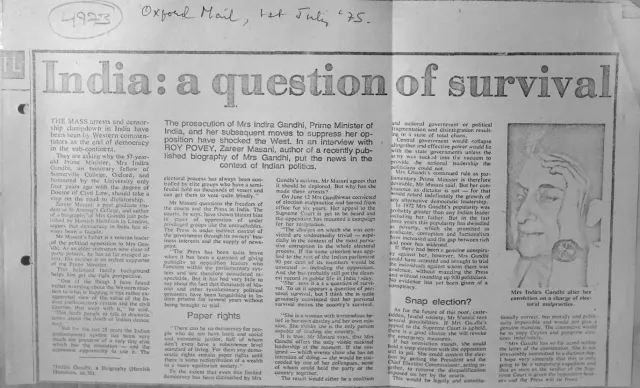
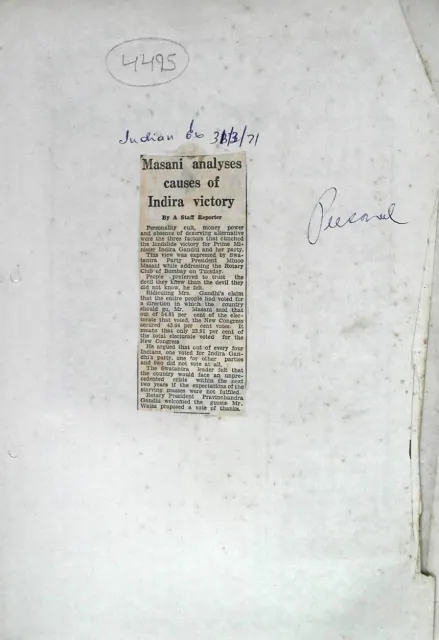
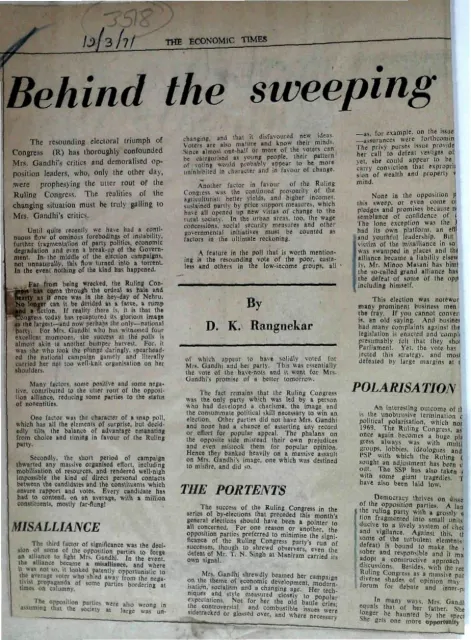
In the rendered pages, D. K. Rangnekar examines the Congress (R)‘s sweeping victory in the 1971 election and argues that it confounded opposition predictions of instability, economic decline, and governmental break-up. The article attributes the result to the timing and surprise of the poll, the opposition’s failure to form a credible alliance, the short and poorly organised campaign, continuing rural prosperity, and the appeal of Indira Gandhi’s promise of a better tomorrow. It also notes that low-income voters largely supported Gandhi and her party, while the opposition misjudged the electorate by relying on a mass assault centred on alleged failures of government and the election platform.
Key points
- The Congress (R)‘s victory is presented as a repudiation of opposition forecasts of instability and governmental disintegration.
- The article identifies the snap election, campaign timing, and the opposition’s organisational weakness as important causes of the result.
- Opposition parties failed to forge a convincing alliance against Indira Gandhi and were divided by differences over policy and leadership.
- Rural prosperity, higher agricultural yields, rising incomes, and price-support measures strengthened the ruling party’s position.
- Indira Gandhi’s campaign emphasis on economic development, modernisation, socialism, and change is described as electorally effective.
- The opposition’s reliance on criticism of government failures and property-related issues failed to dislodge Gandhi’s appeal.
- The article sees the election as creating an opportunity for governmental reorientation, improved party management, and a more constructive opposition.
- The final section argues that the ruling party must use its mandate to govern decisively while remaining responsive to public opinion and vigilance.
Metadata and summary are AI-extracted from the source PDF and reviewed for editorial accuracy. The original work is available via the Read PDF tab above (where present); paragraph-level citation inside the PDF is deferred to a future engagement.