
minutes · report
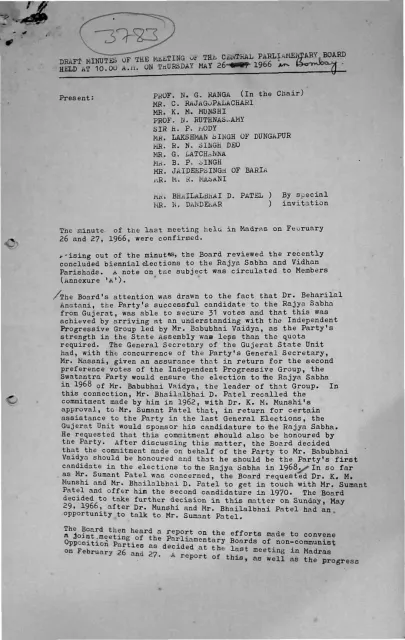
DRAFT MINUTES OF THE MEETING OF THE CENTRAL PARLIAMENTARY BOARD HELD AT 10.00 A.M. ON THURSDAY MAY 26, 1966 in Bombay
SWATANTRA PARTY · Bombay · 1966
26 pages
Summary
These draft minutes record the Swatantra Party Central Parliamentary Board’s meetings in Bombay on 26 and 29 May 1966. The Board reviewed the recent Rajya Sabha and Vidhan Parishad elections, including arrangements with the Independent Progressive Group in Gujarat that enabled Dr. Beharilal Anatani’s election and created prospective commitments for Babubhai Vaidya and Sumant Patel. It also assessed efforts to coordinate non-Communist opposition parties before the coming general elections. The Board favoured bilateral electoral discussions, rejected a formal national united front at that stage, and insisted that cooperation should exclude Communists and avoid arrangements based on financial commitments.
The minutes then turn to party organisation and candidate selection. They establish closer supervision of constituency organisers and three-man committees, procedures for expediting nominations, confidentiality around Scheduled Caste candidates, and a more flexible approval process for unanimously recommended candidates. The Board records prospective candidates and unresolved negotiations across Rajasthan, Uttar Pradesh, Madras, Orissa, Mysore, Gujarat, Andhra, and other regions. Annexures provide reports on Rajya Sabha elections, electoral understandings with opposition parties, and tabulated statements of candidate-related expenditure and activity. The rendered set ends during the annexure material; later PDF pages were not available for review.
Key points
- The Board reviewed Rajya Sabha and Vidhan Parishad election results and related electoral commitments.
- It pursued bilateral cooperation with non-Communist opposition parties while rejecting a national united front at this stage.
- It distinguished electoral adjustments from broader political alliances and required any common programme to remain compatible with the Swatantra Party’s national manifesto.
- It reorganised constituency-level supervision through candidates, three-man committees, State Units, and the Central Office.
- It adopted procedures to accelerate candidate nominations and preserve secrecy concerning Scheduled Caste candidates.
- It approved or considered prospective parliamentary and assembly candidates across several states.
- The annexures document party electoral negotiations, Rajya Sabha outcomes, and reports on organisational activity and expenditure.
Metadata and summary are AI-extracted from the source PDF and reviewed for editorial accuracy. The original work is available via the Read PDF tab above (where present); paragraph-level citation inside the PDF is deferred to a future engagement.
Related across the archive
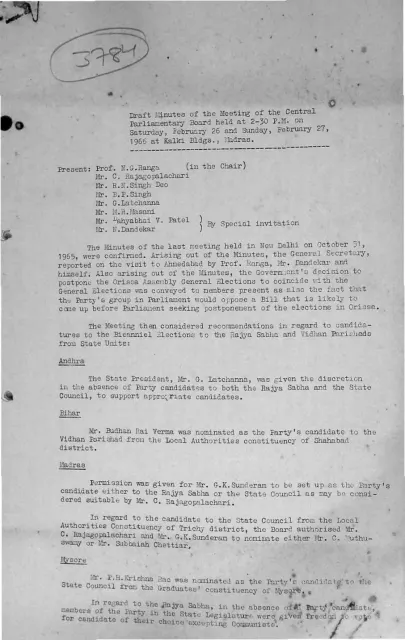 Primary workDraft Minutes of the Meeting of the Central Parliamentary Board held at 2-30 P.M. on Saturday, February 26 and Sunday, February 27, 1966 at Kalki Bldgs., Madras.
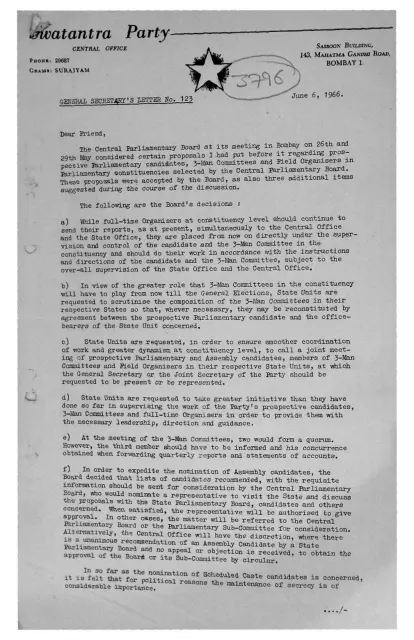 Primary workGeneral Secretarys Letter no-123
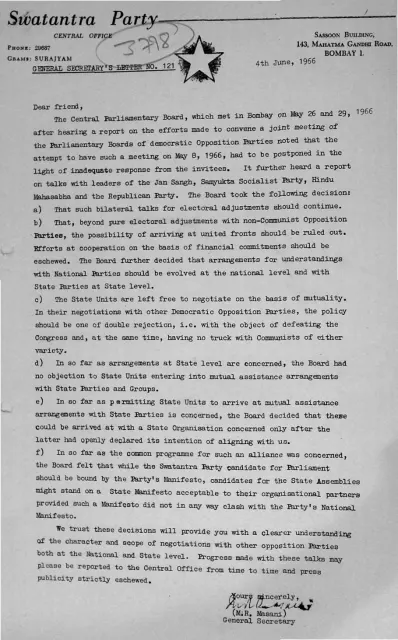 Primary workGENERAL SECRETARY'S LETTER NO. 121
 OpinionThe Swatantra Way for Forging a Formidable Coalition
 ExcerptThe Education of the Electorate