resolution
Foreign Loans
Swatantra Party · 1966
1 pages
Summary
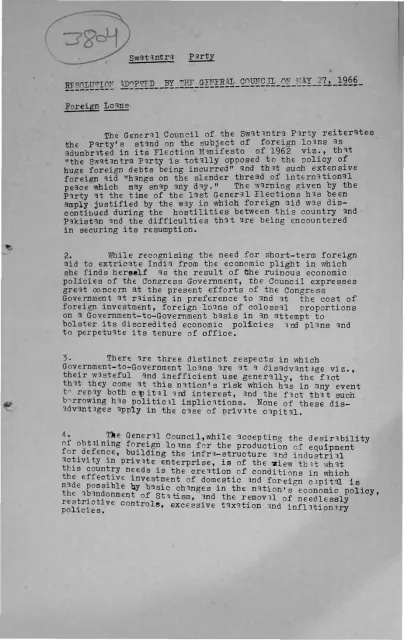
This one-page resolution, adopted by the Swatantra Party General Council on May 27, 1966, reiterates the party’s opposition to large-scale foreign borrowing. It accepts that short-term foreign aid may be necessary to help India recover from what it describes as the economic damage caused by Congress government policies, but argues that extensive aid is dangerously dependent on international peace and can be suspended during conflict, as occurred during hostilities between India and Pakistan.
The resolution distinguishes government-to-government loans from private foreign capital. It criticises state loans as wasteful and inefficient, as exposing India to repayment of both principal and interest, and as carrying political implications. It argues instead that foreign and domestic investment should be encouraged through changes in economic policy, including the abandonment of socialism, removal of unnecessary controls, lower taxation, and an end to inflationary policies. The document also expresses concern that the Congress government is seeking foreign loans and colonial-style government-to-government assistance primarily to sustain its existing economic policies and prolong its tenure in office.
Key points
- The Swatantra Party reiterates its opposition to the policy of incurring huge foreign debts.
- The resolution accepts a limited need for short-term foreign aid to address India’s economic difficulties.
- It argues that dependence on foreign aid is vulnerable to disruptions in international peace, citing the suspension of aid during hostilities with Pakistan.
- Government-to-government loans are criticised as wasteful, costly to repay, and politically consequential.
- Private foreign capital is presented as free from the specific disadvantages attributed to government loans.
- The resolution supports foreign loans for defence equipment, infrastructure, and industrial activity in private enterprise.
- It calls for abandoning socialism, removing unnecessary controls, reducing excessive taxation, and ending inflationary policies to attract investment.
Metadata and summary are AI-extracted from the source PDF and reviewed for editorial accuracy. The original work is available via the Read PDF tab above (where present); paragraph-level citation inside the PDF is deferred to a future engagement.