circular
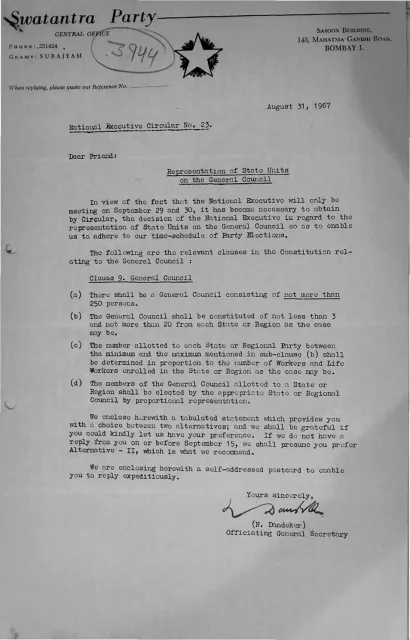
National Executive Circular No. 23.
Swatantra Party · Bombay · 1967
2 pages
Summary
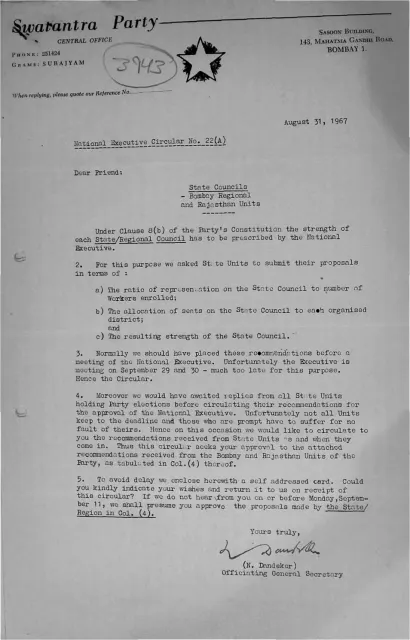
The Swatantra Party’s National Executive Circular No. 23, dated August 31, 1967, seeks state and regional units’ preferences on the composition of the Party’s General Council. It explains that the National Executive will meet on September 29–30 and that a decision by circular is necessary to maintain the scheduled timetable for Party elections. The circular reproduces constitutional provisions limiting the General Council to 250 members, requiring between three and twenty representatives from each state or region, allocating representation in proportion to enrolled workers, and providing for election by the relevant state or regional council through proportional representation.
An attached table compares two representation formulas. Alternative I, based on the previous allocation, gives three representatives for the first 200 members and one for each additional 100, subject to a maximum of 20 per state or region. Alternative II gives three representatives for the first 400 members and one for every additional 150, also subject to a maximum of 20. On the membership figures recorded as of June 30, 1967, the alternatives would produce totals of 193 and 170 General Council representatives respectively. The circular recommends Alternative II if no response is received by September 15 and encloses a self-addressed postcard for replies.
Key points
- The circular requests state and regional preferences concerning representation on the Swatantra Party’s General Council.
- The National Executive uses the circular because its forthcoming September 29–30 meeting must accommodate the Party election timetable.
- The Party constitution sets a maximum General Council size of 250 members.
- Representation must range from three to twenty members per state or region and be allocated in proportion to enrolled workers.
- State or regional councils are to elect their allotted General Council members by proportional representation.
- Alternative I applies the previous representation basis: three members for the first 200 enrolled members and one for each additional 100.
- Alternative II allows three members for the first 400 enrolled members and one for each additional 150.
- The attached figures yield totals of 193 representatives under Alternative I and 170 under Alternative II; Alternative II is recommended by default.
Metadata and summary are AI-extracted from the source PDF and reviewed for editorial accuracy. The original work is available via the Read PDF tab above (where present); paragraph-level citation inside the PDF is deferred to a future engagement.