
Summary
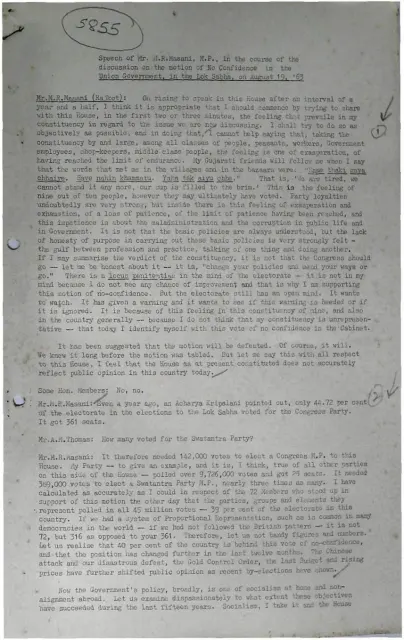
In this parliamentary speech, delivered in the Lok Sabha on 19 August 1963, Minoo Masani argues that public frustration with Congress reflects exhaustion with maladministration, corruption, rising prices, and the gap between stated policy and actual performance. He presents the electorate as open to political change, while insisting that the alternative must be judged by its ability to restore honesty, competence, and confidence in public life.
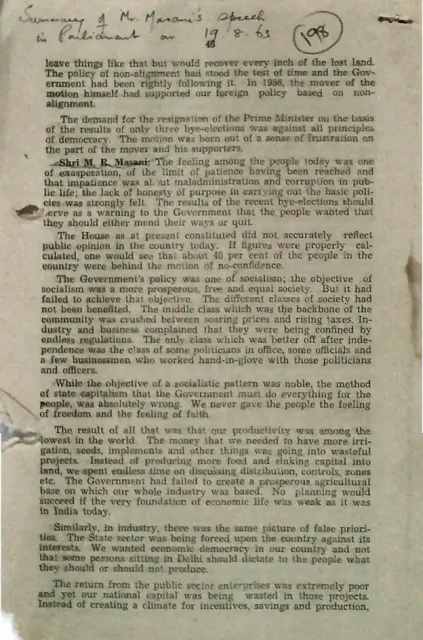
Masani attacks the Government’s socialist and statist approach across agriculture, industry, employment, monetary policy, and economic controls. He argues that planning has produced low agricultural productivity, wasteful public investment, unemployment, inflation, and excessive official discretion. His alternative is a genuinely mixed economy based on private and State enterprise competing freely, with greater scope for individual initiative and less bureaucratic control. In the foreign-policy passages visible here, he similarly criticises non-alignment as appeasement and argues that India’s response to communist aggression must be grounded in moral clarity and national defence. The rendered pages end during this discussion; the final seven PDF pages were not available for review.
Key points
- Masani describes widespread public exasperation with maladministration, corruption, policy inconsistency, and the failure to deliver promised improvements.
- He argues that socialism’s objectives may be attractive, but that Statism and State Capitalism have been fundamentally ineffective methods.
- The speech links planning and bureaucratic controls to low agricultural productivity, wasteful investment, inflation, unemployment, and corruption.
- Masani advocates a mixed economy in which private and State enterprises operate side by side under free and equal competition.
- He uses public-sector losses, including Hindustan Steel, as evidence of what he calls a false order of priorities.
- The speech presents non-alignment as having drifted from independence of judgment toward appeasement of communism.
- Masani frames the central international issue as freedom versus totalitarian tyranny and connects foreign policy to defence preparedness.
Metadata and summary are AI-extracted from the source PDF and reviewed for editorial accuracy. The original work is available via the Read PDF tab above (where present); paragraph-level citation inside the PDF is deferred to a future engagement.
People in this work
Related across the archive
 Primary workSpeech of Mr. M.R.Masani, M.P., in the course of the discussion on the motion of No Confidence in the Union Government, in the Lok Sabha, on August 19, ’63
 Primary workSummary of Mr Masanis Speech
 Primary workINDIA’S ONLY HOPE
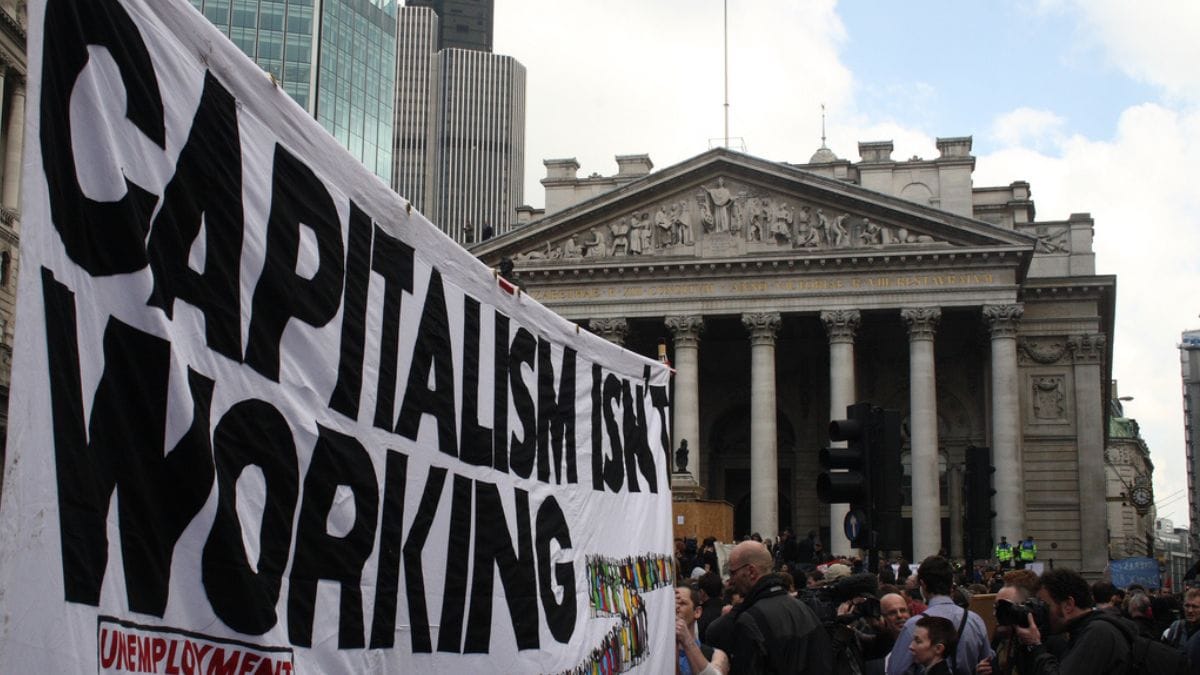 ThePrintCapitalism isn’t responsible for mass unemployment. Look at Japan, Singapore: BS Iyer
 ExcerptSocialism or State Capitalism