speech · parliamentary
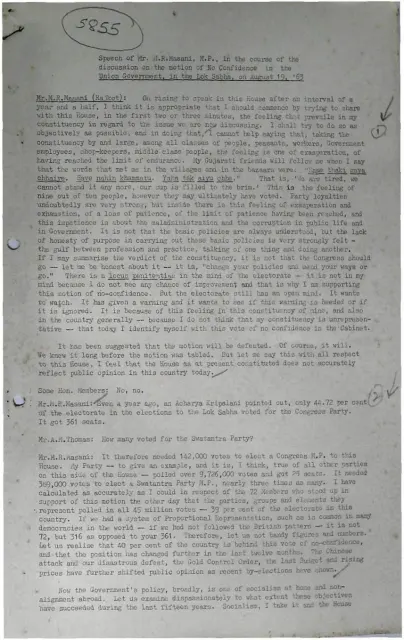
Speech of Mr. M.R.Masani, M.P., in the course of the discussion on the motion of No Confidence in the Union Government, in the Lok Sabha, on August 19, ’63
By Minoo Masani
1963
10 pages
Summary
In this speech in the Lok Sabha on 19 August 1963, Minoo Masani supports a no-confidence motion against the Union Government, arguing that public frustration has reached a point of “exasperation” because of maladministration, corruption, inflation, bureaucratic controls, and the widening gap between official policy and everyday experience. He presents the motion as a warning to the Congress rather than an immediate attempt to form an alternative government, claiming that Parliament no longer accurately reflects public opinion. Electoral figures are used to argue that the Congress’s parliamentary majority rests on a minority of the vote and that the Swatantra Party and other opposition forces represent a substantial body of public sentiment.
Masani attacks the government’s socialist planning on economic as well as social grounds. He argues that agricultural production has been neglected, the landless labourer and middle class have not materially benefited, and expanding state ownership has produced low returns, taxation, inflation, controls, and bureaucratic delay. He advocates stable prices, a sound currency, productive investment, competition between public and private enterprise, and checks on administrative power. In the latter part of the speech, he turns to foreign and defence policy, criticising non-alignment, the government’s handling of Communist China and Tibet, its failure to anticipate the 1962 war, and what he calls a double standard in judging democratic and communist states. He concludes by urging Congress members to replace the existing leadership and form a more pragmatic government capable of restoring security and freedom.
Key points
- Masani frames the no-confidence motion as an expression of widespread public frustration with maladministration, corruption, inflation, and bureaucratic government.
- He argues that Congress’s parliamentary majority does not correspond to majority electoral support and that public opinion has shifted toward the opposition.
- The speech claims that socialist planning has failed to improve conditions for agricultural labourers, peasants, industrial workers, the middle class, and government employees.
- Masani criticises state-sector expansion, high taxation, inflationary finance, price controls, and regulations for weakening incentives, production, and investment.
- He presents agriculture as the foundation of economic development and argues that centralised planning has imposed false priorities and neglected productive investment in the land.
- He distinguishes support for a mixed economy from acceptance of state-capitalist monopolies and unchecked bureaucratic controls.
- Masani attacks the government’s non-alignment and China policies, linking diplomatic misjudgment to the 1962 military defeat and the loss of national security.
- The speech ends with an appeal for Congress reform, a new government, stronger defence, and the restoration of a free and secure India.
Metadata and summary are AI-extracted from the source PDF and reviewed for editorial accuracy. The original work is available via the Read PDF tab above (where present); paragraph-level citation inside the PDF is deferred to a future engagement.