essay
On the right road, but not a market-driven economy
By S. V. Raju
THE FINANCIAL EXPRESS · 2005
2 pages
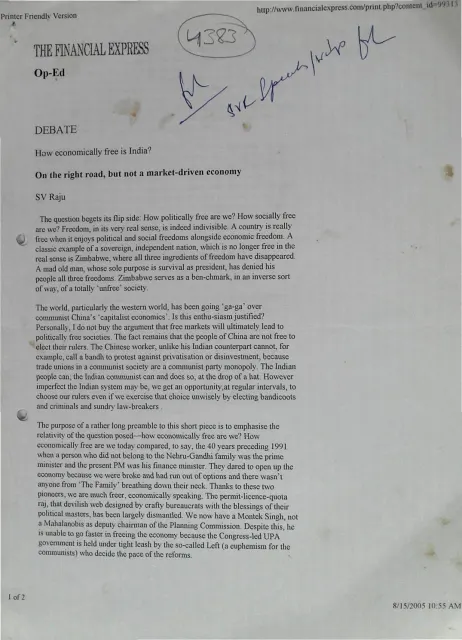
Summary
In the rendered pages, S. V. Raju argues that economic freedom cannot be separated from political and social freedom. He contrasts India with Zimbabwe, where he says all three dimensions of freedom have disappeared, and with China, whose capitalist economic reforms have not been accompanied by the freedom to elect rulers or organise politically. India, despite serious imperfections, retains electoral and protest freedoms that make it freer in the broader sense.
Key points
- Raju treats political, social, and economic freedom as interconnected rather than separate categories.
- He uses Zimbabwe as an example of a society in which all three dimensions of freedom have been lost.
- He rejects enthusiasm for China’s capitalist economics because Chinese citizens cannot freely choose their rulers or organise independent trade unions.
- Compared with the pre-1991 period, India has dismantled much of the permit-licence-quota raj and expanded consumer choice.
- The Congress-led UPA government is portrayed as constrained by its dependence on the Left, especially on disinvestment, privatisation, and labour reform.
- India is described as having moved beyond an economy of shortages, with competition lowering prices and banks competing for customers.
- Raju concludes that India is moving in the right direction but remains far from a genuinely free, market-driven economy.
Metadata and summary are AI-extracted from the source PDF and reviewed for editorial accuracy. The original work is available via the Read PDF tab above (where present); paragraph-level citation inside the PDF is deferred to a future engagement.