
Summary
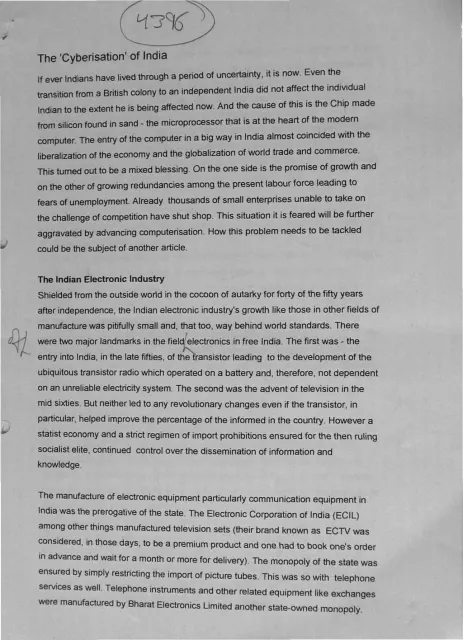
S.V. Raju presents computerisation as a transformative force reshaping India after economic liberalisation and the globalisation of trade. In the rendered pages, he describes this transformation as a mixed blessing: microprocessor-based technology promises growth and new opportunities, but also threatens employment and has already contributed to the closure of small enterprises. The essay contrasts this emerging “cyber age” with the protected, state-dominated electronic industry of post-independence India, where import restrictions and public-sector monopolies limited production, communication, and access to information.
The rendered pages also trace several forms of Indian migration, from indentured labour and Gulf employment to the overseas movement of highly trained professionals and computer specialists. Raju links the recent technology diaspora to India’s English-language skills, IITs, IIMs, and private computer-training institutes, while noting the costs of subsidised education and the poor working conditions that discourage skilled people from returning. In the final sections, he argues that information technology could support governance and rural development through Indian-language information systems, computer networks, satellite imagery, agricultural information exchange, and expanded telecommunications. He concludes that temporary unemployment and industrial displacement may be a relatively small price for India’s transition from the bullock-cart era to the cyber age.
Key points
- Computerisation entered India alongside economic liberalisation and the globalisation of trade, creating both growth prospects and employment anxieties.
- The post-independence electronic industry developed slowly under autarky, import restrictions, and state control.
- State-owned enterprises dominated television, telephone equipment, exchanges, and teleprinter production before the economy began opening in the late twentieth century.
- India’s English-language capacity and higher-education institutions helped produce computer professionals who found work abroad.
- The essay presents Indian emigration as a succession of waves, culminating in the large-scale overseas recruitment of programmers, engineers, and software developers.
- Remote provision of computer services from India could create a domestic information-technology industry and reduce the need for large-scale emigration.
- Information technology is presented as a potential tool for rural governance, agricultural management, Indian-language communication, and the integration of indigenous knowledge.
- The author frames telecommunications infrastructure and computerisation as prerequisites for a democratic developmental transformation.
Metadata and summary are AI-extracted from the source PDF and reviewed for editorial accuracy. The original work is available via the Read PDF tab above (where present); paragraph-level citation inside the PDF is deferred to a future engagement.
People in this work
Related across the archive
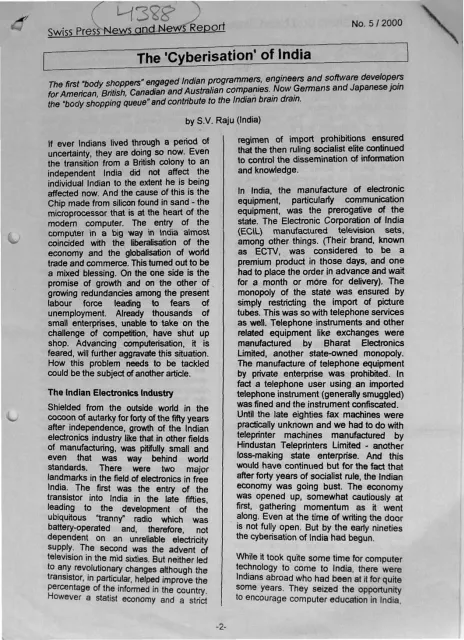 Primary workThe 'Cyberisation' of India
 Primary workTowards a Telecommunications Revolution in India
 ExcerptTHE APPLICATION OF SCIENCE AND TECHNOLOGY TO SOCIO-ECONOMIC DEVELOPMENT
 Primary workIndia Needs Urgently a Communication Revolution
 ExcerptEconomic Reforms In India: Where Are We And Where Do We Go?