speech · convention address
Are Coalition Governments Good or Bad
Bombay · 1999
19 pages
Summary
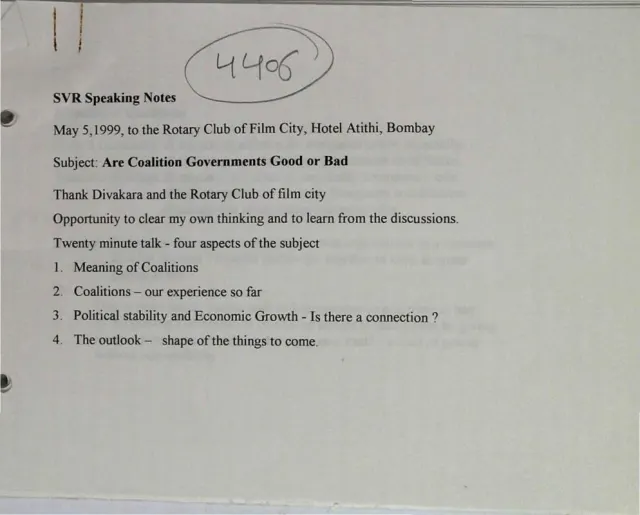
These speaking notes, prepared for S. V. Raju’s 5 May 1999 address to the Rotary Club of Film City in Bombay, examine whether coalition governments are good or bad through four stages: the meaning of coalitions, India’s experience with them, the relationship between political stability and economic growth, and the likely future shape of Indian politics. The notes distinguish the Indian use of coalitions—often intended to keep a rival party out—from Western examples such as Germany, where parties combine to share power and offer governance.
Key points
- Coalitions are defined as temporary alliances among parties that retain distinctive principles.
- The notes argue that Indian coalitions have traditionally had a negative, exclusionary purpose, unlike the governing coalitions described in Western examples.
- India’s political history is presented as a movement from Congress dominance toward fragmented and coalition-based politics.
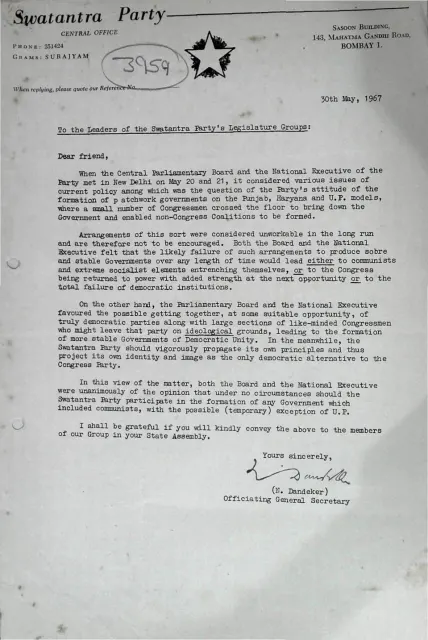
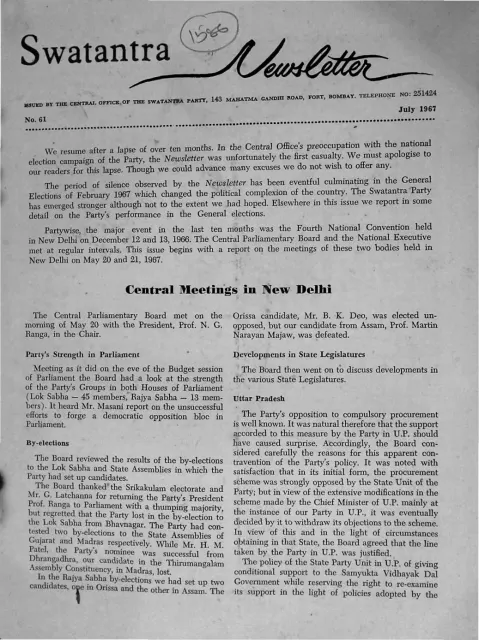
- The Janata Party and later United Front governments are treated as examples of coalitions formed primarily to displace a dominant party.
- The notes challenge the assumption that political stability automatically produces economic growth, citing higher growth during periods of minority or coalition government.
- Economic performance is linked more closely to restrained government, stable economic policies, the rule of law, education, health care, clean water, and infrastructure.
- The speech predicts the growth of federal groupings of state parties and concludes that coalition governments are neither inherently good nor bad: their value depends on what governments make of them.
Metadata and summary are AI-extracted from the source PDF and reviewed for editorial accuracy. The original work is available via the Read PDF tab above (where present); paragraph-level citation inside the PDF is deferred to a future engagement.