letter
Letter to S V Raju
FRIEDRICH-NAUMANN-STIFTUNG · New Delhi · 1998
3 pages
Summary
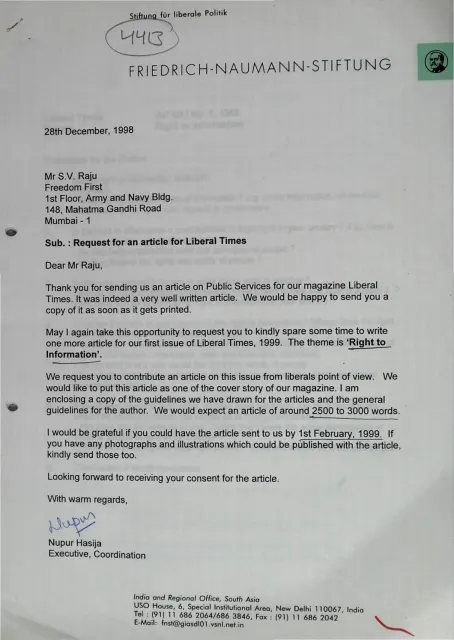
This three-page English-language document is a letter dated 28 December 1998 from Nupur Hasija of the Friedrich-Naumann-Stiftung’s India and Regional Office to S. V. Raju of Freedom First. Hasija thanks Raju for an article on public services submitted to Liberal Times and requests a further 2,500–3,000-word article for the journal’s first 1999 issue, whose theme is “Right to Information.” The proposed article is to approach the issue “from liberals point of view” and was intended as a possible cover story, with a requested submission date of 1 February 1999.
The two attached guideline pages define the journal’s editorial purpose and outline questions for the proposed article. They ask contributors to define the right to information, assess its constitutional or legal basis and practical accessibility, examine limits such as censorship and national security, and consider democratic control, social and economic equity, public participation, and government disclosure. The guidelines also state that Liberal Times promotes individual freedom, self-reliance, autonomy, human rights, and the rule of law, and provide readership, formatting, style, submission, and copyright requirements. The document does not contain Raju’s requested article; it records the request and supplies the journal’s editorial brief.
Key points
- Nupur Hasija writes to S. V. Raju on 28 December 1998 on behalf of the Friedrich-Naumann-Stiftung.
- The letter acknowledges Raju’s submitted article on public services for Liberal Times.
- Hasija requests a second article for the journal’s first 1999 issue, themed “Right to Information.”
- The proposed contribution should present a liberal perspective and run approximately 2,500 to 3,000 words.
- The editorial brief asks about the definition, legal basis, practical accessibility, limits, and abuse of the right to information.
- The guidelines connect the journal’s aims with individual freedom, self-reliance, autonomy, human rights, and the rule of law.
- The attached instructions specify an intended readership of decision-makers, business and industry, media, researchers, and NGOs in South Asia, along with technical and submission requirements.
Metadata and summary are AI-extracted from the source PDF and reviewed for editorial accuracy. The original work is available via the Read PDF tab above (where present); paragraph-level citation inside the PDF is deferred to a future engagement.