speech
Address at the First National Convention of the Indian Liberal Group
By Hubertus von Welck
Friedrich-Naumann-Stiftung / Indian Liberal Group · Hyderabad · 2002
9 pages
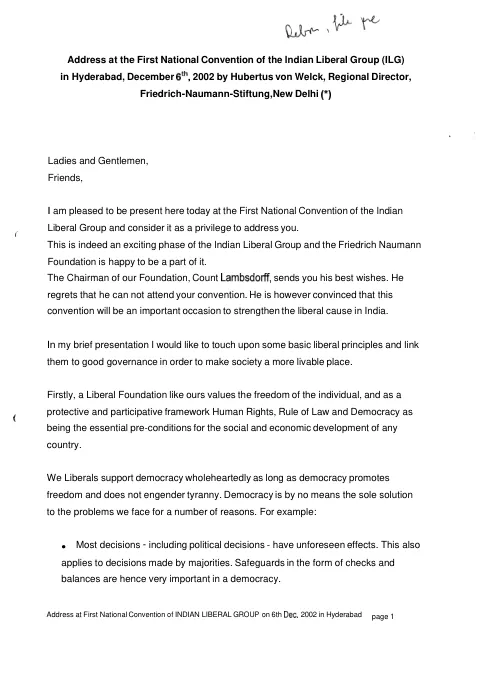
Address at the First National Convention of the Indian Liberal Group
By Hubertus von Welck (Friedrich-Naumann-Stiftung) · Hyderabad, 6 December 2002
Summary
Address at the First National Convention of the Indian Liberal Group is a speech delivered on 6 December 2002 in Hyderabad by Hubertus von Welck, Regional Director of the Friedrich-Naumann-Stiftung in New Delhi, who welcomes the ILG’s first national gathering as an exciting phase for Indian liberalism and conveys the good wishes of the Foundation’s Chairman, Count Lambsdorff. Framing his remarks around some basic liberal principles linked to good governance, von Welck sets out the classical-liberal case that the freedom of the individual, protected by human rights, the rule of law and democracy, is the essential precondition for any country’s social and economic development.
The heart of the address is a nuanced, liberal defence of democracy. Von Welck argues that liberals support democracy “as long as democracy promotes freedom and does not engender tyranny,” but that it is by no means the sole solution to public problems: majorities can err, minorities and fundamental rights must be protected even against the majority, and power must be limited through checks and balances, the rule of law and what he calls “small government.” He stresses the principle of subsidiarity — that decisions be taken at the lowest possible level — warns against both over-reliance on democracy and the danger of an “illiberal democracy,” and urges liberals to “focus on freedom first,” a phrase he ties to the title of the ILG’s own magazine, Freedom First. He then reads out the Liberal International resolution on good governance adopted at its 51st Congress in Budapest in March 2002, which calls for returning power to individuals, separation of powers, decentralisation, transparency, free trade, a social market economy and the fight against poverty and corruption.
Turning directly to the ILG, von Welck presents good governance as inexpensive, transparent, accountable and decentralised — favouring privatisation and citizens’ initiative — and praises concrete chapter work such as the Bangalore chapter’s public-transport privatisation proposal and electoral-reform efforts in Gujarat. He then presses the group with a series of strategic questions: whether it means to be a pressure group or a political party, how it will build networks, activate its chapters, motivate members and set a three-to-five-year plan. Commending Mr. Raju for reviving the liberal movement in India and situating the ILG within a global family of 84 liberal parties across 67 countries, he closes with a plea to treat India’s pluralism as enriching rather than threatening, expressing hope that the Indian Liberal Group can grow into a true Indian Liberal Movement with the Friedrich Naumann Foundation’s support. (The author notes his debt to Dr. Stefan Melnik’s paper “Democracy and freedom: general observations from a liberal point of view.”)
Key points
-
A convention address given on 6 December 2002 in Hyderabad by Hubertus von Welck, Regional Director of the Friedrich-Naumann-Stiftung, welcoming the Indian Liberal Group’s First National Convention and conveying Chairman Count Lambsdorff’s greetings.
-
Frames liberalism around the freedom of the individual, with human rights, the rule of law and democracy as the essential preconditions for social and economic development.
-
Defends democracy conditionally — valuable only so long as it promotes freedom rather than tyranny — and insists on checks and balances, protection of minorities, and fundamental rights no majority may amend.
-
Argues for limited (“small”) government, the free market and the principle of subsidiarity (decisions at the lowest possible level), warning against over-reliance on democracy and against “illiberal democracy.”
-
Ties the liberal creed to the ILG’s magazine Freedom First and to the Liberal International good-governance resolution (51st Congress, Budapest, March 2002): returning power to individuals, decentralisation, transparency, free trade and the fight against corruption.
-
Presents good governance as inexpensive, transparent and decentralised, favouring privatisation and citizens’ initiative, and praises the Bangalore chapter’s transport-privatisation proposal and electoral-reform work in Gujarat.
-
Challenges the ILG with strategic questions (pressure group vs. political party, networking, chapter activity, member motivation, a 3-5 year plan) and hopes it can become a true “Indian Liberal Movement”; thanks Mr. Raju and situates the ILG among 84 liberal parties in 67 countries.
Ingested 2026-07-21 from the CCS source archive. AI-drafted summary awaiting editorial review.
Metadata and summary are AI-extracted from the source PDF and reviewed for editorial accuracy. The original work is available via the Read PDF tab above (where present); paragraph-level citation inside the PDF is deferred to a future engagement.