essay
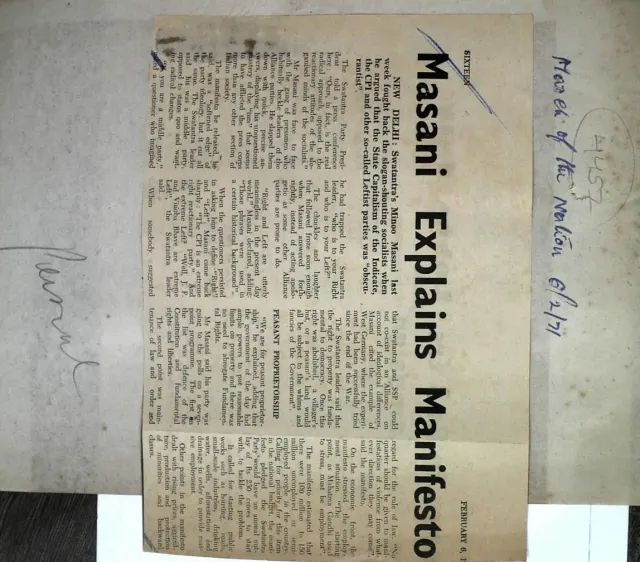
Masani Explains Manifesto
1971
1 pages
Summary
This February 6, 1971 newspaper clipping presents Minoo Masani’s defence of the Swatantra Party manifesto against socialist criticism. Masani argues that the manifesto is neither a return to laissez-faire nor a programme for preserving privilege, but a case for individual freedom, democratic government, private property, and limits on state power. The article describes his rejection of slogan-driven attacks on the party and reports his claim that the Swatantra approach is rooted in a clear distinction between the functions of government and those of private citizens.
Key points
- Minoo Masani responds to socialist criticism of the Swatantra Party manifesto.
- The manifesto is presented as a defence of democracy, individual liberty, and private property.
- Masani argues that government should be limited to essential functions rather than controlling all economic activity.
- The clipping criticises excessive planning, state ownership, and the expansion of the public sector.
- Its economic proposals include employment-oriented growth, agricultural reform, and peasant proprietorship.
- The article frames Swatantra’s programme as an alternative to socialist centralisation while retaining a role for government in law, order, and essential public responsibilities.
Metadata and summary are AI-extracted from the source PDF and reviewed for editorial accuracy. The original work is available via the Read PDF tab above (where present); paragraph-level citation inside the PDF is deferred to a future engagement.