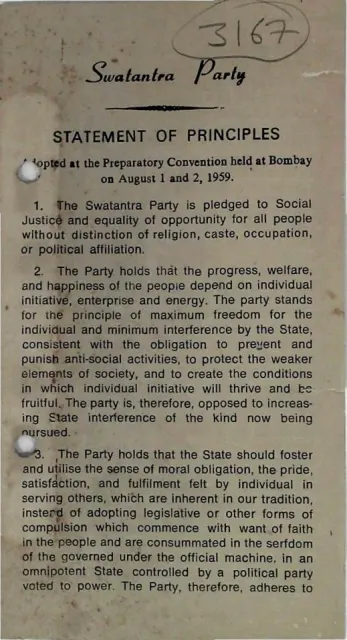
essay · statement of principles
To Prosperity Through Freedom
The Statement of Policy
19 pages
Summary
The Swatantra Party’s statement presents India’s post-independence difficulties as the result of excessive centralisation, statist economic policy, administrative failure and declining respect for individual freedom. It criticises the ruling party’s emphasis on state ownership, heavy industry, collectivised farming, controls, taxation and bureaucratic planning, arguing that these policies have contributed to inflation, stagnant production, corruption, scarcity and insecurity. The statement contrasts this approach with a constitutional order that protects parliamentary democracy, property, occupational choice, religious institutions, independent courts and decentralised authority.
The proposed alternative combines free enterprise with limited but purposeful government action. The Party supports agricultural self-employment and private ownership, voluntary cooperatives, decentralised industrialisation, competition, independent trade unions, collective bargaining, social security and practical measures to meet basic needs such as food, clothing, housing and water. It rejects laissez-faire as an absolute doctrine, endorses Gandhi’s principle of Trusteeship, and argues that planning is acceptable only within constitutional limits and without sacrificing liberty. The document also addresses public administration, education, defence and federalism, ending with a claim that the Swatantra Party seeks “ordered progress” through individual freedom. The supplied pages contain the complete visible statement, printed pages 45–63, but no title page, publication date or imprint.
Key points
- The statement attributes poverty, inflation, corruption and public frustration to statist planning, excessive controls and weak administration.
- It distinguishes broad democratic aspirations from disagreement over the methods used to achieve them.
- The Swatantra Party advocates individual initiative, private property, competitive enterprise and minimum necessary state interference.
- Agricultural policy centres on self-employed peasant proprietors, voluntary cooperation, access to inputs and protection against compulsory collectivisation.
- Industrial policy favours decentralised development, small and rural industries, mixed ownership and competition rather than expanding state monopolies.
- The statement supports independent trade unions, collective bargaining, the right to strike, social security and employment-generating public works.
- Constitutionalism, federalism, judicial independence, administrative integrity and freedom in education are presented as safeguards against concentrated power.
- The Party calls for a vigilant defence policy while presenting itself as a democratic alternative committed to prosperity through freedom.
Metadata and summary are AI-extracted from the source PDF and reviewed for editorial accuracy. The original work is available via the Read PDF tab above (where present); paragraph-level citation inside the PDF is deferred to a future engagement.