Summary
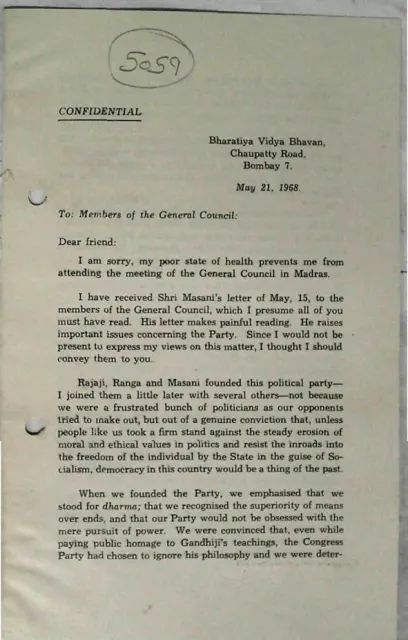
This 21 May 1968 confidential letter from K. M. Munshi to members of the Swatantra Party’s General Council argues that the party must preserve its identity through constitutional methods, ethical discipline, and fidelity to principle rather than pursue power or electoral numbers. Munshi recalls that he, Rajaji, Ranga, and Masani founded the party to resist the erosion of individual freedom by the State and to uphold moral and ethical values in politics. He invokes the party’s 1960 Statement of Policy and its commitment to “dharma,” arguing that the Congress had abandoned Gandhi’s political philosophy.
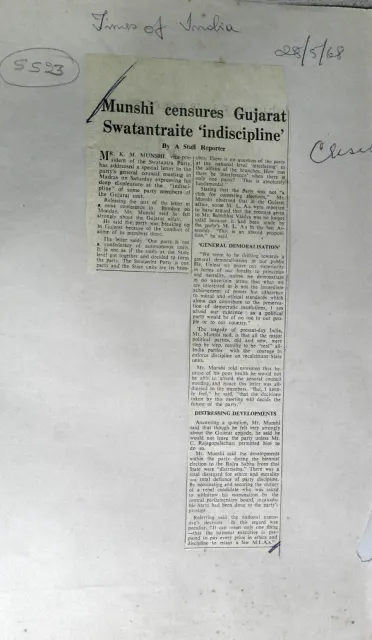
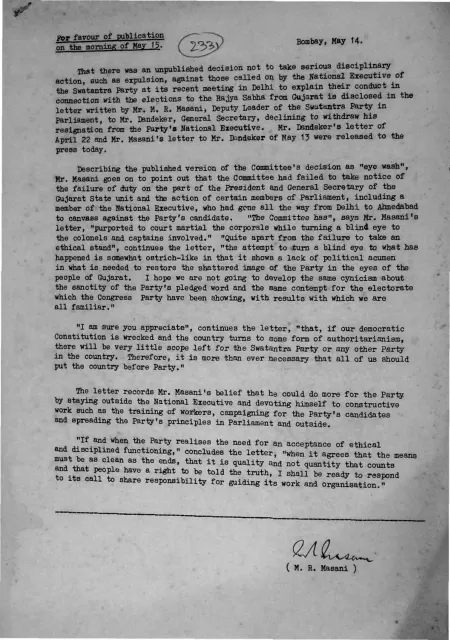
The immediate issue is the party’s handling of disciplinary controversies in Gujarat, including the Rajya Sabha election, the retention of MLAs accused of violating party pledges, and the case of the Raja of Ramgarh. Munshi insists that a national party must exercise authority over its state branches and that maintaining purity may require accepting reduced numbers. He concludes that Swatantra’s role is primarily political education: its survival is meaningful only if it demonstrates loyalty to principles, morality, and democratic institutions. The appended correspondence records Munshi’s and Rajaji’s agreement that Gujarat rebels should be expelled.
Key points
- Munshi explains that Swatantra Party was founded to defend individual freedom against expanding state power and to resist the erosion of political morality.
- He presents the party’s constitutionalism, ethical discipline, and commitment to means over ends as its defining principles.
- He condemns contemporary Indian politics as dominated by power, numbers, bribery, corruption, and public distrust.
- The Gujarat party crisis is treated as a test of whether Swatantra will enforce its own pledges and disciplinary standards.
- Munshi argues that the national party is one organisation, not a federation of autonomous state units, and must govern its branches.
- He accepts that strict discipline may reduce the party’s legislative strength but insists that quality matters more than quantity.
- He describes Swatantra as a middle-of-the-road party whose primary role is political education rather than the immediate pursuit of office.
- The letter ends by asking Rajaji to release Munshi from his promise to stand by the party if the General Council rejects his position.
Metadata and summary are AI-extracted from the source PDF and reviewed for editorial accuracy. The original work is available via the Read PDF tab above (where present); paragraph-level citation inside the PDF is deferred to a future engagement.