correspondence
Letter to K M Munshi
By K. M. Munshi
Associated Advertisers & Printers, Bombay-14 · Bombay · 1968
8 pages
Summary
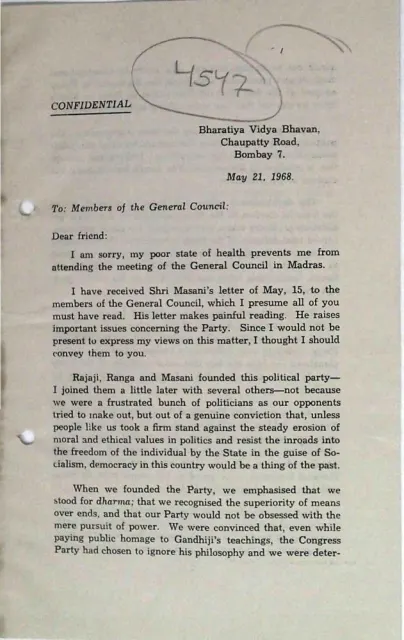
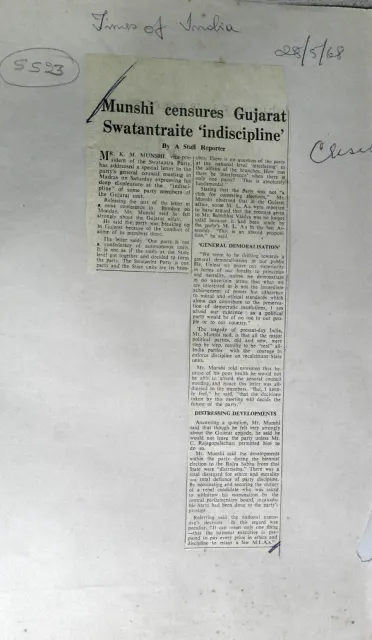
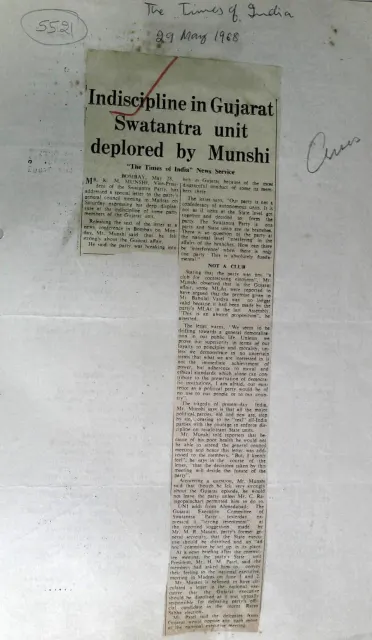
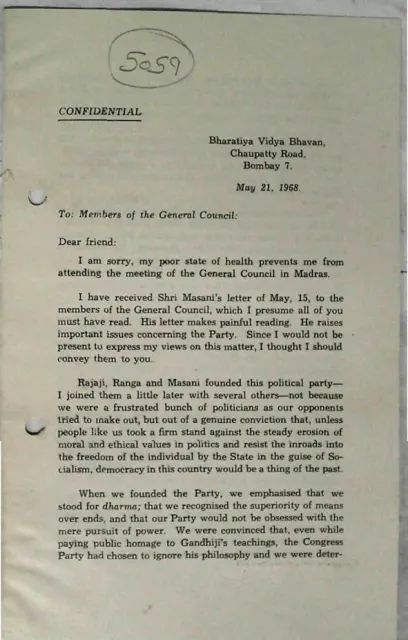
This confidential correspondence dossier, dated April–May 1968, records K. M. Munshi’s criticism of internal developments in the Swatantra Party and his concern that expediency was displacing the party’s constitutional and moral commitments. In his 21 May letter to the General Council, Munshi argues that the party was founded to resist the erosion of moral and ethical values in politics and the expansion of state power in the name of socialism. He condemns the Gujarat Rajya Sabha episode, alleged indiscipline among party members, and the National Executive’s reluctance to expel those who violated party pledges or worked against its candidates.
Munshi insists that the Swatantra Party is a single national party whose state units are its branches, not autonomous entities, and that it must preserve continuity as an organization built around an ideal rather than electoral advantage. He acknowledges that disciplinary action could reduce the party’s numbers, but presents adherence to principle as more important than legislative strength. The final pages reproduce Munshi’s 4 April letter to C. Rajagopalachari and Rajagopalachari’s 6 April reply; both support expelling the Gujarat rebels and affirm the need to stand by the party’s principles. The dossier does not include the referenced letter from Minoo Masani or the General Council meeting itself.
Key points
- Munshi explains that the Swatantra Party was founded to defend moral and ethical values, individual freedom, and constitutional methods.
- He criticizes contemporary Indian politics as dominated by power, numbers, bribery, corruption, and public distrust.
- The Gujarat party crisis is presented as a serious breach of discipline involving a rebel Rajya Sabha candidate and alleged efforts against party candidates.
- Munshi rejects the argument that party pledges can be abandoned for electoral or legislative advantage, including in the Privy Purses controversy.
- He argues that the Swatantra Party is one national party, with state units functioning as branches rather than autonomous organizations.
- The correspondence treats party continuity and fidelity to principle as more important than short-term electoral strength.
- Munshi indicates that, if the General Council rejects his position, he may ask Rajagopalachari to release him from his commitment to stand by the party.
Metadata and summary are AI-extracted from the source PDF and reviewed for editorial accuracy. The original work is available via the Read PDF tab above (where present); paragraph-level citation inside the PDF is deferred to a future engagement.